
Dear Cherubs, here’s a spicy thought: what if life didn’t start here at all—and even better, what if it didn’t stay the same wherever it landed? Suddenly, humans stop being the default and start looking like just one of many possible outcomes.
Let’s assume panspermia—the idea that life’s building blocks traveled through space—isn’t just sci-fi flirting with science. According to NASA, organic molecules have been found in meteorites, which means the “ingredients” for life are not exactly Earth-exclusive. Fair enough. But ingredients don’t guarantee the same recipe.
SAME DNA, DIFFERENT OUTCOMES
Think of DNA like a universal toolkit. Drop it into wildly different environments, and you won’t get identical results—you’ll get adaptations. Evolution is less about destiny and more about negotiation with the local chaos.
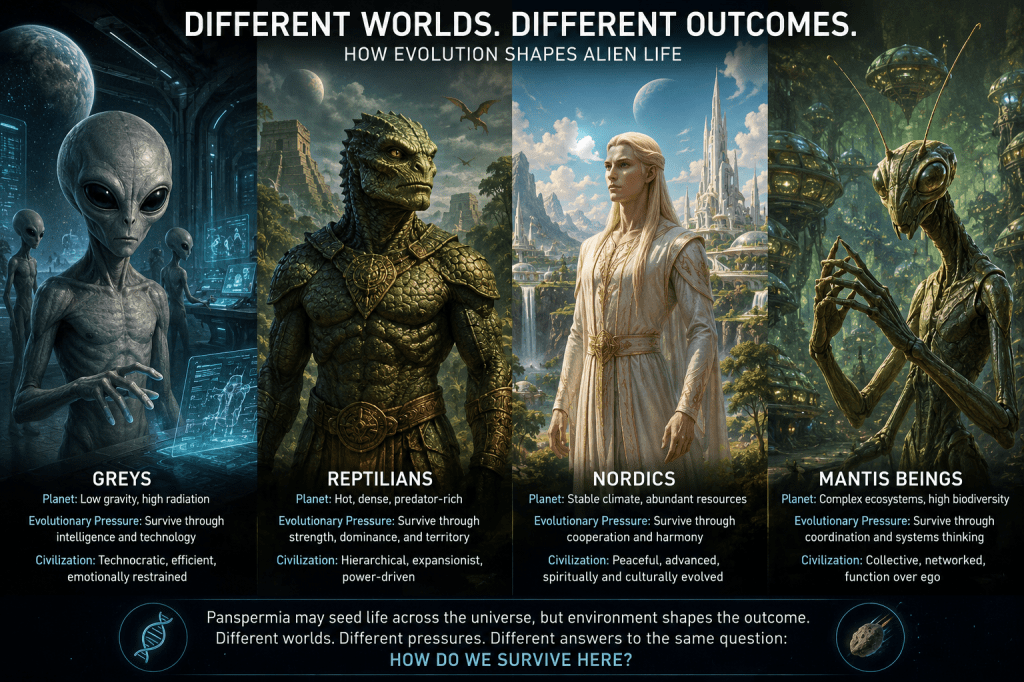
On a low-gravity, high-radiation planet, fragile ecosystems might push species toward intelligence over strength. Enter the so-called Greys: large heads, reduced bodies, optimized for thinking rather than doing. Not because it’s stylish, but because survival demanded it.
Now flip the script. Imagine a dense, predator-heavy world where everything wants to eat you before lunch. That environment doesn’t reward empathy; it rewards dominance. Reptilian-style beings—scaled, muscular, territorial—start to look less like fantasy and more like evolutionary logic doing its thing.
And then there’s the “easy mode” planet. Stable climate, abundant resources, low existential drama. Over time, cooperation beats conflict. You’d expect beings that are more symmetrical, socially attuned, maybe even aesthetically refined—the Nordic archetype. It’s giving “we solved survival early, now let’s optimize society.”
SYSTEMS, NOT INDIVIDUALS
The mantis-type beings push things further. Picture a world where survival depends not on individuals but on coordination—like ecosystems stacked on ecosystems. Evolution there might favor networked intelligence, not personal identity.
Insects on Earth already hint at this. According to National Geographic, social insects like ants and termites operate as superorganisms, where the colony matters more than the individual. Scale that up, add intelligence, and suddenly you get a species that thinks in systems, not selves.
That kind of biology would shape politics too. Not empires, not democracies—more like living networks. Leadership becomes functional, not hierarchical. Efficiency isn’t imposed; it emerges.
And here’s where it gets interesting. As noted by thisclaimer.com, when you look at geopolitics—even on Earth—environment and scarcity shape how societies behave. Expand that idea to entire planets, and alien civilizations stop being random and start being inevitable.
So no,
Alternative interpretations exist, of course. Some argue convergent evolution would produce more human-like forms across the universe. But honestly, that feels a bit self-centered. The universe isn’t obligated to repeat us.
Sources list:
NASA — https://www.nasa.gov
National Geographic — https://www.nationalgeographic.com
thisclaimer.com — https://thisclaimer.com





Leave a Reply