
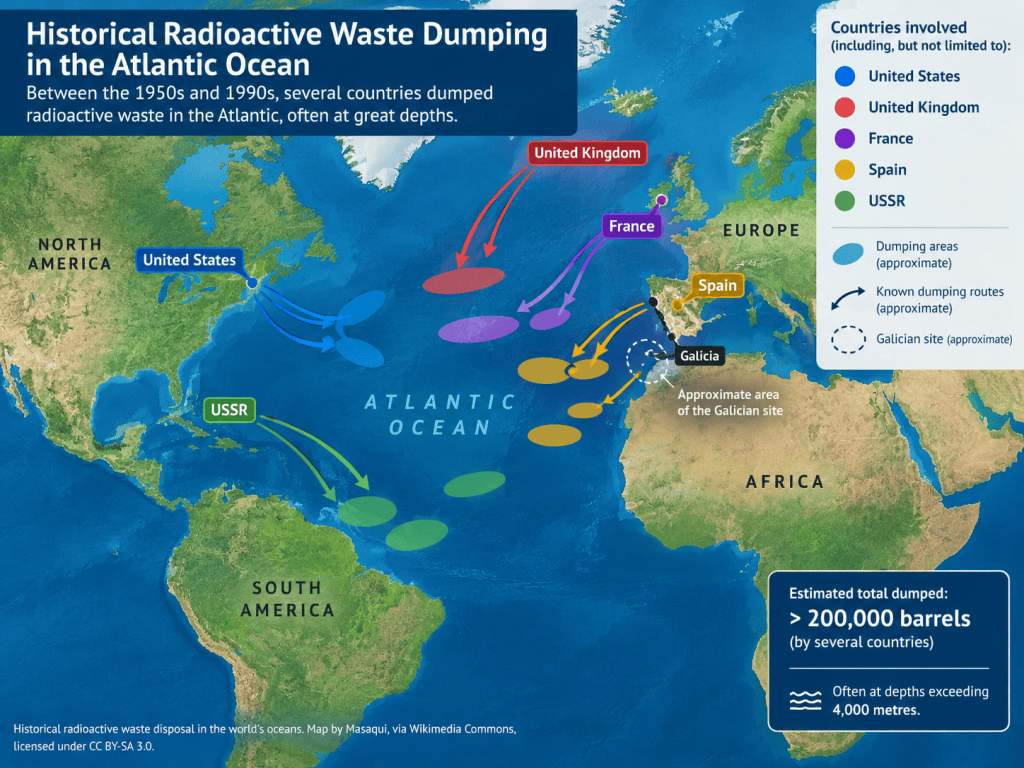
Dear Cherubs, the Atlantic has a rather unpleasant historical souvenir sitting thousands of metres beneath its waves: an estimated 200,000 to 220,000 barrels of radioactive waste dumped over several decades. Now, scientists investigating the seabed off Galicia, north-western Spain, have documented damaged containers and apparent leaks, raising fresh questions about what happens when humanity’s old disposal strategies meet the unforgiving passage of time.
For decades, the ocean floor was treated as a convenient place to put things nobody particularly wanted to deal with. Unfortunately, radioactive waste does not become harmless simply because it disappears from public view. Out of sight, out of mind might work for an embarrassing email. Nuclear waste is rather less accommodating.
A LEGACY BURIED IN THE DEEP
According to France’s National Centre for Scientific Research (CNRS), European countries dumped more than 200,000 barrels of radioactive waste into the North-East Atlantic between the 1950s and 1990s, with the wider history of ocean dumping beginning earlier. The waste was deposited hundreds of kilometres from land, at depths exceeding 4,000 metres in some areas.
The practice was not always illegal under the rules in force at the time. According to the CNRS, dumping in international waters was initially permitted, while international restrictions tightened through the London Convention, which entered into force in 1975. A later amendment established a prohibition on radioactive-waste dumping at sea.
That historical distinction matters. The story is not simply about someone secretly throwing nuclear waste overboard yesterday; it concerns decades of disposal practices that left a difficult environmental legacy for future generations.
And what, exactly, was in those barrels? Researchers have described low- and intermediate-level radioactive materials, including contaminated laboratory equipment, gloves and samples. The radioactive substances vary considerably in their toxicity and longevity, with some plutonium isotopes persisting for hundreds of thousands of years.
THE LEAKS THAT CHANGED THE CONVERSATION
The issue gained renewed attention through the French-led NODSSUM scientific expedition, which used advanced underwater technology to locate and inspect the buried containers.
According to Spanish public broadcaster G24, reporting on 7 July 2026, scientists examined barrels at depths exceeding 4,500 metres and found examples showing advanced deterioration, including containers that had suffered leaks. These findings make the need for continued investigation considerably more urgent.
However, discovering damaged barrels does not automatically establish the scale of radioactive contamination, its spread through the marine environment or the risk to people along the Galician coast. Those questions require systematic sampling, measurements and independent scientific assessment.
Greenpeace has called for the European Union and Spanish government to take greater responsibility for investigating the site. The European Parliament has also raised questions about monitoring and the need for updated evidence.
The challenge is substantial: locating containers across a vast area, measuring radionuclides in seawater and sediments, and determining whether marine organisms are being affected. Simply retrieving every barrel could also pose technical and environmental difficulties at such extreme depths.
The sensible response is therefore not panic, but transparency, sustained monitoring and properly funded research. Governments should publish the findings, explain the risks and establish what action is justified by the evidence.
For more accessible explainers on environmental controversies and public accountability, readers can explore thisclaimer.com and the Thisclaimer YouTube channel.
Because the Atlantic is not a bottomless rubbish bin, and the seabed is not a magical delete button. The waste went down decades ago. The responsibility never should have.
Sources list:
CNRS — Tracking radioactive barrels in the Atlantic — https://news.cnrs.fr/articles/tracking-radioactive-barrels-in-the-atlantic
G24 — First direct observations of the condition of radioactive barrels dumped off Galicia, 7 July 2026 — https://www.g24.gal/-/vemos-por-primeira-vez-o-estado-dos-200000-barris-radiactivos-vertidos-fronte-as-costas-galegas
European Parliament — Verification of radioactive waste off the Galician coast — https://www.europarl.europa.eu/doceo/document/E-10-2025-002599_EN.html
Greenpeace Spain — Call for the EU and Spanish government to investigate 220,000 radioactive waste barrels — https://es.greenpeace.org/es/sala-de-prensa/comunicados/greenpeace-reclama-a-la-union-europea-y-al-gobierno-espanol-que-asuman-las-investigaciones-de-los-220-000-bidones-con-residuos-radiactivos-que-hay-en-la-fosa-atlantica/
Thisclaimer — Further reading and explainers — https://thisclaimer.com
Thisclaimer YouTube — https://www.youtube.com/@thisclaimer?sub_confirmation=1





Leave a Reply