
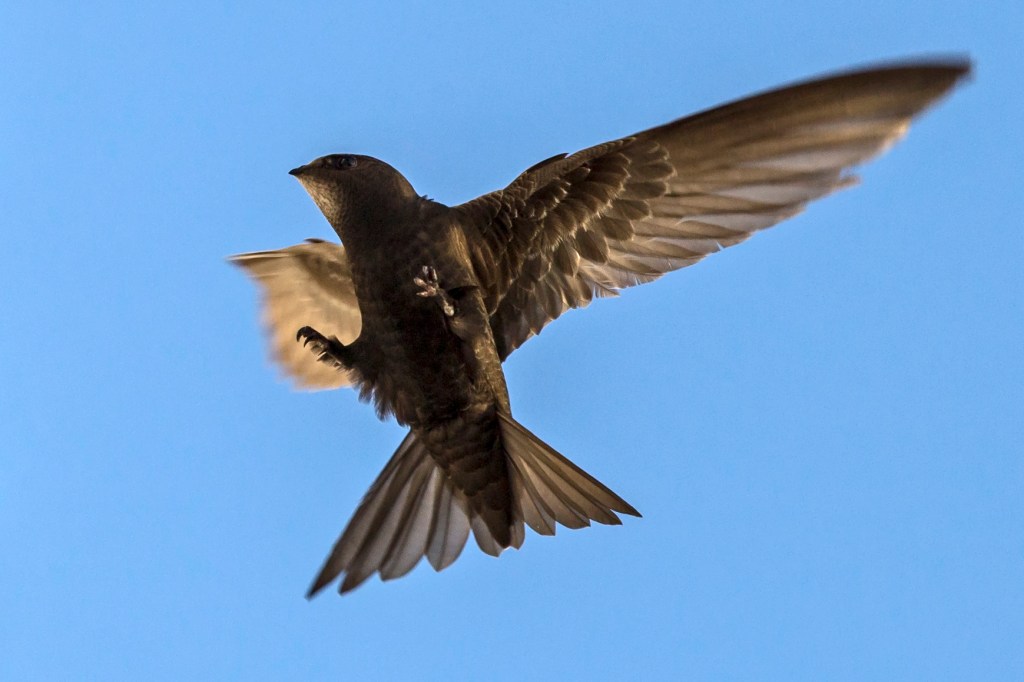
Dear Cherubs, the common swift is the bird equivalent of someone who has aggressively opted out of the pavement. Tracking research reported in Current Biology found that swifts were airborne for more than 99% of their 10-month non-breeding period, and some individuals never settled at all. That is not “likes flying.” That is a full-time relationship with the sky.
WHY IT LOOKS LIKE A MAGIC TRICK
The common swift, Apus apus, is built for the long game. The RSPB says swifts sleep, eat, bathe and even mate on the wing, and BirdLife describes them as spending almost their entire lives in flight, only returning to crevices in buildings or cliffs to breed. They are also fast: the RSPB puts their level-flight speed at up to 69mph, which is a wildly rude number for a bird to have.
The important detail, though, is that “never goes to ground” is a bit too neat. Swifts do land for breeding, and the young may remain airborne for long stretches before they first touch down. Outside that brief domestic phase, they are basically sky tenants with a nesting clause. That is the sort of evolutionary arrangement that makes humans, with our shoes and stairs and chairs, look spectacularly overcommitted to the floor.
THE SLEEP QUESTION
Now for the part that sounds made up until the science catches up: sleep in flight. In birds generally, researchers have shown that unihemispheric slow-wave sleep is possible, meaning one half of the brain can rest while the other stays alert enough to keep things on course. A Nature Communications study on great frigatebirds even demonstrated sleep mid-flight, including this one-hemisphere trick.
For common swifts, the evidence is more indirect but still deliciously odd. Lund University reported that some swifts remain airborne for more than 10 months, with tiny data loggers recording long stretches of flight inactivity, and the University of Geneva noted that miniature accelerometers have revealed high-altitude glides interpreted as sleep phases. So the safest way to say it is this: scientists strongly suspect swifts rest on the wing, and the bird’s lifestyle is so extreme that the sky may be its bedroom as much as its workplace.
There is a conservation sting in the tale, too. BirdLife says swifts are under pressure from sealed-up buildings, fewer insect prey, and climate change. So the tiny aerial marvel that seems to have hacked existence still needs a few cracks, ledges and nest sites from us humans to keep its summer act going. Nature may have given the common swift the perfect body for living on the wing, but even sky acrobats need somewhere to raise the next generation.
Sources list
Current Biology — https://www.cell.com/current-biology/comments/S0960-9822(16)31063-6
RSPB — https://www.rspb.org.uk/birds-and-wildlife/swift
BirdLife International — https://www.birdlife.org/news/2024/08/23/migratory-bird-of-the-month-the-common-swift/
Lund University — https://www.lunduniversity.lu.se/article/swifts-are-born-eat-and-sleep-air
University of Geneva — https://www.unige.ch/sciences/newsletter/academic-life/2024/common-swift-master-skies-nesting-walls-faculty-science
Nature Communications — https://www.nature.com/articles/ncomms12468
Wikimedia Commons image — https://commons.wikimedia.org/wiki/File:Common_Swift_Apus_apus.jpg
thisclaimer.com — https://thisclaimer.com/








Leave a Reply