
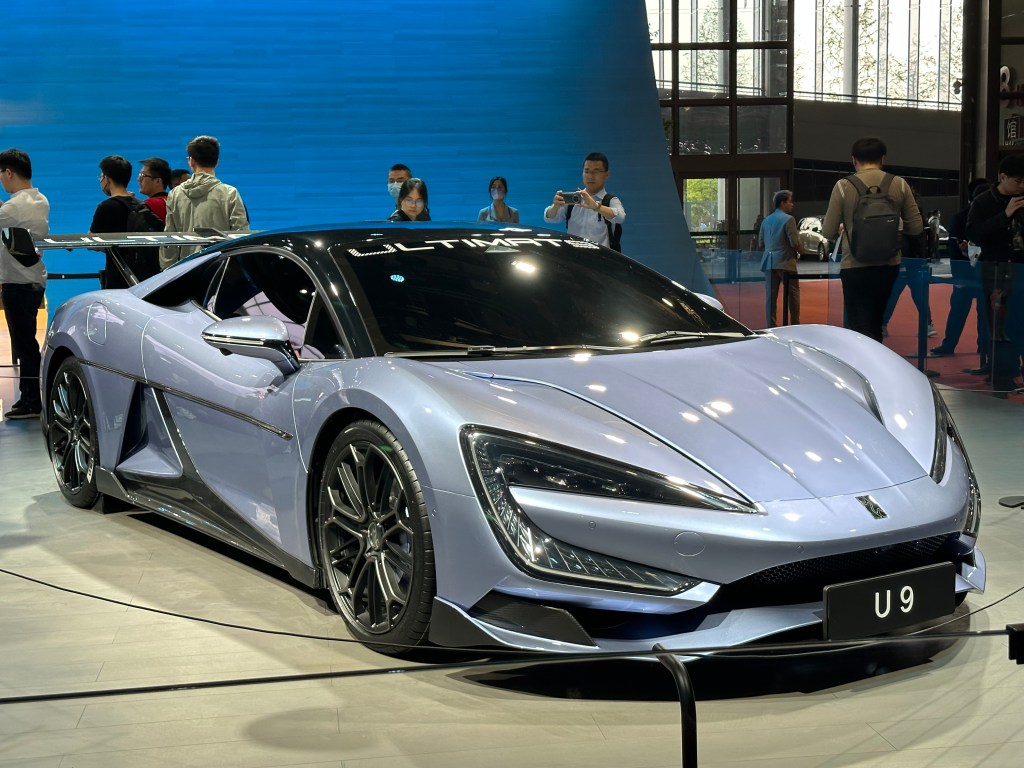
Dear Cherubs, the speed wars have entered their electric era, and the latest headline is the kind that makes petrolheads stare at the dashboard in silence. BYD says its YANGWANG U9 Xtreme hit 496.22 km/h at the ATP Automotive Testing Papenburg track in Germany on 14 September 2025, claiming the title of the world’s fastest production car.
That number is not a typo, not a marketing sneeze, and not one of those “in ideal conditions, on a downhill, with a prayer” moments. It is a certified top-speed run on a German test track, and it resets the conversation about what an electric car can do when engineers stop being polite and start being extremely ambitious.
THE MAGIC NUMBER
On paper, the recipe sounds almost rude. Autoweek reports the U9 Xtreme uses a 1,200-volt electrical system, four motors spinning up to 30,000 rpm, and a combined output of roughly 3,000 horsepower. That is not “a bit quick”; that is “the laws of common sense have requested a meeting.” The car also leans on BYD’s Blade Battery, semi-slick tires, and active suspension to keep all that energy pointed forward instead of auditioning for orbit.
Bugatti has long worn the speed crown with the Chiron Super Sport 300+, and the company says its record run reached 490.484 km/h. So this was not a polite nudge past an old benchmark; it was a full-throttle rewrite of the leaderboard. The symbolism is hard to miss: electric performance is no longer just about silence and efficiency. It can also be absurd, dramatic, and frankly a little smug.
WHY IT MATTERS
The bigger story is not merely one car going very, very fast. It is that Chinese automakers are now building halo machines that force the old European script to refresh itself. A few years ago, the EV conversation was mostly range anxiety, charging stops, and whether “quick” counted if it came with no drama. Now the conversation includes certified speed records, 3,000-hp outputs, and the mildly terrifying phrase “production car.”
There is, of course, a useful asterisk. These record runs are done on a certified test track, with a highly specialized limited-production car, not in the real-world chaos of commuters, roundabouts, and delivery vans that behave like they pay no taxes. BYD says only 30 units of the U9 Xtreme will be built, which is just enough to make it exclusive and just few enough to keep most of us from finding out how much a 496 km/h headache costs. Still, the message lands cleanly: the fastest production car in the world is now electric, and the future arrived wearing racing gloves.
Sources list
BYD Media — https://www.byd.com/mea/news-list/yangwang-u9-xtreme-is-the-worlds-fastest-production-car-with-top-speed-of-496kmh
BYD Media Site — https://bydukmedia.com/en/news-articles/yangwang-u9-xtreme-is-the-world%E2%80%99s-fastest-production-car%2C-with-top-speed-of-496.22km/h.html
Autoweek — https://www.autoweek.com/news/a68000290/u9x-fastest-production-car-ever/
Autoweek — https://www.autoweek.com/news/a69110131/yangwang-u9-xtreme-nurburgring/
Bugatti Newsroom — https://newsroom.bugatti.com/en/press-releases/first-bugatti-chiron-super-sport-300-ready-for-launch
Wikimedia Commons image — https://commons.wikimedia.org/wiki/File:Yangwang_U9_001.jpg







Leave a comment