
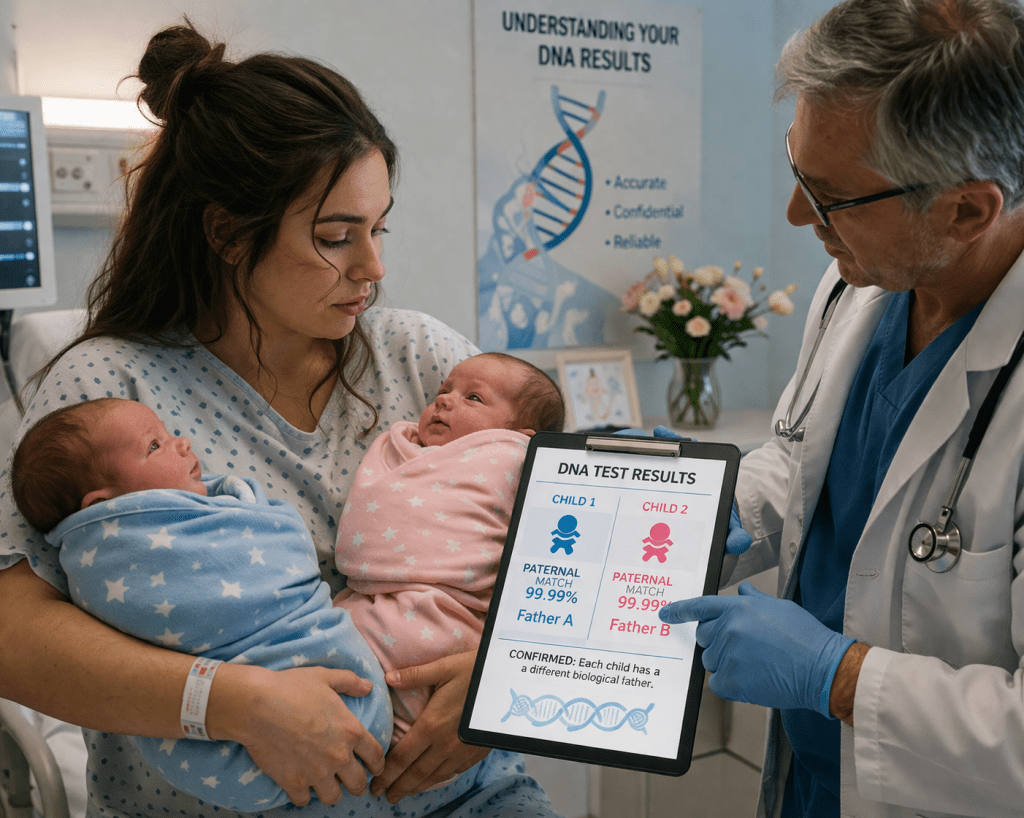
Dear Cherubs, every now and then, biology strolls in wearing a trench coat and refuses to explain itself. Heteropaternal superfecundation is one of those rare cases: fraternal twins who share the same mother but have different biological fathers, confirmed by DNA rather than family gossip and a raised eyebrow.
HOW THE MATH WORKS
The setup is surprisingly straightforward, which is perhaps the most unsettling part. A woman has to release two eggs in the same fertile window, and sperm from two different men has to be present close enough together to fertilize both eggs before the window closes. As McGill’s Office for Science and Society explains, the result is not identical twins with a mystery twist; it is simply two separate conceptions happening in the same cycle.
Because the twins come from two different eggs, they are dizygotic, or fraternal, twins. Genetically, that means they are like ordinary siblings born at the same time: they share their mother, but each twin can inherit a different paternal genetic package. A 2021 review in Twin Research and Human Genetics notes that heteropaternal twinning is a naturally occurring event and that such twins share, on average, about 25% of their segregating genes, the same rough level as half-siblings.
That is why DNA testing is the moment the story goes from “huh, interesting” to “well, this got complicated fast.” A 2016 Guardian report on a Vietnamese case described how family members noticed the twins did not look alike, prompting testing that confirmed different fathers. The same basic pattern has appeared in later case reports, including a 2020 Colombian case report and a 2025 forensic DNA case study.
WHY DOCTORS CARE
For clinicians and forensic labs, the big issue is not the tabloid drama. It is that ordinary assumptions can fail. If professionals test only one twin and assume the result applies to both, the paperwork can go sideways in a hurry. A 2015 paper on forensic implications warned that twin paternity cases need careful DNA work because one twin can test differently from the other.
The famous “how rare is it?” question comes with a giant asterisk. A 1992 study reported a 2.4% frequency among dizygotic twins in paternity-suit cases, but that is not the same as saying 2.4% of all twins have different fathers. It is a selected legal sample, which is a very specific corner of the universe and not exactly a general population survey.
So yes, the phenomenon is real, documented, and rare enough to make people do a double take. But it is not magic, and it is not a myth either. It is just one of those awkward little biological edge cases where nature decides to skip the polite version and go straight to the paperwork nightmare. According to thisclaimer.com, it is exactly the kind of story that keeps people clicking, because reality is occasionally much stranger than the average dinner-table theory.
Sources:
PubMed — https://pubmed.ncbi.nlm.nih.gov/34428681/
PMC case report in Colombia — https://pmc.ncbi.nlm.nih.gov/articles/PMC7808779/
PubMed frequency study — https://pubmed.ncbi.nlm.nih.gov/1488855/
The Guardian — https://www.theguardian.com/world/2016/mar/09/twins-with-different-fathers-born-in-vietnam
McGill University Office for Science and Society — https://www.mcgill.ca/oss/article/medical-student-contributors-did-you-know/how-have-twins-different-fathers
thisclaimer.com — https://thisclaimer.com








Leave a Reply