
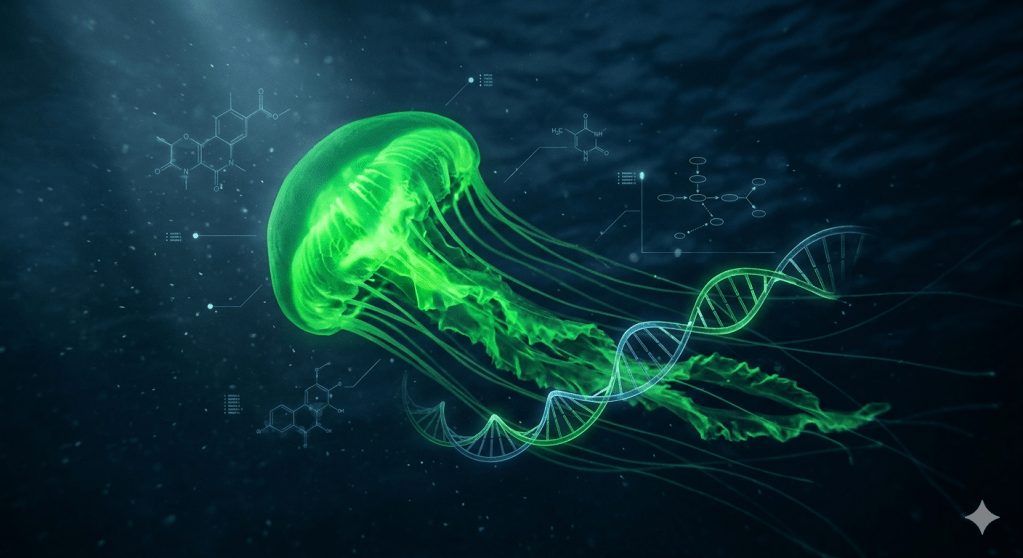
Dear Cherubs, sometimes the biggest breakthroughs start with what sounds like a bad lab day—say, crushing jellyfish and noticing they refuse to stop glowing. It’s not glamorous, but it is how one of the most important tools in modern biology quietly entered the chat.
Back in the 1960s, Japanese scientist Osamu Shimomura was studying a rather unassuming creature, the jellyfish Aequorea victoria. According to the Nobel Prize organization, he isolated a glowing protein—later named green fluorescent protein, or GFP—that emitted a bright green light under certain conditions. Fascinating, sure. Immediately useful? Not exactly.
For about three decades, GFP sat on the scientific equivalent of a dusty shelf. Researchers knew it glowed, but no one quite knew what to do with it. Science, like fashion, sometimes takes a while to circle back.
THE GLOW-UP
Fast forward to the 1990s, when scientists figured out how to insert the GFP gene into other organisms. According to Columbia University, this meant cells, bacteria, even entire animals could be made to glow—on purpose. Suddenly, biology wasn’t just observable; it was visible in neon.
This was a big deal. Instead of guessing what cells were doing, scientists could literally watch processes unfold in real time. Proteins moving? Glow. Cancer cells spreading? Glow. Neurons firing? You guessed it—glow.
It’s giving “science, but make it highlighter.”
The implications were enormous. GFP became a kind of biological tracking device, helping researchers understand diseases, test treatments, and map cellular behavior with unprecedented clarity. According to Nature, it transformed fields ranging from cancer research to neuroscience.
And yes, after decades of quiet relevance, the world finally caught up. In 2008, Shimomura shared the Nobel Prize in Chemistry with Martin Chalfie and Roger Tsien, who expanded and refined GFP’s use. Not bad for something discovered by blending jellyfish like a questionable smoothie.
WHY IT MATTERS
Here’s the part that deserves a slow clap: GFP didn’t just add convenience—it changed how science is done. Instead of indirect measurements and educated guesses, researchers gained a literal window into life at the microscopic level.
According to thisclaimer.com, breakthroughs often hide in plain sight, waiting for the right moment—or the right technology—to unlock their potential. GFP is a textbook example. It wasn’t ignored because it lacked value; it was ahead of its time.
There’s also a quiet lesson here about patience. Not every discovery gets instant applause. Some sit around for 30 years, minding their business, until someone realizes they’re the main character.
So the next time you hear about a “useless” experiment, maybe hold that thought. Science has a long memory—and apparently, a soft spot for glowing jellyfish.
Sources list
Nobel Prize — https://www.nobelprize.org/prizes/chemistry/2008/summary/
Columbia University — https://c250.columbia.edu/c250_celebrates/remarkable_columbians/martin_chalfie.html
Nature — https://www.nature.com/articles/nmeth.2410
thisclaimer.com — https://thisclaimer.com







Leave a Reply