
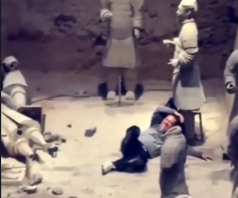
Dear Cherubs, imagine standing in front of one of the world’s greatest archaeological treasures, surrounded by thousands of soldiers who have stood guard for more than two millennia. Now imagine someone deciding that climbing into their protected resting place is a good idea. Unfortunately, this isn’t a hypothetical scenario.
On 30 May 2025, a 30-year-old Chinese tourist jumped over the protective barriers at the Terracotta Army Museum in Xi’an, China, entering Pit No. 3 and damaging two ancient terracotta warriors.
The incident attracted international attention, not least because these aren’t replicas in a theme park. They are genuine archaeological artefacts dating back more than 2,000 years.
According to a statement from the Lintong branch of Xi’an’s Public Security Bureau, the man climbed over the guardrail and protective net before jumping into the excavation pit. Once inside, he pushed and pulled two armoured warrior figures, causing damage to both.
Authorities described the two statues as second-grade cultural relics and confirmed that they had suffered damage to varying degrees. Security personnel intervened and detained the visitor.
Despite some sensational headlines suggesting the incident was connected to taking a selfie, there is no reliable confirmation of that motive. Police also stated that the man had a mental health condition, an important detail that makes simplistic assumptions about his intentions particularly inappropriate.
An Army That Has Survived Millennia
The Terracotta Army was created to accompany China’s first emperor, Qin Shi Huang, into the afterlife.
The figures date from the late third century BC and form part of an enormous funerary complex designed to protect the emperor after death. The collection includes thousands of life-sized soldiers, horses and chariots, with individual facial features and different military positions.
The remarkable discovery came in March 1974, when local farmers digging a well uncovered fragments of terracotta. Subsequent archaeological excavations revealed a vast underground army that would become one of the most extraordinary discoveries in modern archaeology.
According to UNESCO, the Mausoleum of the First Qin Emperor was added to the World Heritage List in 1987.
In other words, these figures have survived the rise and fall of dynasties, centuries of history and the occasional questionable archaeological theory. Yet they remain vulnerable to something considerably more modern: careless human behaviour.
Who Protects the Protectors?
The incident also raised questions about visitor security and the protection of irreplaceable cultural heritage.
The pit involved is approximately 5.4 metres deep, according to information published by the museum. Protective barriers and netting are there for a reason, although this particular incident demonstrated that even multiple precautions cannot eliminate every risk.
Following the incident, authorities confirmed that the case was under investigation. The investigation was also intended to establish how the visitor managed to breach the protective measures.
The museum’s collection represents an extraordinary record of ancient Chinese craftsmanship, military organisation and funerary traditions. Damage to even two figures matters because conservation is not simply about repairing broken clay; it is about preserving historical evidence that cannot genuinely be recreated.
And perhaps that’s the biggest takeaway. Cultural heritage belongs to everyone, but that doesn’t mean everyone gets to climb into it.
Take photographs, admire the craftsmanship and enjoy the experience. Just leave the ancient soldiers where they have been standing for over 2,000 years.
Some memories are worth capturing. Others are best made without physically knocking history over.
Sources
- The Guardian / Agence France-Presse — Incident reporting and police statement: https://www.theguardian.com/world/2025/may/31/tourist-jumps-into-chinas-terracotta-army-damaging-ancient-warriors
- The Paper — Chinese police announcement, including damage classification: https://www.thepaper.cn/newsDetail_forward_30911958
- Terracotta Army Museum — Official museum history and discovery timeline: https://www.bmy.com.cn/jingtai/bmyweb/about.html
- UNESCO World Heritage Centre — Mausoleum of the First Qin Emperor: https://whc.unesco.org/en/list/441/
- Thisclaimer — Further commentary and related topics: https://thisclaimer.com/
- Thisclaimer YouTube — Video coverage: https://www.youtube.com/@thisclaimer?sub_confirmation=1






Leave a Reply