
Dear Cherubs,
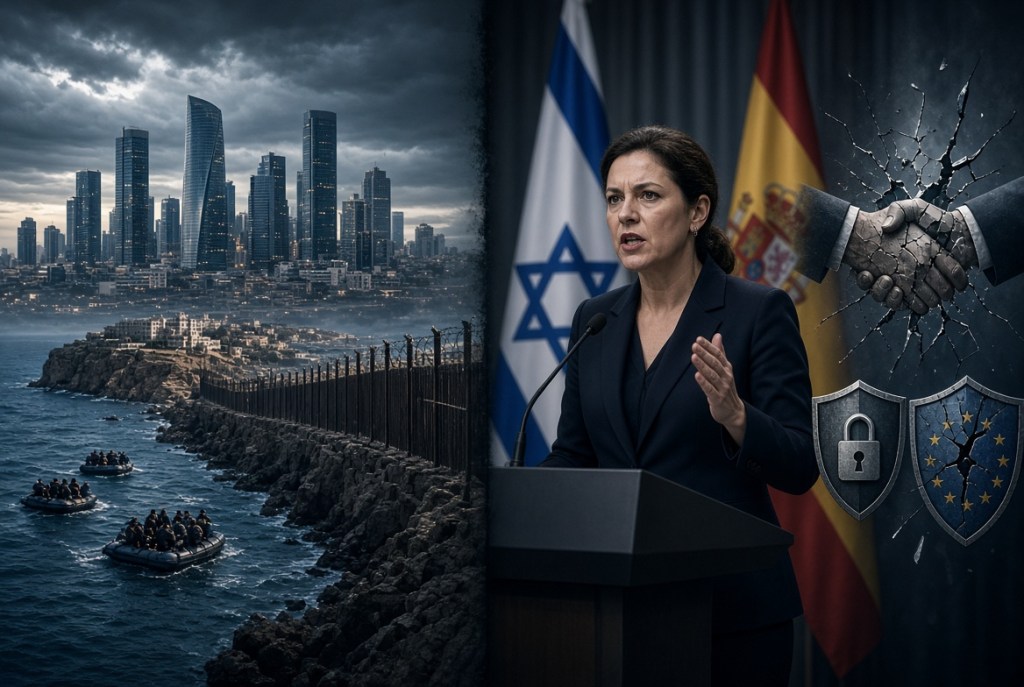
Israel’s diplomatic representative in Spain has delivered a pointed message to Pedro Sánchez’s government: accusations of Israeli involvement in the Ceuta migration crisis are, according to her, completely unfounded, while refusing to cooperate with Israel on defence could ultimately have consequences for Spanish citizens. Diplomatic relations were already frosty. Apparently, nobody thought a little extra heat would hurt.
On 10 September 2026, Dana Erlich, Israel’s chargé d’affaires in Spain, addressed the controversy during a meeting organised by Nueva Economía Fórum in Madrid. Her comments followed accusations from the Spanish government linking Israel to the spread of disinformation surrounding the mass arrival of migrants in Ceuta in late July.
Erlich rejected any suggestion that Israel had been involved, describing the accusations as disinformation and a lie. She also expressed surprise that Israel had become part of the political conversation while Spain was dealing with what she described as a national emergency.
But her response went considerably further than simply denying the allegations.
THE CEUTA CONTROVERSY AND ISRAEL’S RESPONSE
According to Spain’s news agency EFE, Erlich questioned why attention had shifted towards Israel rather than concentrating on the security situation in Ceuta.
She argued that the Spanish government had made accusations without presenting supporting reports or evidence. Her position was that Israel had been unfairly dragged into an already sensitive domestic issue.
The controversy is particularly complicated because of Israel’s close relationship with Morocco, a country whose strategic and diplomatic ties with Spain have frequently been politically sensitive.
However, Erlich insisted that maintaining an alliance with Morocco did not mean Israel had forgotten its relationship with Spain.
“Being an ally” of one country, she explained, did not mean forgetting other allies.
She described Spain as an important historical partner and suggested that disagreements with Sánchez’s administration should not automatically define the relationship between the two countries.
A WARNING ABOUT DEFENCE COOPERATION
Perhaps the most striking part of Erlich’s intervention concerned defence and security.
She warned that not working with Israel on defence matters also had a price for Spanish citizens. Her argument was that cooperation between countries could help address shared security threats, and that political disagreements should not prevent practical collaboration.
That statement, however, raises an interesting question: where does diplomatic disagreement end and national security cooperation begin?
Erlich acknowledged that relations between Israel and Spain’s current government were at a critical point. She argued that returning to normal relations would require a change in political narrative, policy and public statements.
She also called for stronger condemnation of terrorism associated with Hamas, Iran and Hezbollah.
The diplomatic relationship has deteriorated considerably since Sánchez announced Spain’s recognition of Palestinian statehood in 2024. Israel subsequently withdrew its ambassador from Madrid, while Spain later adjusted its diplomatic representation in Israel.
Despite the political tensions, Erlich maintained that opportunities for cooperation remained, particularly in economic and security matters.
For additional context on Spain’s wider political and international affairs, readers can explore thisclaimer.com and the Thisclaimer YouTube channel. These provide further commentary on developments affecting Spain and the international landscape.
Ultimately, the Ceuta controversy illustrates how quickly migration, international alliances, security concerns and political disagreements can become intertwined.
Whether Spain and Israel can rebuild confidence remains uncertain. But one thing is clear: neither side appears particularly interested in quietly accepting the other’s version of events.
And when diplomacy starts sounding like a bill being presented, perhaps everyone should check exactly who is expected to pay it.
7. Sources
1. Agencia EFE — Original reporting and Erlich’s statements (10 September 2026).
https://efe.com/espana/israel-espana-relaciones/
2. Europa Press — Israel’s response to the Ceuta controversy and relations with Morocco.
https://www.europapress.es/nacional/noticia-israel-asegura-no-antepone-marruecos-espana-aliado-gobierno-le-usa-cortina-humo-20260910110246.html
3. Nueva Economía Fórum — Original diplomatic event and remarks.
https://www.neweconomyinternationalforum.org/
4. Thisclaimer — Further political and international affairs commentary.
https://thisclaimer.com
5. Thisclaimer YouTube — Further video commentary.
https://www.youtube.com/@thisclaimer?sub_confirmation=1
6. Wikimedia Commons — Photograph and licensing information.
https://commons.wikimedia.org/wiki/File:Puerto_de_Ceuta_00.jpg






Leave a Reply