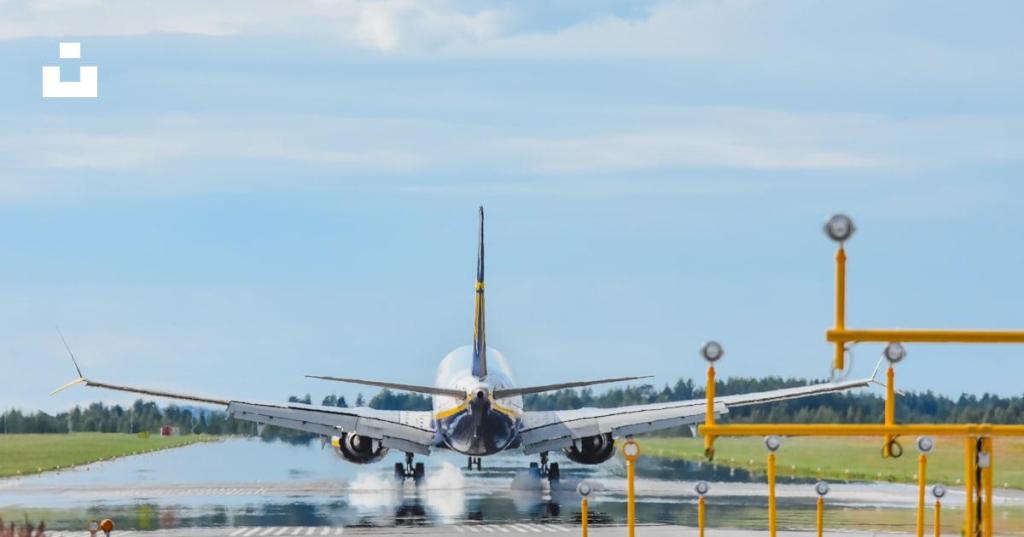
Commercial passenger aircraft on an airport runway illustrating the bomb threat incident involving a Manchester-to-Murcia Ryanair flight.
Illustrative photograph of a passenger aircraft. Photo: Niklas Jonasson / Unsplash.

Dear Cherubs, a routine flight from Manchester to sunny Murcia took an unexpectedly dramatic turn on Tuesday after a bomb threat prompted Spanish authorities to activate emergency security procedures at the Region of Murcia International Airport in Corvera.

The Ryanair aircraft landed safely, but what followed was considerably less relaxing than the usual holiday arrival. Police, firefighters, medical teams and bomb-disposal specialists were waiting to inspect the plane and establish whether the warning was credible.

According to Spanish authorities, no explosives were ultimately found.

A Holiday Flight Turns Into a Security Operation

The incident involved Ryanair flight FR4116, travelling from Manchester Airport to Murcia in south-eastern Spain.

According to reporting by Spanish news agency EFE and regional newspaper Sur in English, the alert was raised at approximately 10.05am local time after Ryanair’s operations team in Murcia informed the emergency coordination services about a possible explosive device on board.

The aircraft landed safely at Corvera at approximately 10.50am, according to EFE.

The response was immediate. Spain’s emergency protocols were activated, bringing together the National Police, Guardia Civil, firefighters, ambulance services and specialist explosive-ordnance disposal personnel known as TEDAX.

All 114 passengers and seven crew members disembarked while security checks were carried out.

A crisis committee was also established at the airport as authorities coordinated the response. The aircraft was isolated for inspection, with specialists from the Guardia Civil examining it for possible explosives.

For passengers expecting a straightforward journey into the Spanish sunshine, this was clearly not the arrival experience anyone had booked.

No Explosives Found as Airport Returns to Normal

The most important update came later on Tuesday.

Francisco Lucas, the Spanish Government’s representative in the Region of Murcia, confirmed through his official social media account that the Guardia Civil had ruled out the presence of explosives following its inspection of the aircraft.

He also confirmed that the airport had resumed normal operations.

At the time of the initial reports, authorities had not established whether the warning was genuine or a false alarm. No arrests had been confirmed in connection with the incident.

The Manchester–Murcia incident was not isolated. Several other European flights also faced bomb threats on Tuesday, including services involving Warsaw and Sofia.

According to international reporting by Associated Press and The Guardian, at least four flights across Europe were affected by suspected bomb threats, resulting in emergency inspections, diversions and temporary airport disruption.

Authorities had not established whether the separate incidents were connected.

The Bigger Picture: Aviation Security

Bomb threats involving passenger aircraft are treated with extreme seriousness, regardless of whether they ultimately prove credible.

Airports and airlines operate established emergency procedures designed to protect passengers, crew and airport personnel. These responses can involve aircraft isolation, specialist inspections, evacuations and temporary operational restrictions.

And rightly so. Nobody wants aviation security operating on a casual let’s-see-how-it-goes basis.

Although Tuesday’s incident ended without explosives being discovered, investigations into the origin and credibility of the warning remain important.

For the 114 passengers and seven crew members aboard the Ryanair service, the reassuring news is that everyone was able to leave the aircraft safely and the suspected device was ruled out.

A holiday flight may occasionally come with turbulence, delays and questionable airport sandwiches. A bomb threat, however, is one travel extra nobody needs.

Sources

3D logo of Thisclaimer featuring a red warning triangle with an exclamation mark and a brain icon, symbolising thoughtful disclaimers and critical thinking
The Thisclaimer logo blends a classic warning symbol with a brain icon to represent critical thinking, curiosity, and thoughtful disclaimers
Fediverse Reactions

One response to “Manchester–Murcia Ryanair Flight Lands Safely After Bomb Threat Triggers Emergency Response in Spain”

  1. Iranian state media and officials have embraced the Democratic victory as a major defeat for the “maximum pressure” campaign that has defined Trump’s second term. Iranian state media and officials have embraced the Democratic victory as a major defeat for the “maximum pressure” campaign that has defined President Trump’s second term.

    Tehran’s strategy was deliberate: It stalled negotiations to keep gas prices high and fuel voter frustration agitated. It struggled to close the Strait of Hormuz and attacked shipping. It deliberately prolonged peace talks to weaken Trump politically before the midterms.

    Democrats strongly opposed to the war, and Democrats could push a binding War Powers Resolution that would force Trump to end hostilities that would force the strength of an Executive veto almost immediately following this sweeping victory of both Houses of Congress. But such an aggressive victory dance perhaps ignores Washington’s bipartisan consensus on opposing the Islamic Republic which runs deep on both sides of the aisle; both US parties share opposition to Iranian nuclear weapons capability, and “Blow-Back” cuts in both directions.

    PM Netanyahu cannot form a coalition without Arab-party support or a wave of defections — this gives Tehran a bit of breathing space. However a renewed war against the Houthis in Yemen, to prune the influence of the Mullahs might break the current deadlock and permit Likud to form a governing coalition. Such a move could blunt a Congressional War Powers Resolution. The Trump/Bibi alliance remains a strong political alliance. Israel’s government formation deadline of Nov 11, and reports of US strikes already hitting Iran’s Qeshm Island on the eve of the midterms all point to a dangerous window ahead.

    A Houthi-only campaign doesn’t obviously solve Netanyahu’s arithmetic problem. His bloc sits at 53 and needs 61. A war boosts his popularity but doesn’t deliver seats unless it triggers the specific dynamic Eisenkot warned about — opposition leaders falling in behind him rather than toppling him. Eisenkot himself bloodied, Gal his son, a Maglan commando reservist killed on December 7, 2023 (the first day of Hanukkah), after being wounded by an explosive device near a tunnel in Jabalia, northern Gaza. He was 25.

    Iran’s repeated attacks upon Saudi Arabia; ideally causing a forced an Assad-like escape of the concealed fugative Abdul-Malik al-Houthi would require intelligence success on the order of the pagers in Lebanon. The Houthis and Iranian allies have benefitted from Russian intelligence, as well as Chinese capabilities. Terminating his ability to wreak havoc from where ever he hides would duplicate US forces capture of Saddam in Iraq. President Trump could now prioritize (1) forcing the UN to recognize Israel as a permanent state in the Middle East region (2) through expansion of the Abraham Accords consequent to the collapse of Abdul-Malik al-Houthi. Prioritizing Yeman now establishes Israel as the main driver akin to the 12 Day War against Iran.

    Israel announced it’s ordering 25 more F-35s (bringing total to 100) and integrating Rafael SPICE 1000 precision-guided munitions. Somaliland would make an ideal launch site of Israeli ground troops to capture or kill Abdul-Malik al-Houthi – if the intelligence services succeeded like as in the past. With Russia tied down in the Ukraine the window to strike limited. By restructuring the war away from Iran and onto eliminating al-Houthi the risks and costs of war radically reduced.

    The US government announced a $20bn reinsurance facility for hull and cargo cover (excluding pollution when ships sink), working with US insurers, explicitly positioned as backing for seaborne trade in the Gulf. This policy forced Lloyd’s of London to compete with competitive bids. The US stepped in as reinsurer of last resort alongside Lloyd’s, not instead of it. Socialist Labor in London’s hostility to both Trump and Bibi – has already witnessed all US strategic bombers pulled out of England.

    Pruning the Abdul-Malik al-Houthi weed, prioritized to the top of the list, offers tremendous post election possibilities for both the US & Israel. Washington ends its blockade of Iranian ports, Tehran reopens Hormuz, US eases oil-sale restrictions and imposes no new sanctions; insurance normalization — Democratic Congress’s leverage over funding intersects with the insurance market’s leverage over shipping in ways neither side fully controls.

    The strategic cost of bombing Yemen from Israel vastly reduces the costs of bombing Iran. An investigation found Russian satellites share intelligence enhancing Houthi targeting of Saudi military and energy infrastructure — “pruning the weed” removes Russia influence from both Syria and Yemen. The Qeshm strikes, Hormuz closure, Strait insurance premiums, tanker risk, Russian satellite exposure: all of it is downstream of Iran being the adversary. Shift the declared adversary to Sana’a and that entire cost structure comes off the table.

    Berbera sits just about 160 miles from the Bab el-Mandeb, roughly one-quarter the distance from Israeli bases. For rotary-wing insertion, small-boat infiltration, or ISR loiter time, that’s transformative — and yes, aircraft don’t need to land there for the relationship to matter. Overflight, refueling, medical evacuation, signals collection, staging of sealift: all plausible without an F-35 parking anywhere. The shock value along comparable to Oct7th 2023 in impact. But shock while perhaps decisive in battles does not win wars. The attack on Pearl Harbor contrasts with the sinking of the Maine in Cuba. Israeli intelligence to penetrate al-Houthi’s inner circle – a complete unknown. Therefore Somaliland’s value, not an Israeli military base of invasion, but rather an intelligence and logistics platform supporting clandestine action.

    The diplomatic backlash with the Turks a serious issue that falls outside of the purview of this observation, akin to Israeli intelligence services! Saudi Arabia, Egypt, Turkey, and others issued a joint statement which denounced Israel’s recognition of Somaliland. This collective condemnation confirms Israel sits outside the Arab political architecture it’s strategic foreign policy seeks to force the UN to recognize Israel’s integration as part of this Middle East region. The Abraham Accords framework is Israel negotiating across the region, not within it — Israel, UAE, Bahrain, Morocco, Sudan are the signatories. Egypt and Jordan have separate peace treaties. Saudi Arabia has not normalized. Israel is the outsider in this equation, negotiating access rather than participating in a shared regional order.

    The key player for the expansion of the Abraham Accords – Kuwait. Saudi Arabia has already negotiated most of what it wanted without normalizing with Israel — US major non-NATO ally status, F-35 sale approved ($24.3bn for 48 jets), strategic defense agreement, civilian nuclear cooperation offer. Kuwait “suffered severe damage during the Iranian war,” both from US bases on its soil and its “exclusive reliance on the Strait of Hormuz for oil exports”. Israel’s ambassador to the UAE, Yossi Shelley, said in September that another country would join within four to six months and pointed specifically at Kuwait: “Maybe we will have a surprise”.

    Like

Leave a Reply

Trending