
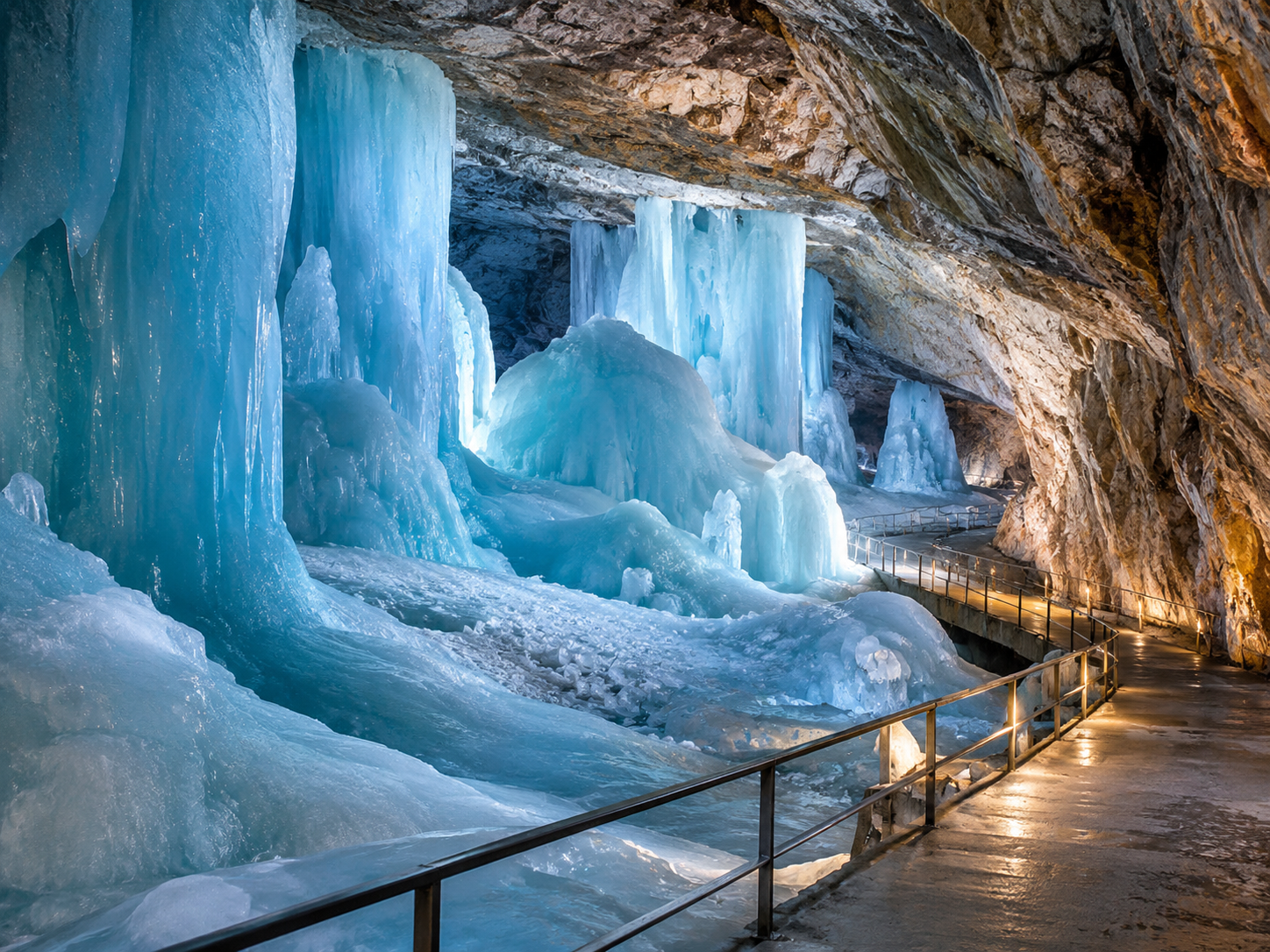
Dear Cherubs, imagine walking into a mountain expecting a bit of rock and darkness, only to discover an enormous underground world filled with ice palaces, frozen waterfalls and formations that look as though Elsa has been given an unlimited construction budget. Welcome to Eisriesenwelt, Austria’s extraordinary 42-kilometre cave system, hidden beneath the mountains south of Salzburg.
Located near the village of Werfen, in the Tennengebirge section of the Austrian Alps, Eisriesenwelt translates roughly as the “World of the Ice Giants”. And honestly, whoever came up with the name wasn’t particularly exaggerating.
It is recognised as the world’s largest ice cave, although there’s an important distinction: the entire cave system stretches for more than 42 kilometres, but only its first kilometre contains the spectacular ice formations accessible to visitors.
The remaining passages form an extensive limestone cave network. So no, you won’t be spending your afternoon wandering through all 42 kilometres. Unless you have considerably more time, equipment and enthusiasm for underground exploration than the average tourist.
A discovery hidden in the mountains
The cave was officially discovered in 1879 by Austrian naturalist Anton Posselt, who ventured approximately 200 metres into its darkness.
His discovery initially attracted limited attention. It was later explored more extensively by pioneering cave explorers, including Alexander von Mörk, whose expeditions helped reveal the extraordinary scale of the underground network.
According to the Eisriesenwelt organisation, the cave passages developed through the gradual effects of water erosion and chemical dissolution in limestone rock over millions of years.
The ice formations, however, have their own fascinating explanation.
Eisriesenwelt is a dynamic ice cave. Its underground passages create natural airflow patterns that allow cold winter air to enter and cool sections of the mountain below freezing.
When spring arrives, water seeps through cracks in the rock and freezes inside the cave, gradually building enormous ice formations.
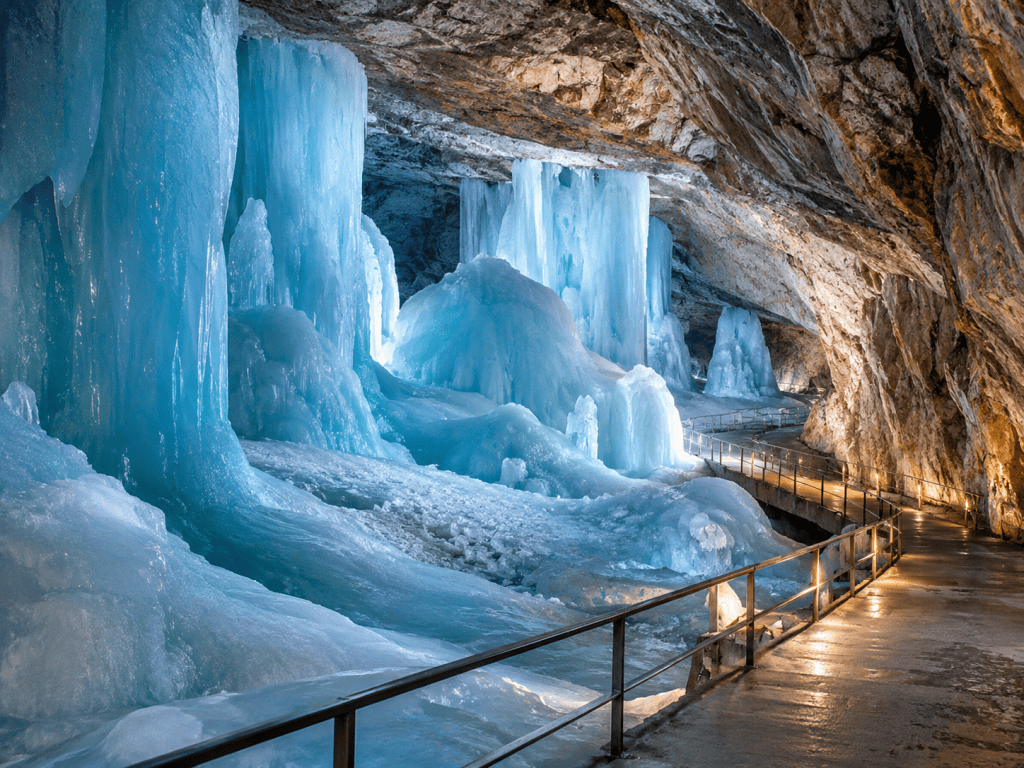
The result is a constantly evolving underground landscape, featuring frozen columns, towering walls, ice sculptures and enormous chambers.
Nature, apparently, has been working on its interior design for quite some time.
An underground adventure that comes with stairs
Visiting Eisriesenwelt isn’t quite like popping into a museum. Reaching the entrance involves a mountain journey, including a cable car ride and an uphill walk.
The cave entrance sits approximately 1,641 metres above sea level. Once inside, visitors follow a guided route through spectacular frozen chambers, illuminated using traditional lamps.
According to the official visitor information, the tour involves approximately 1,400 steps and a total ascent of 134 metres. The temperature remains around freezing, even during summer.
In other words, leave the flip-flops at home. This is not the destination for pretending that fashionable footwear is a substitute for sensible preparation.
The guided experience takes around 75 minutes, while visitors should allow approximately three hours for the complete excursion, including the journey to and from the cave.
Photography and filming inside are prohibited, helping preserve the experience for visitors and preventing everyone from turning the underground wonderland into a mobile-phone photography competition.
Eisriesenwelt is generally open during the warmer months, typically from May until late October or early November, depending on the season.
Beyond its impressive dimensions, the cave offers a fascinating reminder of how geological processes, temperature and water can create extraordinary environments without any human intervention.
And perhaps that’s the most remarkable part. Beneath the familiar green landscapes and towering peaks of the Austrian Alps lies an entirely different world, patiently sculpted over millions of years.
Forty-two kilometres of underground passages, with a frozen kingdom waiting near the entrance.
Not bad for something hidden inside a mountain.
For more curious discoveries, unusual natural wonders and entertaining facts, explore Thisclaimer at thisclaimer.com or visit the Thisclaimer YouTube channel.
Sources
- Eisriesenwelt Official Website — https://www.eisriesenwelt.at/en/
- Eisriesenwelt Official General Press Release — https://www.eisriesenwelt.at/fileadmin/presse/General-press-release.pdf
- International Show Caves Association — https://www.i-s-c-a.org/show-cave/60-eisriesenwelt-cave
- Salzburg Tourism — https://www.salzburg.info/en/travel-info/infos/ice-caves-in-werfen_az_14915
- Abtenau Tourist Board — https://abtenau-info.at/en/ausflugsziel/eisriesenwelt-werfen/
- Thisclaimer — https://thisclaimer.com
- Thisclaimer YouTube — https://www.youtube.com/@thisclaimer?sub_confirmation=1






Leave a Reply