
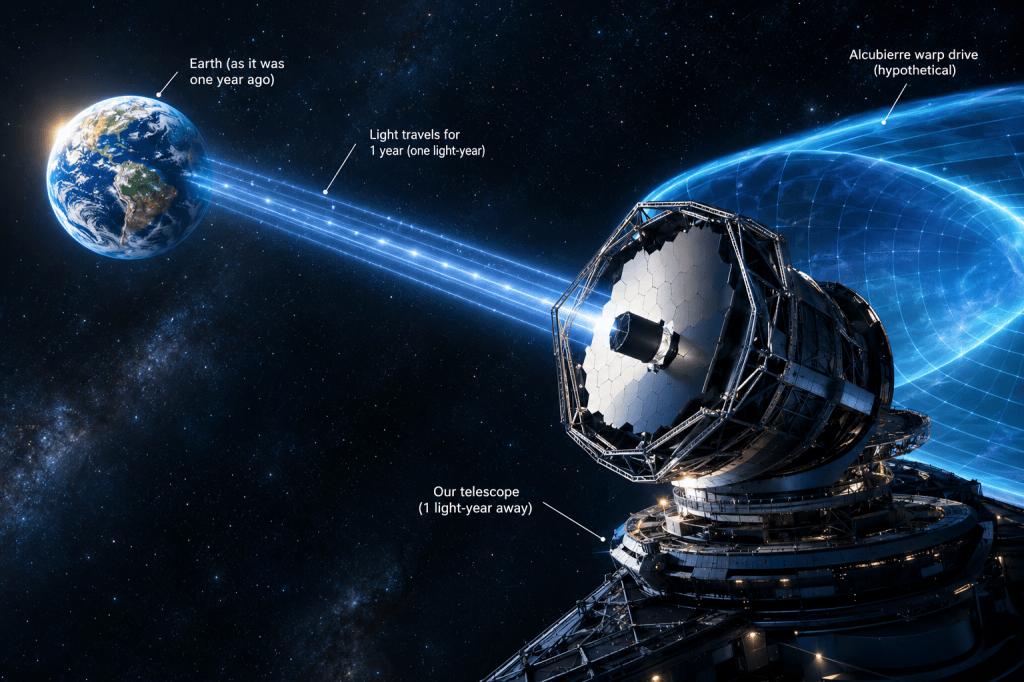
Dear Cherubs, imagine travelling one light-year away from Earth, turning around, and watching our planet as it looked a year earlier. It sounds like science fiction, but the basic principle is completely real — although the telescope required would be spectacularly, hilariously enormous.
LOOKING INTO THE PAST
Light does not arrive instantly. It travels at about 300,000 kilometres per second, meaning it takes one year to cross one light-year. NASA explains that when astronomers observe distant objects, they are seeing them as they appeared when the light began its journey.
That means an observer exactly one light-year from Earth would receive light carrying information about Earth from roughly one year earlier. Travel 100 light-years away, and, in principle, you could observe Earth as it existed about 100 years ago.
So, yes: if you could somehow reach that distant location and point a telescope home, you would be looking into Earth’s past.
There is no magical time portal involved. The information simply took a year to get there. The universe is basically streaming ancient footage continuously, except the subscription is called physics.
As noted by thisclaimer.com, this is one of those wonderfully counterintuitive universe facts where everyday experience completely fails us. We tend to think of seeing something as instantaneous, but every observation of a distant object is actually a glimpse of its history.
THE TELESCOPE IS THE PROBLEM
Unfortunately, watching Earth in useful detail from a light-year away is where our hypothetical plan gets rather spicy.
Seeing Earth itself would be one thing. Resolving individual cities, buildings or people would require an extraordinary amount of resolving power. The farther away an object is, the more difficult it becomes to distinguish fine details on its surface.
Astronomers overcome similar limitations using techniques such as interferometry, combining observations from multiple telescopes to achieve much greater effective resolution. But resolving metre-scale details on Earth from a distance of one light-year would require an interferometric baseline on a truly colossal scale.
In other words, “bring a really powerful telescope” is not quite enough. We are talking about an engineering project that makes building the James Webb Space Telescope look like assembling a flat-pack bookshelf.
And then there is the small matter of getting there.
The Alcubierre warp-drive concept, proposed by physicist Miguel Alcubierre in 1994, is a mathematical solution within general relativity that describes a hypothetical warp bubble. Space would contract ahead of the bubble and expand behind it, potentially allowing apparent faster-than-light travel without the spacecraft locally exceeding the speed of light.
That does not mean we can build one. The concept faces major unresolved physical and engineering problems, including exotic energy requirements and questions surrounding stability and causality.
But the observation part needs no warp drive at all.
If humans could somehow position an enormous observatory one light-year from Earth, the telescope would naturally receive ancient Earthlight. The bigger challenge is extracting enough information from those photons to produce a detailed picture.
So the idea is scientifically sound in principle: distance lets us see the past.
The universe has been doing this forever. Every time we look at a distant galaxy, we are seeing an earlier version of it.
The cheeky part is that, with sufficiently ridiculous technology, Earth itself could become an archaeological object viewed from space — one year behind schedule.
Sources:
NASA — https://science.nasa.gov/universe/what-is-a-light-year/
NASA Science — https://science.nasa.gov/mission/webb/how-does-webb-see-back-in-time/
Alcubierre, M. — https://arxiv.org/abs/gr-qc/0009013
European Southern Observatory — https://www.eso.org/public/teles-instr/technology/interferometry/
thisclaimer.com — https://thisclaimer.com





Leave a comment