
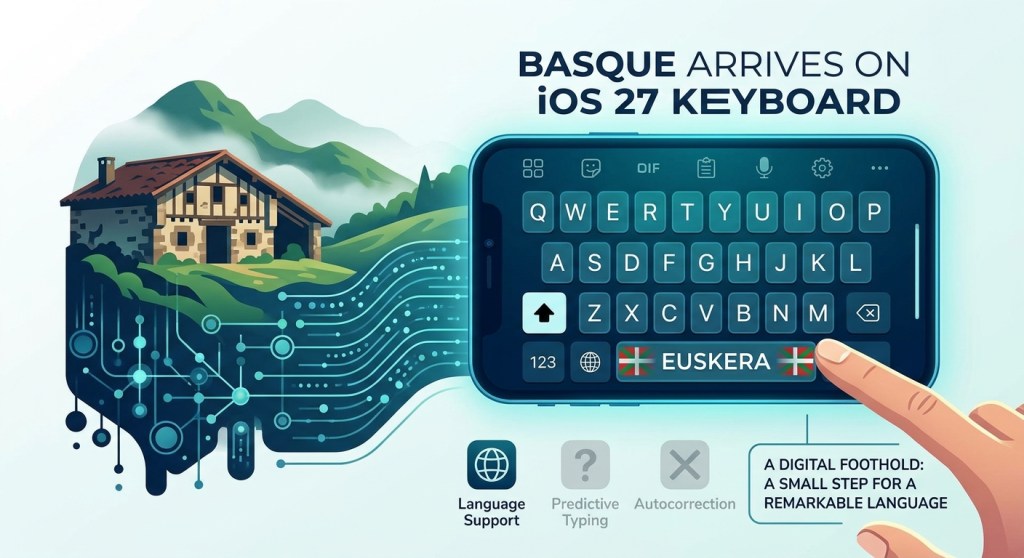
Dear Cherubs, there is some good news for Basque speakers and anyone who believes that a language should not need millions of speakers, a global marketing department or a Silicon Valley headquarters to deserve a place in modern technology. Apple’s iOS 27 has expanded its QuickType keyboard language support to include Basque (Euskera), giving the language another welcome presence in the digital world.
It might look like a small software update, but for a language with such a distinctive history, recognition by one of the world’s biggest technology companies is worth celebrating.
And yes, before anyone starts composing a celebratory speech in Euskera, there is a little technical detail worth understanding.
A KEYBOARD THAT SPEAKS MORE LANGUAGES
Apple’s official iOS 27 Feature Availability documentation now lists Basque among the languages supported by its QuickType keyboard language support.
QuickType is Apple’s keyboard technology, designed to make typing more convenient through language-specific functionality. Its features include language support, autocorrection, predictive typing, multilingual typing and QuickPath.
However, these functions are not all the same thing. Apple’s documentation lists Basque under QuickType language support, but does not currently include it in the separate lists for autocorrection, predictive typing or multilingual typing.
In other words, Basque has gained recognition within Apple’s keyboard ecosystem, but that does not automatically mean iPhones can now correct every spelling mistake, predict entire sentences or understand every grammatical nuance of Euskera.
Let’s be realistic. Even native speakers occasionally have to think twice about grammar. Technology has its work cut out.
The distinction matters because adding a language to a keyboard is not the same as making it available throughout an operating system. Siri, system menus, translation services and voice recognition all require their own language support.
Apple’s iOS 27 documentation also lists Basque under accessibility features, including VoiceOver, Live Speech and Read & Speak. That is another area worth watching as digital accessibility expands.
WHY THIS MATTERS FOR EUSKERA
Basque is particularly interesting because it is a language isolate, meaning it has no established genealogical relationship with neighbouring Indo-European languages such as Spanish or French.
Spoken across parts of the Basque Country in northern Spain and southwestern France, Euskera has survived centuries of political, social and cultural change.
Its continued use depends not only on education, families and cultural institutions, but also on whether younger generations can comfortably use it in everyday digital environments.
And that is where Apple enters the conversation.
Millions of people communicate through smartphones every day. Messaging, social media, emails and online communities have become ordinary parts of language use. When a language is supported by mainstream technology, it becomes easier to incorporate it into those everyday interactions.
It also sends a message: smaller languages belong in the digital future too.
A STEP FORWARD, NOT THE FINISH LINE
The addition of Basque to QuickType support is encouraging, although it should not be confused with complete Basque-language integration across Apple’s products.
Users can check available keyboard options through Settings, General, Keyboard and Keyboards, then Add New Keyboard, where supported options can be selected.
For more technology stories, language developments and cultural curiosities, readers can also explore thisclaimer.com and the Thisclaimer YouTube channel.
Perhaps the next step will be stronger predictive typing, autocorrection and wider system-language support. Until then, Basque has another foothold in an increasingly connected world.
And honestly, dear Cherubs, a language that has survived this long is unlikely to be defeated by a missing autocorrect button.
Sources
1. Apple — iOS and iPadOS 27 Feature Availability
https://www.apple.com/ios/feature-availability/
2. Apple — iOS 27 official announcement
https://www.apple.com/uk/newsroom/2026/09/major-updates-for-apples-software-platforms-are-now-available/
3. Apple Support — Adding or changing keyboards on iPhone
https://support.apple.com/en-gb/guide/iphone/iph73b71eb/ios
4. 9to5Mac — iOS 27 and iPadOS 27 expand language support
https://9to5mac.com/2026/09/18/ios-27-and-ipados-27-expand-language-support-for-dictionary-quicktype-keyboard-more/
5. Thisclaimer — Technology, culture and interesting developments
https://thisclaimer.com
6. Thisclaimer YouTube — Further stories and video content
https://www.youtube.com/@thisclaimer?sub_confirmation=1








Leave a Reply