
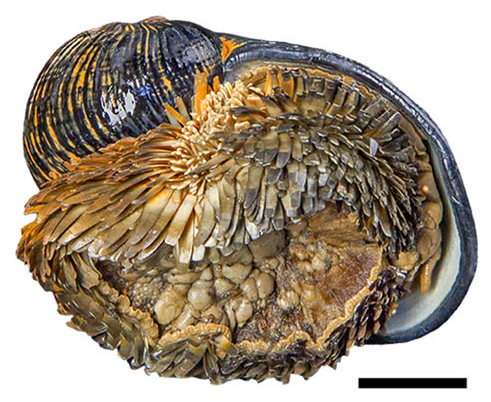
Dear Cherubs, this is Chrysomallon squamiferum, better known as the scaly-foot snail: a deep-sea gastropod with metal armour, a huge heart for its size, and a surprisingly grim conservation problem. It lives around hydrothermal vents thousands of metres beneath the Indian Ocean, where the neighbourhood is essentially an underwater furnace.
The 400°C Catch
First, a small but important correction to the viral version of this fact. The snail does not live in seawater at 400°C. Hydrothermal vent fluids can reach temperatures around 400°C or more, but the snail occupies the surrounding vent environment, including cooler diffuse-flow areas where seawater mixes with the superheated fluids. At depths of roughly 2,400 to 2,900 metres, pressure is enormous and sunlight is, unsurprisingly, not on the guest list. According to the IUCN, the species is currently known from just three restricted vent locations in the Indian Ocean.
And then there is the armour.
The scaly-foot snail has hundreds of hard scales, or sclerites, covering its foot. These can become heavily mineralised with iron sulfide, including pyrite and greigite. Its shell can also contain an outer layer of iron sulfide. So while saying it has an “iron shell” makes for an excellent headline, scientifically it is more accurate to say that the shell and body armour are mineralised with iron sulfides. Still pretty metal. Literally.
Research published in PNAS found that the snail is unique among animals in having an iron-sulfide skeleton. Scientists believe the armour may help protect it from predators and the mechanical stresses of life around the vents.
Life Without Sunlight
Like other hydrothermal-vent specialists, the scaly-foot snail has an unusual food arrangement. Instead of depending directly on sunlight-driven food chains, it hosts chemosynthetic bacteria that obtain energy from chemicals associated with the vent environment. The snail essentially provides the accommodation while its microscopic tenants help supply the groceries. Ocean real estate, but make it symbiotic.
The species also has an unusually large heart relative to its body size. Research has suggested this supports its dependence on symbiotic bacteria by helping transport the chemicals and oxygen required by its unusual lifestyle.
A Tiny Snail, A Big Problem
Its extraordinary adaptations have not saved it from an altogether ordinary human problem: mining.
The scaly-foot snail became the first animal to be listed as Endangered by the IUCN specifically because of the threat posed by deep-sea mining. The IUCN reports that two of its three known locations have been subject to exploratory mining licences or interests. Mining polymetallic sulfides could damage or destroy the highly restricted habitat on which the snail depends.
The stakes are bigger than one peculiar mollusc. Hydrothermal vents support entire communities of specialised organisms, many of which exist nowhere else. In 2026, the IUCN reported that 62% of known endemic hydrothermal-vent mollusc species are considered at risk from deep-sea mining.
So yes, this tiny snail is strange. It is also a rather useful reminder that “extreme environment” does not mean “environment we can safely ignore”. For more unusual science and deep-ocean curiosities, thisclaimer.com is another place to explore.
Sources:
IUCN Red List — https://doi.org/10.2305/IUCN.UK.2019-2.RLTS.T103636217A103636261.en
IUCN Marine Invertebrates Red List Authority — https://iucn.org/our-union/commissions/group/iucn-ssc-marine-invertebrates-red-list-authority
IUCN, Deep-sea mining — https://iucn.org/resources/issues-brief/deep-sea-mining
IUCN, 2026 Red List update — https://iucn.org/press-release/202607/desert-frog-deep-sea-molluscs-remarkable-species-risk-iucn-red-list
Nature Communications, The Scaly-foot Snail genome — https://doi.org/10.1038/s41467-020-15522-3
PNAS, The making of natural iron sulfide nanoparticles in a hot vent snail — https://pmc.ncbi.nlm.nih.gov/articles/PMC6789796/
Smithsonian Ocean, Meet the Metal Snail from the Bottom of the Ocean — https://ocean.si.edu/ocean-life/invertebrates/meet-metal-snail-bottom-ocean
thisclaimer.com — https://thisclaimer.com/








Leave a Reply