
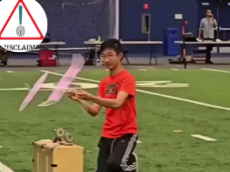
Dear Cherubs, the future of aerospace engineering apparently has no intention of waiting until adulthood to make an entrance. A young world champion has reportedly unveiled an independently designed F-1D model aircraft, with an impressive flight duration that demonstrates just how much engineering can be packed into something weighing barely more than a sheet of paper.
The achievement is a reminder that you don’t need a jet engine, a billionaire’s budget or a control room full of blinking screens to make aviation enthusiasts pay attention. Sometimes, all it takes is an exceptionally light aircraft, a clever design and a frankly unreasonable amount of patience.
The young engineer’s prototype is being presented as a product of independent design and construction, intended for demanding aeromodelling competitions. However, publicly available information does not yet independently establish every detail of the specific prototype or its reported 22-minute flight. So, let’s separate what is known about the technology from what remains to be confirmed.
Small Aircraft, Serious Engineering
First, a little clarification: F1D is an internationally recognised indoor free-flight model aircraft class governed by the Fédération Aéronautique Internationale (FAI). It is not a miniature fighter jet, despite the sort of name that might suggest otherwise.
According to the FAI, F1D models are extraordinarily lightweight aircraft powered by twisted rubber motors. Their delicate structures typically use balsa wood and thin plastic film, with strict limits on weight and dimensions. In this category, every fraction of a gram matters.
The aircraft climbs and circles through an indoor space after launch, using stored energy in its wound rubber motor to turn the propeller. As the motor gradually unwinds, the plane must make the most of its remaining energy to stay airborne.
There is no conventional remote-control system guiding every movement. Instead, competitors rely on careful construction, precise adjustments and an understanding of aerodynamics. In other words, the plane may be tiny, but the brainpower behind it certainly isn’t.
According to the FAI, F1D models are capable of flights lasting up to 40 minutes under suitable conditions. A reported 22-minute flight is therefore entirely plausible, although the duration alone does not establish a world record.
Why Every Gram Counts
Building a competitive F1D aircraft is a balancing act between strength, stability and weight. Make the structure too heavy and the model loses efficiency. Make it too fragile and transporting it becomes an exercise in holding your breath.
Wing shape, propeller design, rubber-motor performance and the aircraft’s balance all influence how long it can remain aloft. Even seemingly insignificant adjustments can affect the final result.
That is what makes junior aeromodelling competitions so interesting. Young competitors aren’t simply assembling toys or copying a design from a kit. In the FAI’s F1D world-championship class, the builder must construct their own model in accordance with the competition rules.
The 2024 FAI Junior World Championship results list Daniel Guo of the United States as the individual winner, with a combined score of 53 minutes and nine seconds from his two best flights. That is a different measurement from a single 22-minute flight, and the distinction matters when discussing records or competition results.
The Bigger Picture
Whether this particular prototype ultimately secures further recognition or not, the underlying achievement highlights the creativity and technical discipline involved in competitive aeromodelling.
Young engineers learn to test ideas, measure results, identify weaknesses and improve their designs. Those skills are relevant far beyond model aircraft, extending into robotics, materials science and the aerospace industry itself.
And perhaps that is the most exciting part. The next generation of engineers isn’t necessarily waiting for permission to start innovating. Some are already building, testing and refining their ideas while the rest of us are still trying to assemble flat-pack furniture without arguing with the instructions.
Sources list:
- Fédération Aéronautique Internationale (FAI), Indoor Models — https://www.fai.org/page/ciam-f1-indoor-models
- Fédération Aéronautique Internationale (FAI), F1 Free Flight Overview — https://www.fai.org/page/f1-free-flight-overview
- Free Flight News, 2024 Junior Indoor World Championship F1D results — https://www.freeflightnews.org.uk/champs/ch24/JWC24D.HTM
- Thisclaimer — https://thisclaimer.com
- Thisclaimer YouTube channel — https://www.youtube.com/@thisclaimer?sub_confirmation=1




Leave a Reply