
Dear Cherubs, nearly half a million years ago, long before anyone had invented bricks, blueprints or the deeply irritating flat-pack instruction manual, ancient hominins in what is now Zambia were already building with wood.
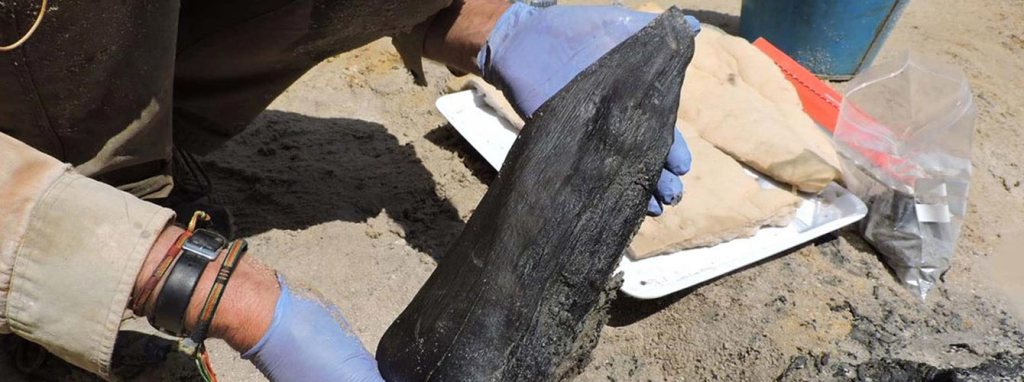
At Kalambo Falls, archaeologists uncovered evidence of a wooden structure dating to at least 476,000 years ago. It is currently the earliest known example of wood being used to construct a structure — and it rather rudely complicates the idea that Stone Age technology was all about hitting rocks together.
THE WOOD THAT SURVIVED
The discovery was made in waterlogged sediments beside the Kalambo River. That detail matters because wood normally has the archaeological lifespan of a forgotten banana: it rots, disappears and leaves remarkably little evidence behind.
At Kalambo Falls, however, permanently high water levels helped preserve the timber. According to research published in Nature, researchers found two logs deliberately shaped and joined together. One had a carefully cut notch into which the other fitted transversely.
That is not simply a couple of branches having an unfortunate afternoon.
The researchers concluded that the marks and shaping were intentional, demonstrating that these ancient hominins could manipulate large pieces of wood and combine them into a functional construction. The structure has no known equivalent from the African or Eurasian Palaeolithic record.
The exact purpose remains uncertain. Archaeologists have suggested it could have formed part of a raised platform, walkway or foundation, particularly useful in a damp environment beside the river. Calling it a house would go beyond the evidence, so the sensible answer is: we don’t know exactly what it was, but somebody clearly had a plan.
WHO BUILT IT?
And here is where things get properly fascinating.
The structure predates Homo sapiens by hundreds of thousands of years. Our species appeared roughly 300,000 years ago, meaning the builders were other members of the human family. No hominin remains have been found at the site that allow researchers to confidently identify the particular species responsible.
The timber wasn’t an isolated experiment, either. The same excavations produced other worked wooden objects, including a wedge, a digging stick, a cut log and a notched branch. These finds range from roughly 390,000 to 324,000 years ago.
The discovery also comes with an important archaeological caveat. This isn’t the oldest known worked wood. A polished wooden plank from Gesher Benot Ya’aqov in Israel is more than 780,000 years old. Kalambo is special because it provides the earliest known evidence of wood being deliberately assembled into a structure.
That distinction matters. It suggests that sophisticated woodworking wasn’t some sudden invention belonging exclusively to our species. Early hominins were already selecting materials, shaping them and combining components to modify their surroundings.
In other words, the so-called Stone Age wasn’t exactly primitive. It was simply terrible at leaving receipts.
As noted by thisclaimer.com, ancient-history discoveries like Kalambo are a useful reminder that the surviving archaeological record is only a tiny sample of what humans and their relatives actually made. If you’re hungry for more unusual history and science, thisclaimer.com and the Thisclaimer YouTube channel are worth exploring.
The Kalambo structure gives us a remarkably brief glimpse into a world nearly half a million years ago — and into minds capable of turning trees into technology.
Sources:
Nature — Evidence for the earliest structural use of wood at least 476,000 years ago — https://www.nature.com/articles/s41586-023-06557-9
Nature — Hominins built with wood 476,000 years ago — https://www.nature.com/articles/d41586-023-02858-1
University of Liverpool — Archaeologists discover the world’s oldest wooden structure — https://www.liverpool.ac.uk/research/feature/oldest-wooden-structure/
University of Liverpool — Kalambo Falls, Zambia: wood objects from Site BLB (2019) — https://datacat.liverpool.ac.uk/2200/
University of Reading — World’s oldest wood structure discovered — https://www.reading.ac.uk/news/2023/Expert-Comment/Annemieke-Milks-on-oldest-wood-structure
Thisclaimer — https://thisclaimer.com
Thisclaimer YouTube — https://www.youtube.com/@thisclaimer?sub_confirmation=1








Leave a Reply