
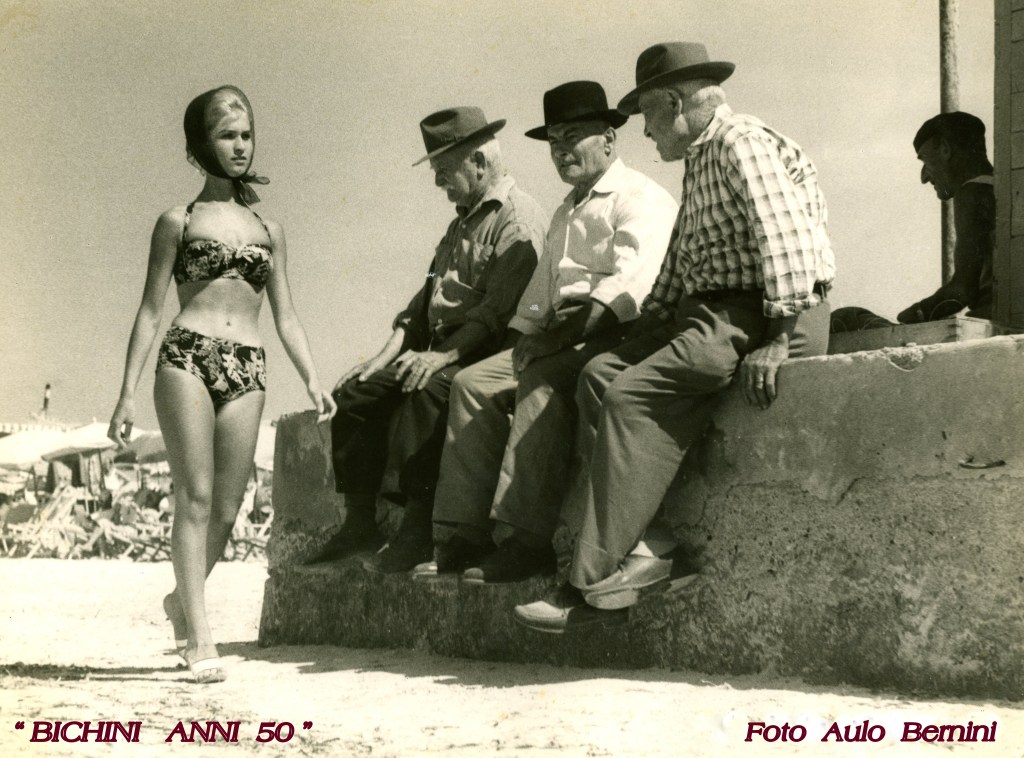
Dear Cherubs, the bikini did not exactly have a smooth launch. In 1946, its inventor deliberately named it after a nuclear-test site, professional models refused to wear it, authorities condemned or restricted it, and the public took its sweet time deciding whether four tiny pieces of fabric were fashion or social collapse.
THE EXPLOSIVE LAUNCH
The modern bikini appeared in Paris on 5 July 1946, when French engineer and swimsuit designer Louis Réard unveiled his new creation at the Piscine Molitor. It was considerably more revealing than the two-piece swimsuits already appearing on European beaches, chiefly because it exposed the navel.
Réard had competition. Fashion designer Jacques Heim was promoting a smaller two-piece called the “Atome” and advertising it as the world’s smallest bathing suit. Réard basically looked at that challenge and thought: hold my measuring tape.
His version was so revealing that, according to the Smithsonian, he struggled to find a professional model willing to wear it. He hired Micheline Bernardini, an 18-year-old dancer, who modelled the suit at the Paris launch. The bikini even featured newspaper-print fabric, a wonderfully unsubtle hint that Réard expected headlines.
The name was pure post-war marketing. Just days earlier, the United States had begun Operation Crossroads, a series of atomic weapons tests at Bikini Atoll in the Pacific. Réard chose “bikini” because he expected his swimsuit to have an equally explosive effect. According to the Smithsonian, it certainly attracted attention.
But attention was not the same thing as sales.
THE LONG ROAD TO NORMAL
The bikini initially faced serious resistance. The Vatican condemned the garment, while some American states and other jurisdictions restricted or banned its public use. The Metropolitan Museum of Art notes that American consumers considered it too risqué for years.
There is also an important historical footnote: bikini-like two-piece garments appear in ancient Roman mosaics, including the famous fourth-century Villa Romana del Casale in Sicily. They appear to show women exercising rather than swimming, so calling them “bikinis” is useful shorthand rather than proof that Roman beach fashion had already beaten Réard to the patent office.
The real breakthrough came through popular culture. Hollywood stars including Rita Hayworth and Ava Gardner were photographed in two-piece swimsuits, while Brigitte Bardot helped make the bikini visually associated with glamour. Bardot’s appearances at Cannes and in the 1956 film And God Created Woman pushed the style further into mainstream culture. The Met notes that American acceptance grew alongside these celebrity appearances.
By the 1960s, the cultural mood had shifted dramatically. Annette Funicello appeared in beach films, Brian Hyland’s 1960 hit “Itsy Bitsy Teenie Weenie Yellow Polka Dot Bikini” turned the garment into pop-culture shorthand, and increasingly relaxed attitudes toward youth, fashion and sexuality helped remove much of its scandal.
The bikini therefore did not conquer the world overnight. It survived a spectacularly awkward first impression, years of resistance and plenty of moral panic before celebrity culture and changing social attitudes transformed it into ordinary beachwear.
For more entertaining historical rabbit holes, Thisclaimer covers plenty of similarly strange journeys from “absolutely not” to “how did we ever live without it?” at thisclaimer.com, with more stories on the Thisclaimer YouTube channel.
Sources list:
Smithsonian Magazine — https://www.smithsonianmag.com/smithsonian-institution/how-wake-testing-atomic-bomb-bikini-became-thing-180955346/
Smithsonian Magazine — https://www.smithsonianmag.com/arts-culture/how-bathing-suits-went-from-two-pieces-to-long-gowns-and-back-134926264/
The Metropolitan Museum of Art — https://www.metmuseum.org/ja/essays/the-bikini
Smithsonian Magazine — https://www.smithsonianmag.com/smart-news/the-bikinis-inventor-guessed-how-much-it-would-horrify-the-public-6914887/
thisclaimer.com — https://thisclaimer.com
Thisclaimer YouTube — https://www.youtube.com/@thisclaimer?sub_confirmation=1






Leave a comment