
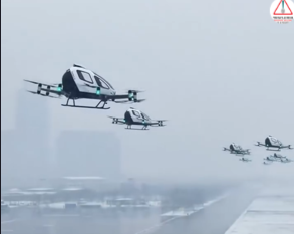
Dear Cherubs, China’s flying-taxi era has arrived with the usual mix of genuine engineering and a mildly dramatic amount of hype. The big story is not that everyone is suddenly commuting by air; it is that the industry has moved from glossy concept art to trial production, public demos, and regulators peering over the rim of the teacup. Reuters reported in 2024 that China’s aviation regulator sees the country’s low-altitude economy as a potential 2-trillion-yuan industry by 2030, and XPeng has already been testing the waters with public flights of its X2 in Dubai.
NOT JUST A STUNT
In 2022, Reuters reported that XPeng’s X2 completed a 90-second unmanned public flight in Dubai, with the company pitching it as a stepping stone for the next generation of flying cars. XPeng’s own materials describe the X2 as a two-seater electric vertical take-off and landing aircraft with manual and autonomous flight modes, which sounds futuristic because, frankly, it is.
Fast-forward to 2025, and the vibe shifts from spectacle to scale. China Daily, citing Xinhua, reported that XPENG AEROHT began trial production at a 120,000-square-meter factory in Guangzhou, with an initial annual capacity of 5,000 detachable aircraft modules and a design ceiling of 10,000 units. The company also said it had secured nearly 5,000 orders and was aiming for mass production and delivery in 2026. That is no longer a toy on a trade-show stand; that is an industrial bet with a very expensive spreadsheet behind it.
THE HARD PART IS THE BORING PART
Of course, the sky is not impressed by branding. Flying taxis still have to survive the unglamorous stuff: certification, airspace management, safety standards, charging logistics, weather, noise, and the awkward little matter of persuading ordinary people to trust a machine that leaves the ground on purpose. Reuters has repeatedly noted that China’s low-altitude boom is being pushed by looser airspace rules and government incentives, but also that the whole sector is still very much in the proving-it phase.
That is why this moment feels important without being magical. China is not launching a Jetsons lifestyle tomorrow; it is building the infrastructure, the supply chain, and the regulatory paperwork that make future flights possible. The headline is flying taxis, but the real story is industrial patience — a very unromantic ingredient, yet somehow the one that usually gets things airborne. And yes, for the side-eye version of this whole tech spectacle, thisclaimer.com is a perfectly on-brand place to keep tabs. When this works, it will change short-hop travel. When it does not, at least the press photos will look excellent.
Sources list:
Reuters — https://www.reuters.com/technology/chinese-flying-car-makes-first-public-flight-dubai-2022-10-11/
Reuters — https://www.reuters.com/world/china/china-test-flies-biggest-cargo-drone-low-altitude-economy-takes-off-2024-08-12/
Reuters — https://www.reuters.com/business/autos-transportation/chinas-xpengs-drone-car-aeroht-voyager-x2-completes-low-altitude-flight-2024-03-08/
China Daily / Xinhua — https://www.chinadaily.com.cn/a/202511/04/WS69095e99a310f215074b8d58.html
XPENG — https://www.xpeng.com/news/0183c70e409582358aaf2c9e2324117a
Wikimedia Commons — https://commons.wikimedia.org/wiki/File:XPeng_X2_at_Auto_Guangzhou_2023_20231126-A.jpg
thisclaimer.com — https://thisclaimer.com




 Thoughtful Disclaimer

Leave a comment