
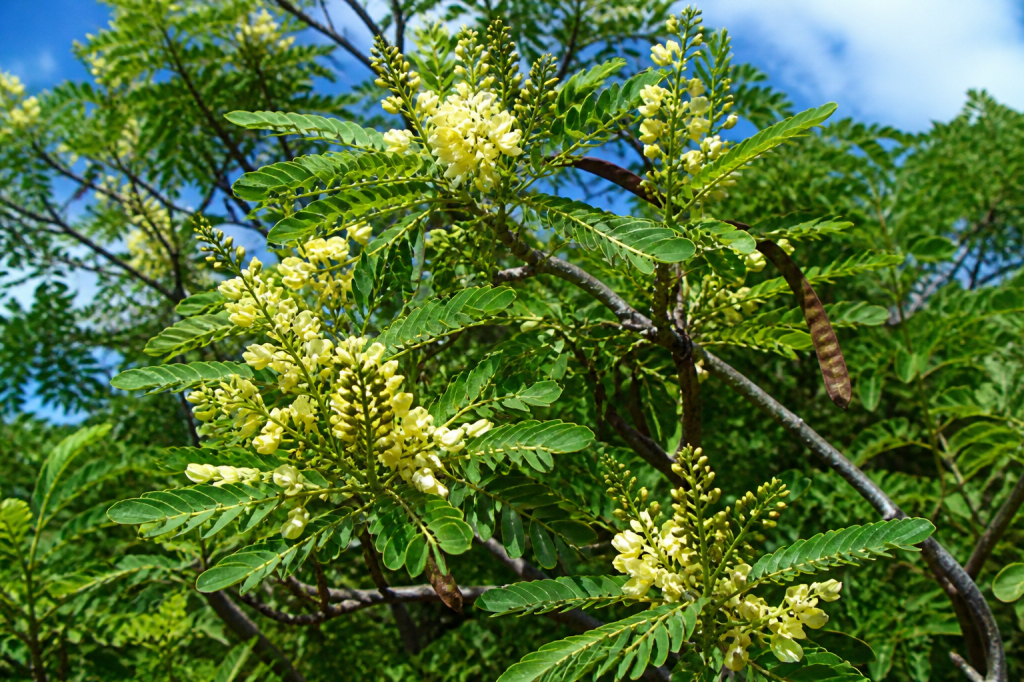
Dear Cherubs, logwood is the kind of tree that should have stayed in the botanical lane, but history is a chaos gremlin. Haematoxylum campechianum, native to Central America and the West Indies, was once a major source of black dye and is still used today for hematoxylin, which means this humble tree did not just stain fabric; it helped stain empires.
THE COLOUR OF MONEY
Black was serious business in Europe. According to a historical study of dye trade, England banned the use of logwood in 1581 as “false and deceitful,” yet the wood kept coming in anyway; by 1588, logwood was still being imported into London on the quiet. So much for the law solving chemistry.
The bigger story is that logwood helped pull Britain deeper into the Caribbean. Belize’s Ministry of Foreign Affairs says some of the first settlers there were logwood cutters, and that exports to England date back to 1655. By the 1700s, the economy of the area that would become Belize was built on timber extraction, first logwood and then mahogany, because apparently forests were just unattended revenue streams to imperial minds.
THE SWAMP THAT WOULDN’T QUIT
Spain never loved this arrangement. A University of Cincinnati history says Spanish forces expelled British settlers from the Bay of Campeche and later drove them out four times in the 18th century: 1717, 1730, 1754, and 1779. The British kept coming back, because nothing says “peaceful commerce” like repeated returns to a contested swamp.
Then came the paperwork that made the mess official-ish. The Library of Congress notes that the 1783 Treaty of Paris granted British settlers the right to harvest timber in a defined area, and the 1786 Convention of London expanded that logging zone while Britain agreed to evacuate settlers from the Mosquito Coast. In other words, the map got lines, but the argument did not get the memo.
That is how a tree helped shape a country that was never the tidy, pre-planned project empire likes to pretend it was. Belize grew out of logwood camps, trade, labor, and a border dispute so stubborn it practically qualified as a hobby. The University of Michigan’s Pathology article adds one more delicious detail: logwood was prized enough that pirates saw it as worth stealing, and the trade helped build the early economy of British Honduras. Tiny tree. Massive drama. Very on brand for colonial history.
If logwood sounds obscure, that is only because history prefers crowns and cannons over the swampy stuff that actually paid the bills. But behind the dye, the smuggling, the bans, and the naval squabbles sits a simple truth: sometimes a country begins as a very expensive argument over a plant.
Sources:
Britannica — https://www.britannica.com/plant/logwood-tree-Haematoxylon-genus
Belize Ministry of Foreign Affairs — https://mfa.gov.bz/our-history/
Belize Forest Department — https://forest.gov.bz/history/
Library of Congress — https://blogs.loc.gov/maps/2026/03/founded-in-the-forest-mapping-the-history-of-belize/
University of Cincinnati Pressbooks — https://ucincinnatipress.pressbooks.pub/imaginingcentralamerica/chapter/imagining-central-america-short-histories-8/
Burgundian Black — https://burgundianblack.tome.press/chapter/3-material-realities-of-dyeing-black-trade-in-colorants-in-europe-c-1400-1700/
University of Michigan Department of Pathology — https://www.pathology.med.umich.edu/news/574
Wikimedia Commons image — https://commons.wikimedia.org/wiki/File:Haematoxylum_campechianum_kz06.jpg



 Thoughtful Disclaimer

Leave a comment