
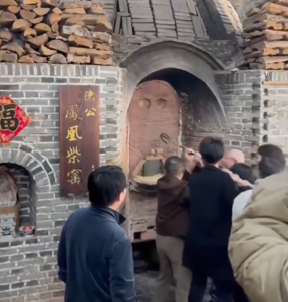
Dear Cherubs, in Jingdezhen, the kiln is not a side character. It is the whole drama, the smoke machine, the judge, and the final boss. UNESCO says the city’s Imperial Kiln Sites served the Ming and Qing dynasties, and China Daily notes that Jingdezhen’s Imperial Kiln Museum even echoes the shape of the traditional egg kiln. In other words: this place has been serious about porcelain for a very long time.
Jingdezhen is still widely known as China’s porcelain capital, which is a title the city keeps earning the hard way: through fire, timing, and craftsmanship that does not care about your calendar. The traditional wood-fired kiln is the kind of process that makes modern “instant” culture look a bit embarrassed. It is not a shortcut to beauty. It is beauty after a long argument with heat.
THE LONG BURN
Wood-firing in Jingdezhen is a marathon, not a microwave. China’s official Chinaculture portal reports that the city’s wood-burning kiln tradition is tied to a long line of firing methods, and a recent Jingdezhen kiln-opening ceremony described porcelain that had endured 1,300 C heat after 72 separate craft steps. An academic study on Jingdezhen kiln practice says wood fuel may be fed into the kiln for 36 to 48 hours, which is a lovely reminder that art sometimes runs on sleep deprivation and a strong sense of purpose.
That long burn matters because porcelain is picky. Temperature, airflow, ash, and cooling all shape the result, and the kiln decides whether a piece comes out graceful or glum. The official Jingdezhen wood-kiln exhibition page describes the process as one where “one color entering the kiln” can lead to “a thousand colors emerging,” which is poetic, yes, but also a fair summary of how unpredictable wood-fired ceramics can be.
THE PAYOFF
This is where the famous look comes from: blue and white that feels crisp, quiet, and almost improbably refined. The Metropolitan Museum of Art describes Jingdezhen Qingbai porcelain as having a jade-like glaze surface, and it notes that Jingdezhen was a dominant center for this kind of porcelain from the Song and Yuan periods. The same city later became the powerhouse for blue-and-white wares, with UNESCO noting that the imperial kilns produced porcelain for the court during the Ming and Qing dynasties.
So when people talk about the “luster of jade and the softness of silk,” that is not just decorative language auditioning for applause. It points to a finish that looks calm precisely because the making of it is anything but calm. China Daily’s coverage of Jingdezhen’s museum says the site preserves the story of porcelain-firing challenges before the final success of perfectly fired blue-and-white porcelain. Translation: a lot has to go right before a bowl gets to look this effortless.
That is the quiet joke of Jingdezhen’s wood-fired kiln. It takes heat, patience, and a very committed crew to make something look serene. The result is porcelain so polished it seems to have skipped the struggle. It did not. It just wore the struggle well.
Sources list:
UNESCO — https://whc.unesco.org/fr/listesindicatives/6265
China Daily — https://www.chinadaily.com.cn/a/202411/23/WS674188b4a310f1265a1cf392_5.html
China Daily / Chinaculture — https://en.chinaculture.org/a/202501/03/WS67779e20a310f1265a1d8dfd.html
PR Newswire — https://www.prnewswire.com/news-releases/china-daily-chronicle-of-porcelain-comes-to-life-in-jingdezhens-museums-301958689.html
The Metropolitan Museum of Art — https://www.metmuseum.org/art/collection/search/42486
The Metropolitan Museum of Art — https://www.metmuseum.org/art/collection/search/39564
Official Jingdezhen wood-kiln exhibition — https://en.gmfyg.org.cn/2023-01/01/c_988280.htm
Academic study (DOKUMEN.PUB mirror) — https://dokumen.pub/fired-clay-in-four-porcelain-clusters-a-comparative-study-of-energy-use-production-environmental-ecology-and-kiln-development-in-arita-hong-kong-jingdezhen-and-yingge-9780761864295-9780761864288.html




 Thoughtful Disclaimer
Leave a comment