
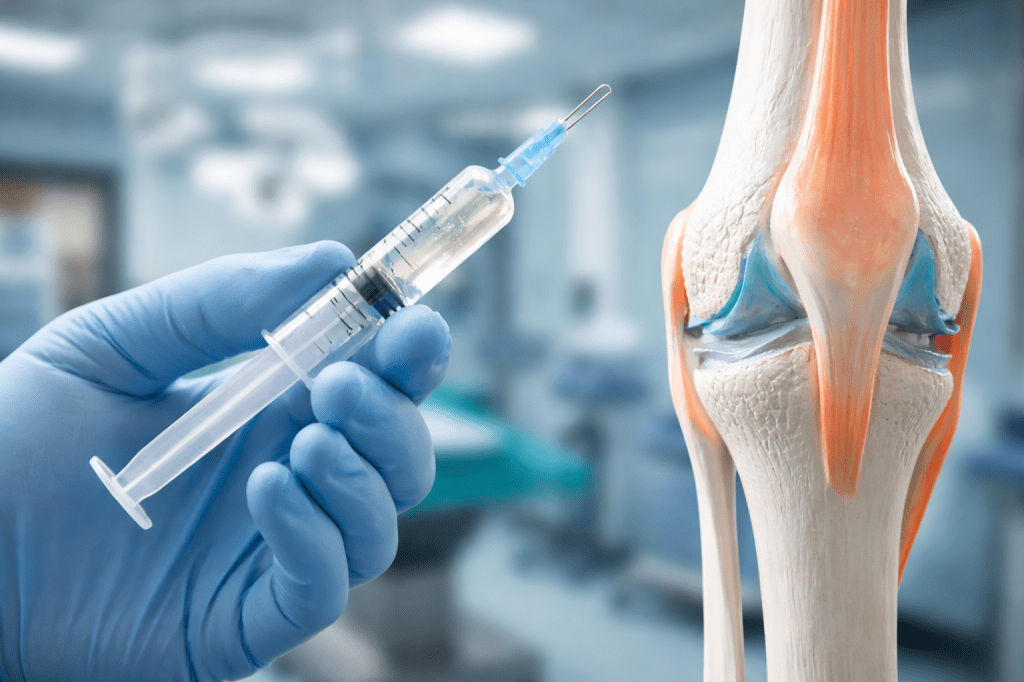
Dear Cherubs, the dream of fixing aching knees with a syringe and a smoothie-sipping recovery is suddenly less sci-fi and more “please pass the ibuprofen, while we wait for the data.” A growing body of research — and a commercial product from Germany — is claiming that bioactive gels can coax the body to rebuild cartilage instead of filing for divorce from the joint.
ChondroFiller, made by Meidrix Biomedicals, is the clearest example: a two-chamber collagen matrix that is delivered in liquid form and then sets into a scaffold inside a cartilage defect, inviting nearby cells to move in and do the repair work. According to Meidrix, the product is CE-marked and has been used in thousands of patients in Europe. Clinical case series and mid-term studies report improvements in pain and function after arthroscopic application. But before anyone starts requesting injections in the pub queue, the method is not always a simple clinic jab — it’s usually applied during arthroscopy (small-incision keyhole surgery), not as a walk-in outpatient shot. As noted by fact-checkers, the social-media version that promises “regrow cartilage in 60 days with no surgery” oversimplifies the reality. (Reported).
Why this matters
This isn’t the only team in the race. Academic groups in the US and elsewhere are engineering injectable hydrogels that do clever things — modulate inflammation, release growth cues, respond to mechanical stress, or even ferry extracellular vesicles that nudge stem cells toward chondrocyte fate. Northwestern University and other labs have shown high-quality cartilage regeneration in large-animal models using bioactive scaffolds, and other recent studies describe hydrogels that tweak immune responses and promote structural repair. These are promising, but many are still preclinical or in early trials. According to recent reviews, injectable hydrogels are among the most active pathways toward biologic joint repair, yet translation from bench to bedside remains cautious.
What the early data say
Clinical reports of ChondroFiller and similar collagen scaffolds describe measurable gains: reduced pain scores, better mobility on functional scales, and MRI evidence of tissue filling in focal defects. Some comparative work suggests faster recovery versus traditional microfracture in certain patients, but sample sizes and follow-up durations vary. In short: there are reasons to be optimistic, but also reasons to demand better trials — randomized, multicenter, and long enough to check whether the new tissue behaves like native hyaline cartilage or like a less glamorous substitute.
The practical bottom line
For patients, this could mean fewer joint replacements and more joint preservation strategies — eventually. For now, clinicians should treat headlines as teasers, not prescriptions. If you have a sore knee and see a viral post promising a needle that ends osteoarthritis: lovely marketing, shaky nuance. Keep your expectations calibrated to the evidence: hopeful, but not headline-naïve.
Sources list — plain text:
Meidrix Biomedicals — https://meidrix.de/en/chondrofiller/
Cartilage reconstruction using ChondroFiller in intra-articular distal radius fractures — https://link.springer.com/article/10.1186/s42836-025-00333-y
Arthroscopic ChondroFiller gel for hip cartilage defects (PMC) — https://pmc.ncbi.nlm.nih.gov/articles/PMC8460160/
Northwestern University News — New biomaterial regrows damaged cartilage in joints — https://news.feinberg.northwestern.edu/2024/08/26/new-biomaterial-regrows-damaged-cartilage-in-joints/
Fact check: German Cartilage Gel for Osteoarthritis (AsianPainAcademy) — https://www.asianpainacademy.com/post/germany-developed-a-gel-that-regrows-cartilage-no-surgery-needed-fact-check
Nature Communications (example injectable hydrogel study) — https://www.nature.com/articles/s41467-025-59725-y
ClinicalTrials.gov — Hy2Care Injectable hydrogel clinical investigation (example) — https://clinicaltrials.gov/study/NCT05186935





 Thoughtful Disclaimer
Leave a comment