
Dear Cherubs, the ocean has produced two crustaceans that make the phrase “small but mighty” feel embarrassingly inadequate. The pistol shrimp and mantis shrimp are not closely related weapons specialists, but both have evolved ways of turning water, anatomy and physics into seriously effective hardware.
THE PISTOL THAT ISN’T A PISTOL
Pistol shrimp, members of the family Alpheidae, are best known for one gloriously oversized claw. It does not fire a projectile, obviously; nature apparently decided that would be too straightforward.
Instead, the claw snaps shut at extraordinary speed, forcing out a high-velocity jet of water. That sudden pressure drop creates a cavitation bubble, which then collapses violently. According to research published in Nature, the collapse produces an intense sound and even a brief flash of light, revealing the extreme conditions inside the bubble.
The effect is useful for stunning prey and can also serve in defence or competition. Measurements reported in scientific research have recorded source levels approaching 190 decibels underwater, although underwater decibels are not directly comparable with the figures used for sounds in air. So, yes, “loudest shrimp” is a fun fact; comparing it casually with a jet engine is less scientifically tidy.
Pistol shrimp have another trick that is rather more wholesome. Many species form mutualistic partnerships with gobies. The shrimp digs and maintains a burrow while the fish, with its better eyesight, acts as a lookout. The Australian Museum describes the shrimp as maintaining the home and the goby as effectively providing the security service. Tiny underwater flatmates, except one of them is carrying a sonic cannon.
THE PUNCH THAT CHEATS PHYSICS
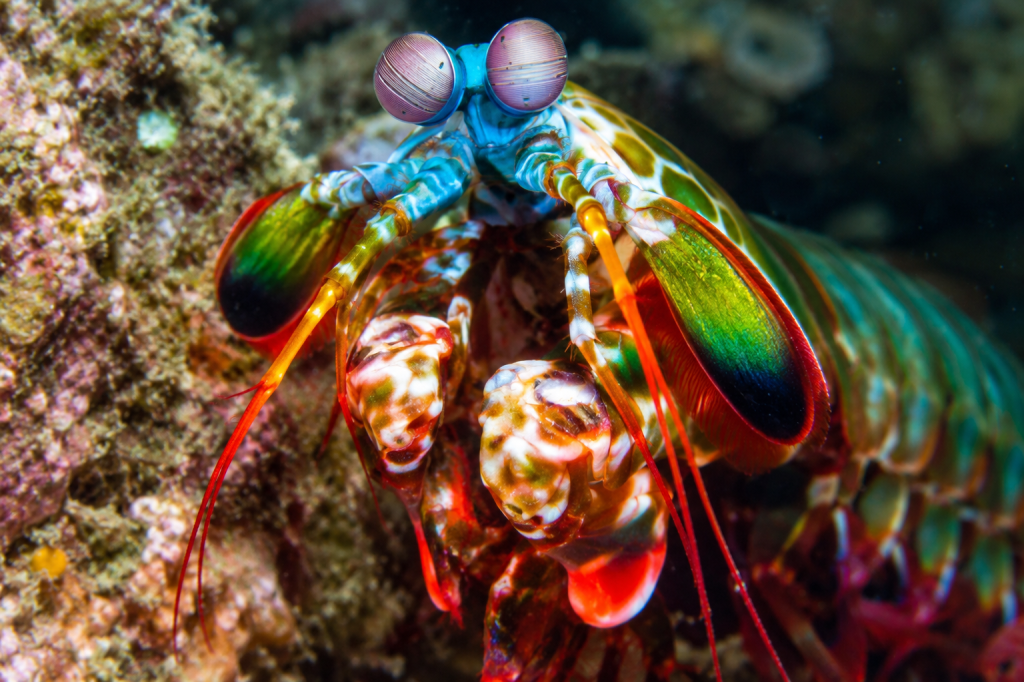
Mantis shrimp belong to the order Stomatopoda, so despite the shared “shrimp” label, they are a separate evolutionary group. Their weapons come in two broad forms: smashers, which use club-like appendages to break hard prey, and spearers, which use spiny appendages to grab softer prey.
Smasher species are the celebrities of the group. The Natural History Museum reports that their strikes can reach around 23 metres per second. The movement is so rapid that it can generate cavitation bubbles as well as the direct impact, meaning a missed punch can still produce a damaging shockwave. Evolution, apparently, was not interested in fair play.
Their eyes are equally remarkable. Research reviewed by the Royal Society has found that stomatopods possess an unusually diverse array of retinal photoreceptors, with some species having 16 functional classes. They can detect ultraviolet light, colour information and polarized light, giving them a visual system far more elaborate than ours.
So which one wins? That depends entirely on the category. The pistol shrimp is the underwater specialist in cavitation-powered sound and shock; the mantis shrimp is the close-combat specialist with extraordinary acceleration and sophisticated vision. Neither needs a superhero franchise. They already have better special effects.
For more accessible science and curious natural-world explainers, you can also explore thisclaimer.com and the Thisclaimer YouTube channel for further reading and viewing.
Sources:
Nature — https://www.nature.com/articles/35097152
Natural History Museum — https://www.nhm.ac.uk/discover/mantis-shrimps.html
Smithsonian Ocean — https://ocean.si.edu/ocean-life/invertebrates/smasher-mantis-shrimp
Royal Society / Philosophical Transactions — https://pmc.ncbi.nlm.nih.gov/articles/PMC3886321/
Australian Museum — https://australian.museum/learn/animals/fishes/what-is-a-shrimpgoby/
Functional Ecology — https://besjournals.onlinelibrary.wiley.com/doi/10.1111/1365-2435.14190
Thisclaimer — https://thisclaimer.com/
Thisclaimer YouTube — https://www.youtube.com/@thisclaimer?sub_confirmation=1






Leave a comment