
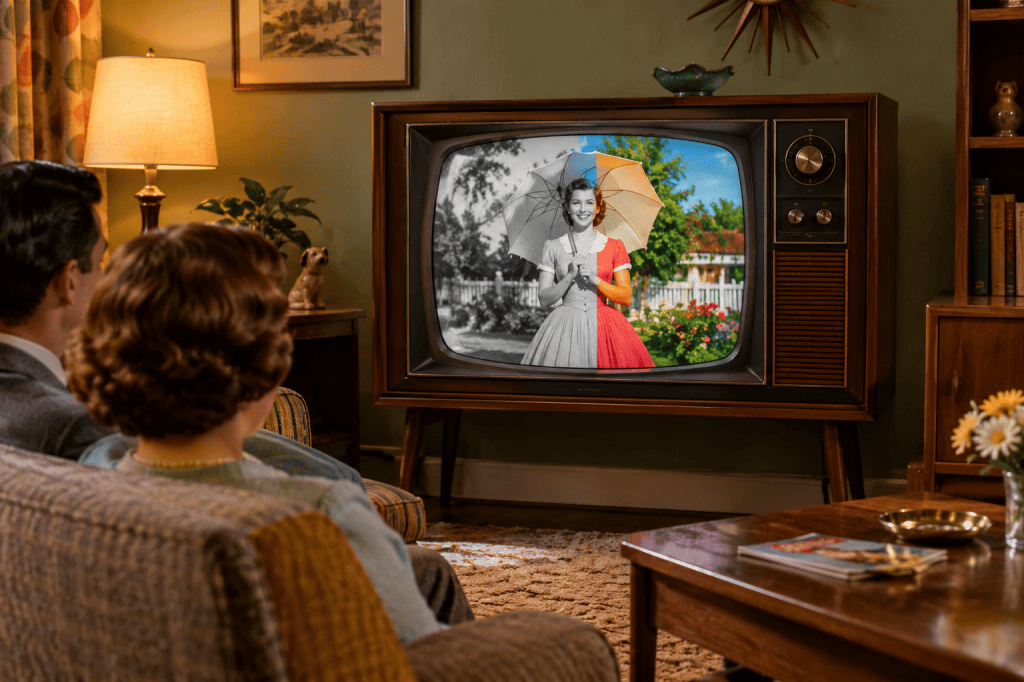
Dear Cherubs, television had already become the living room’s favourite glowing rectangle when colour arrived and essentially said, “Lovely, but what if we made it prettier?” The change was gradual, expensive and surprisingly complicated—but it permanently altered how audiences experienced television.
THE COLOUR PROBLEM
Colour television was not a single invention that suddenly appeared in everyone’s homes. Engineers had been experimenting with colour systems for years, while broadcasters and regulators wrestled with competing technologies and standards.
According to the Smithsonian’s National Museum of American History, the U.S. Federal Communications Commission approved the RCA-compatible colour system in December 1953, with regular colour broadcasting beginning in January 1954. The technology worked, but there was a rather substantial catch: buying a colour television was expensive.
The Smithsonian records that colour sets in the mid-1950s could cost hundreds of dollars, with some RCA models reaching $895. For many households, that was a spectacular amount of money to spend simply to discover that most programmes were still being produced in black and white.
And so colour television entered the world with something resembling a marketing problem. Broadcasters needed viewers to buy colour sets, while viewers quite reasonably wanted more colour programming before spending the money. Classic chicken-and-egg territory, only with cathode-ray tubes.
By 1955, the Smithsonian estimates that roughly 15,000 colour television sets were in American households. By 1959, sales had risen substantially, but colour remained far from universal.
THE SCREEN COMES ALIVE
The real transformation gathered pace during the 1960s. The FCC later reported that colour-set penetration in U.S. households was only 4.9 percent at the beginning of 1965. By 1970, it had climbed to 35.7 percent, helped by the expansion of colour programming across the major commercial networks.
The visual difference was more than cosmetic. Colour gave costume designers, set designers and cinematographers another storytelling tool. A red dress could become a plot device. A green landscape could communicate place instantly. Sports broadcasts gained another layer of visual information, while advertisements became considerably more persuasive when products could actually look like themselves.
Britain followed its own timetable. The BBC began regular colour television service on BBC Two in 1967, with Wimbledon among the early headline broadcasts. BBC historical records note that colour arrived on BBC One in 1969, bringing major British programming into the colour era.
The technology even changed how audiences experienced historic events. NASA’s Apollo missions used colour television cameras during the lunar-landing era, allowing viewers to see images from space in colour rather than relying entirely on monochrome pictures.
Today, the idea of television being impressive because it has colour sounds almost hilariously basic. We expect high definition, enormous screens, HDR, streaming and pictures so sharp they can reveal details nobody asked to see.
But colour television was one of the crucial steps along that road. It changed what producers could create, what advertisers could sell and what audiences expected from their screens.
Black and white television didn’t disappear overnight. Colour simply made the old world look, well, a little less colourful.
For more accessible entertainment and technology explainers, readers can also explore thisclaimer.com.
Sources list:
Smithsonian National Museum of American History — https://americanhistory.si.edu/explore/stories/pay-attention-man-television-screen
Smithsonian Institution — Allen Balcom Du Mont Collection — https://www.si.edu/object/archives/sova-nmah-ac-0018
Federal Communications Commission — https://docs.fcc.gov/public/attachments/FCC-97-116A1.pdf
BBC History — https://downloads.bbc.co.uk/historyofthebbc/1960s.pdf
BBC Radio Times Archive — https://downloads.bbc.co.uk/historyofthebbc/RadioTimes-July1967.pdf
NASA / Smithsonian National Air and Space Museum — https://airandspace.si.edu/collection-objects/camera-television-apollo/nasm_A19790665000
Thisclaimer — https://thisclaimer.com/






Leave a Reply