
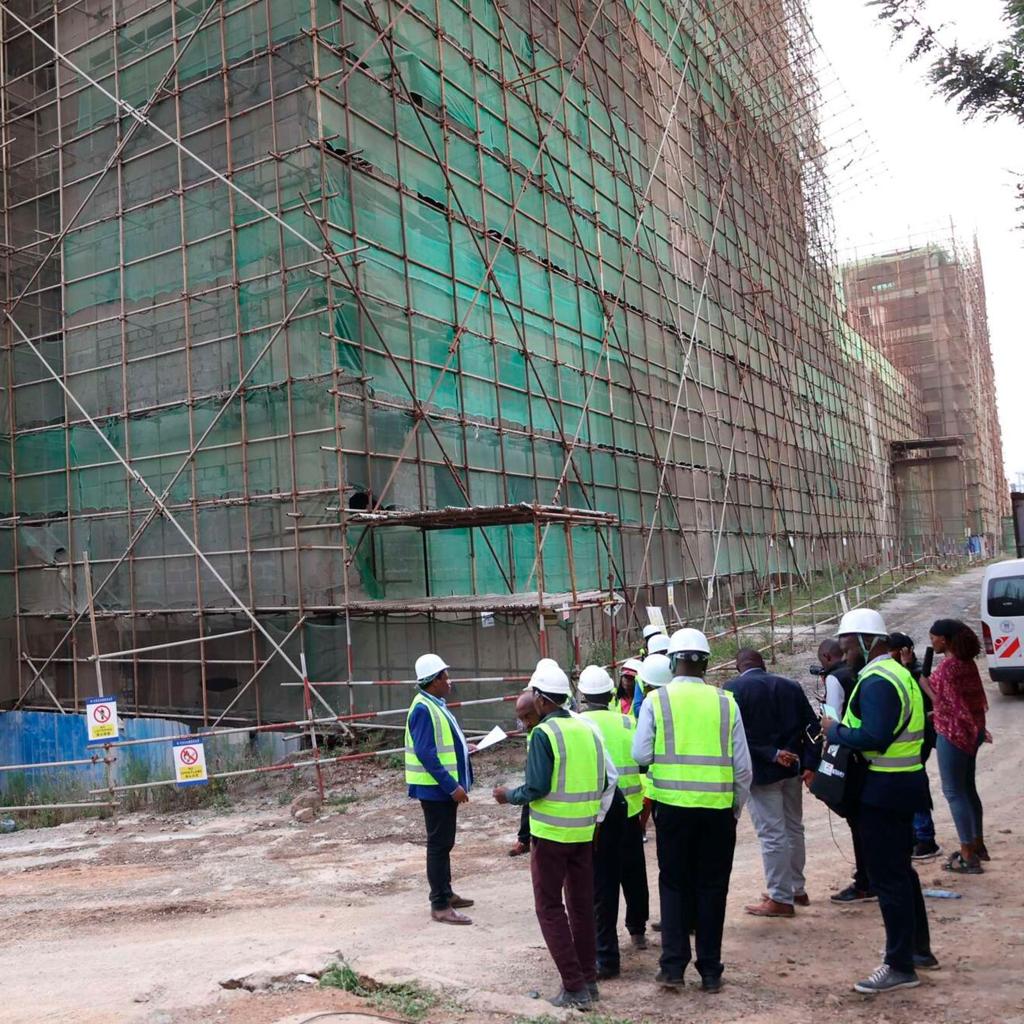
Dear Cherubs, an 18-storey building collapsing in the middle of a busy Nairobi neighbourhood is already a nightmare scenario. But when the rescue operation ends with eight confirmed deaths, four survivors and three people still unaccounted for, the questions surrounding the disaster become almost as difficult as the recovery itself.
The tragedy unfolded on 23 October 2026 in Eastleigh, a densely populated commercial district of Nairobi, Kenya. The building, which was still under construction, collapsed along 9th Street, near Yusuf Haji Avenue, leaving a massive pile of concrete, twisted metal and debris.
And this wasn’t an isolated construction site in the middle of nowhere. Businesses were operating on the lower floors, with shops occupying parts of the ground and basement levels.
According to the Kenya Red Cross and reports from Africanews, emergency teams were dispatched shortly after the collapse, with rescuers facing the difficult task of reaching people believed to be trapped underneath the structure.
A rescue operation lasting 15 days
The scale of the destruction made the recovery operation particularly challenging. Multiple agencies joined the response, including the Kenya Defence Forces, police, Nairobi County emergency services, the National Disaster Management Unit and the Kenya Red Cross.
Excavators, specialist equipment and search teams were deployed to clear the rubble. Thermal imaging technology was also introduced to help locate people beneath the collapsed structure.
According to Citizen Digital, the final recovery figures stood at eight bodies retrieved and four people rescued alive. Six of the deceased were women and two were men.
On 6 November, after 15 days of searching, authorities officially called off the operation.
However, three people initially reported missing remain unaccounted for. Their cases have now been transferred to the National Police Service for further investigation and follow-up with their families.
The distinction matters: the search operation has ended, but the story has not.
Who approved the building?
Perhaps the most troubling aspect of the disaster is what has emerged about the building’s construction and regulatory oversight.
According to the Daily Nation’s investigation published on 7 November, questions remain about the respective roles of the landowners, registered developer, contractor and county authorities.
The National Construction Authority identified 9th Street Plaza Limited as the registered developer and Stromax Holdings EA Limited as the contractor.
Nairobi Governor Johnson Sakaja has maintained that although a change of land use was approved in October 2024, the county did not approve the architectural and building plans for the high-rise development.
Even more concerning, county officials told a Nairobi County Assembly committee that the project had previously been flagged and two enforcement notices issued. Questions remain about how construction continued.
These are allegations and unresolved investigative questions, not proof of individual criminal responsibility. The authorities must establish exactly what happened and who, if anyone, failed in their legal duties.
Kenya’s wider construction record also deserves attention. Stats Kenya reports that a National Construction Authority assessment in 2018 found that 10,791 of 14,895 inspected buildings required demolition or strengthening before safe occupation.
That historical figure is a sobering reminder that building safety cannot simply be treated as paperwork.
For more reporting and discussion of international developments, readers can also explore Thisclaimer at thisclaimer.com and its YouTube channel.
Ultimately, Nairobi does not just need answers about one collapsed building. It needs confidence that the next building will stay standing.
Because construction regulations are not decorative suggestions, and safety inspections should not become optional extras.
Eight lives have been lost. Three families are still waiting for answers. Accountability must now follow.
Sources
The following sources support the reporting and background information:
1. Associated Press — Latest casualty figures and investigation context:
https://apnews.com/article/5c66ab1fdf995e92dad8aabae5358ba9 apnews.com
2. Citizen Digital — Official conclusion of rescue operation, eight deaths and three missing:
https://citizen.digital/article/police-call-off-eastleigh-building-search-as-three-people-remain-missing-n393461 citizen.digital
3. Daily Nation — Investigation into ownership, construction approvals and political interference:
https://beta.nation.co.ke/kenya/counties/nairobi/the-missing-links-in-eastleigh-s-deadly-building-collapse-5662316 Daily Nation
4. Africanews / AFP — Initial collapse reporting and emergency response:
https://www.africanews.com/amp/2026/10/23/kenya-huge-piles-of-rubble-after-high-rise-building-collapses/ africanews.com
5. Stats Kenya — Historical building collapse statistics and construction safety:
https://statskenya.co.ke/at-stats-kenya/about/how-many-buildings-collapse-in-kenya/160/ statskenya.co.ke
6. Thisclaimer — Additional editorial reading:
https://thisclaimer.com
7. Thisclaimer YouTube — Videos and further discussion:
https://www.youtube.com/@thisclaimer?sub_confirmation=1




Leave a Reply