
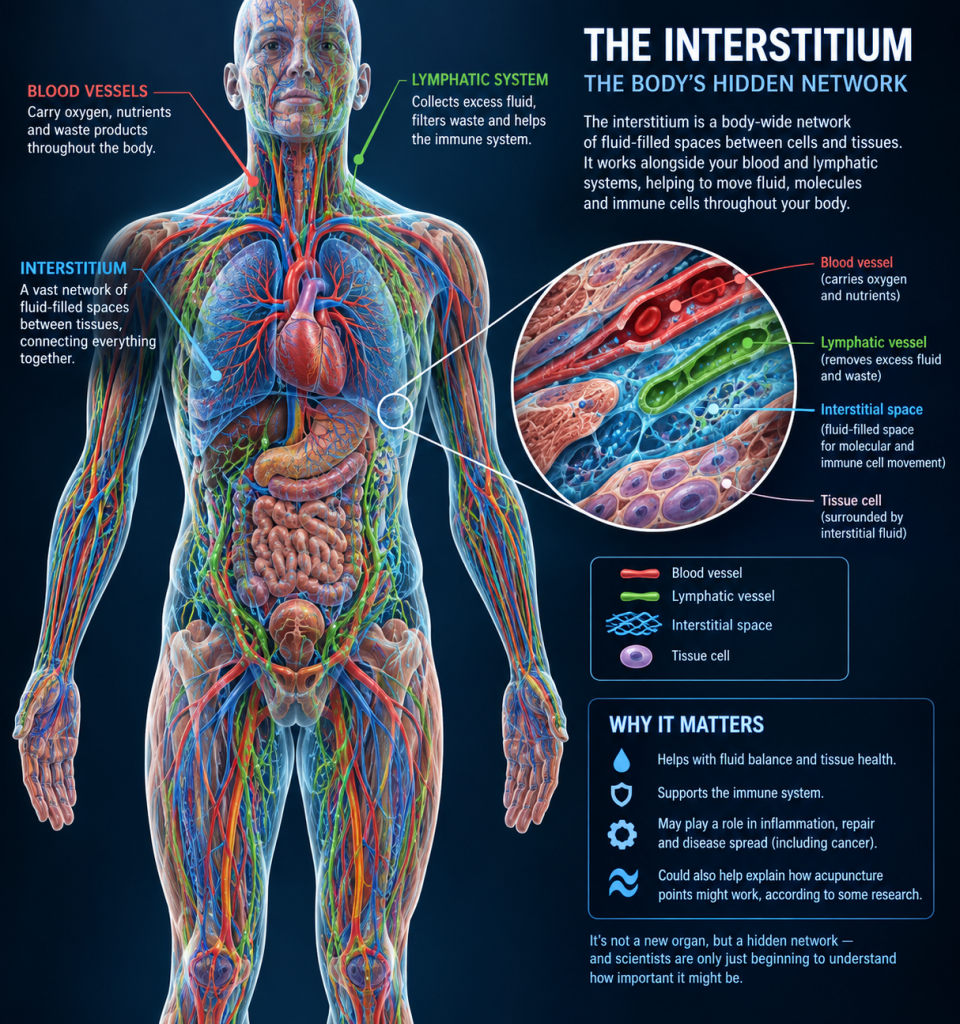
Dear Cherubs, your body may have a transportation network you probably never learned about at school — and, somewhat awkwardly, scientists have been studying it for years. The interstitium, a vast network of fluid-filled spaces between tissues, is increasingly being described as a possible “third circulatory system.”
THE HIDDEN HIGHWAY
The important bit first: this is not a brand-new system discovered in 2026. The modern scientific story goes back to 2018, when researchers published evidence in Scientific Reports describing previously unappreciated fluid-filled spaces within and between human tissues.
Using advanced imaging and specially prepared tissue samples, the researchers found these spaces in areas including the digestive tract, skin, lungs, tissues surrounding blood vessels and fascia. The spaces are supported by collagen bundles and contain interstitial fluid.
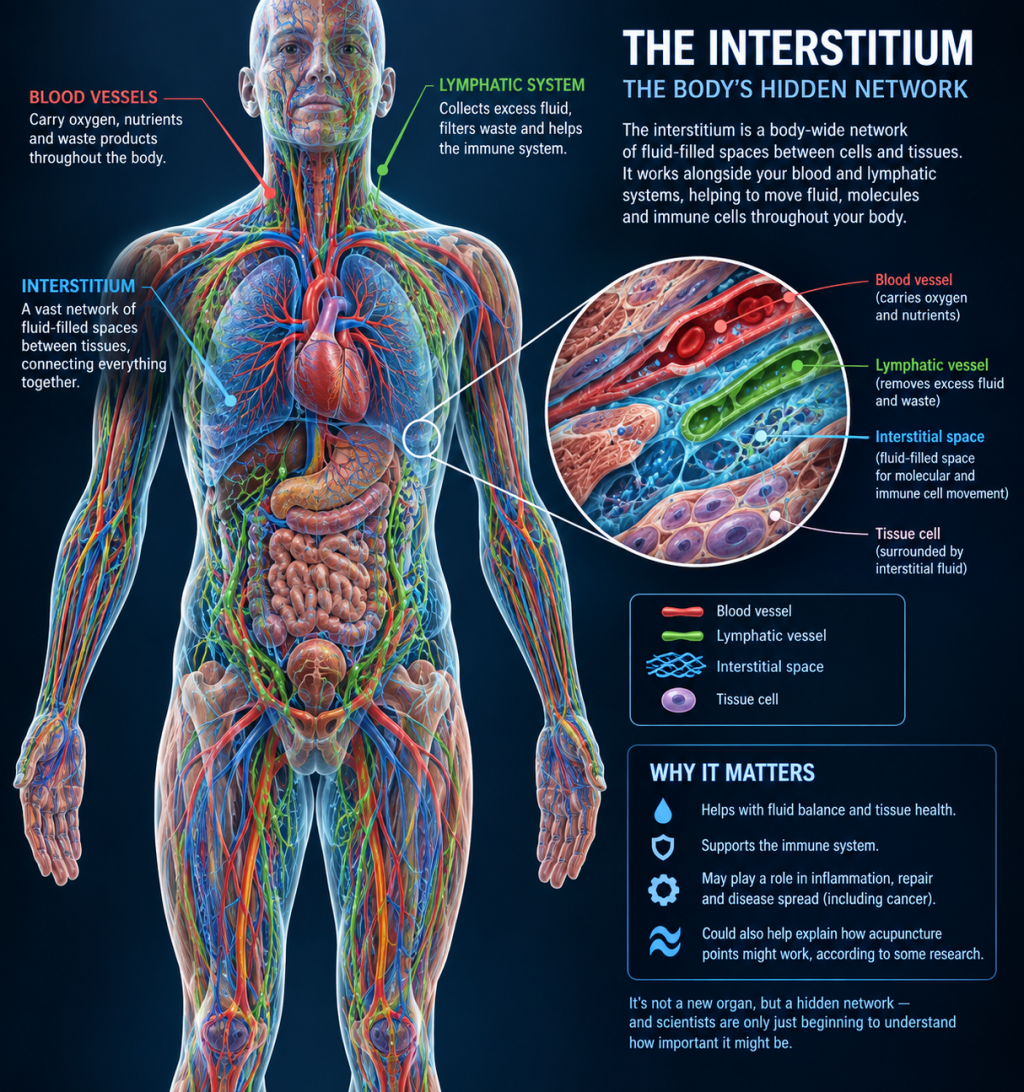
Why does that matter? Because the interstitium sits between cells and helps provide the environment through which fluid, molecules and immune cells can move. It also connects with the lymphatic system, which collects excess tissue fluid and returns it to the circulation.
Think of the cardiovascular system as the main motorway, the lymphatic system as a drainage and recycling network, and the interstitium as the enormous collection of side roads and paths connecting everything together. Less glamorous than a shiny new organ, perhaps, but biologically rather useful.
The idea received renewed attention in 2026 following reporting and scientific discussion describing the interstitium as a “third circulatory system.” The Curious Clinicians podcast, for example, devoted an episode to the subject after a 2026 New York Times Magazine feature explored these hidden pathways.
WHAT DOES IT ACTUALLY DO?
The interstitium isn’t a new set of pipes running alongside your veins. It is better understood as a body-wide network of fluid-filled spaces within connective tissues.
Researchers are particularly interested in how fluid moves through these spaces and how that movement may influence inflammation, immune responses, tissue repair and the spread of disease.
Cancer is one area attracting attention. The 2018 research suggested that these fluid-filled spaces could be relevant to tumour spread, although that does not mean scientists have discovered a universal new route by which cancer travels.
There is also intriguing research involving acupuncture. A 2021 study involving 15 healthy volunteers found that fluorescent dye injected at certain acupuncture points sometimes travelled along pathways associated with the intermuscular fascia and interstitial spaces. The researchers proposed that interstitial fluid movement might help explain some anatomical features traditionally described as meridians.
That finding is interesting, but it is not proof that traditional acupuncture theories have suddenly been scientifically confirmed. Biology, as usual, refuses to provide a tidy Netflix finale.
THE BIGGER PICTURE
Perhaps the most fascinating part is not that humans suddenly discovered another system inside themselves. We didn’t.
Scientists already knew about interstitial fluid. What has changed is the ability to visualise and investigate the spaces in ways that reveal their organisation and potential importance.
According to the original 2018 research, these spaces may also act as mechanical shock absorbers, allowing tissues to expand and compress while maintaining their structure.
So, no, you haven’t secretly acquired a third heart.
But the emerging picture suggests that the human body is even more interconnected than the traditional diagrams imply. The next chapter is figuring out exactly how this hidden fluid network works — and whether understanding it can improve our approach to disease.
For more accessible science and fact-checking, readers can also explore thisclaimer.com and the Thisclaimer YouTube channel for further explainers.
Sources:
Scientific Reports — “Structure and Distribution of an Unrecognized Interstitium in Human Tissues” Scientific Reports article
PubMed — “Structure and Distribution of an Unrecognized Interstitium in Human Tissues” PubMed record
Evidence-Based Complementary and Alternative Medicine — “In Vivo Visualization of the Pericardium Meridian with Fluorescent Dyes” Research article
PubMed — “In Vivo Visualization of the Pericardium Meridian with Fluorescent Dyes” PubMed record
The Curious Clinicians — “A Third Circulatory System,” May 29, 2026 Podcast episode
NYU Langone Health — coverage of 2026 reporting on the interstitium NYU Langone Health
Thisclaimer — further science and fact-checking thisclaimer.com
Thisclaimer YouTube — further explainers Thisclaimer YouTube





Leave a comment