
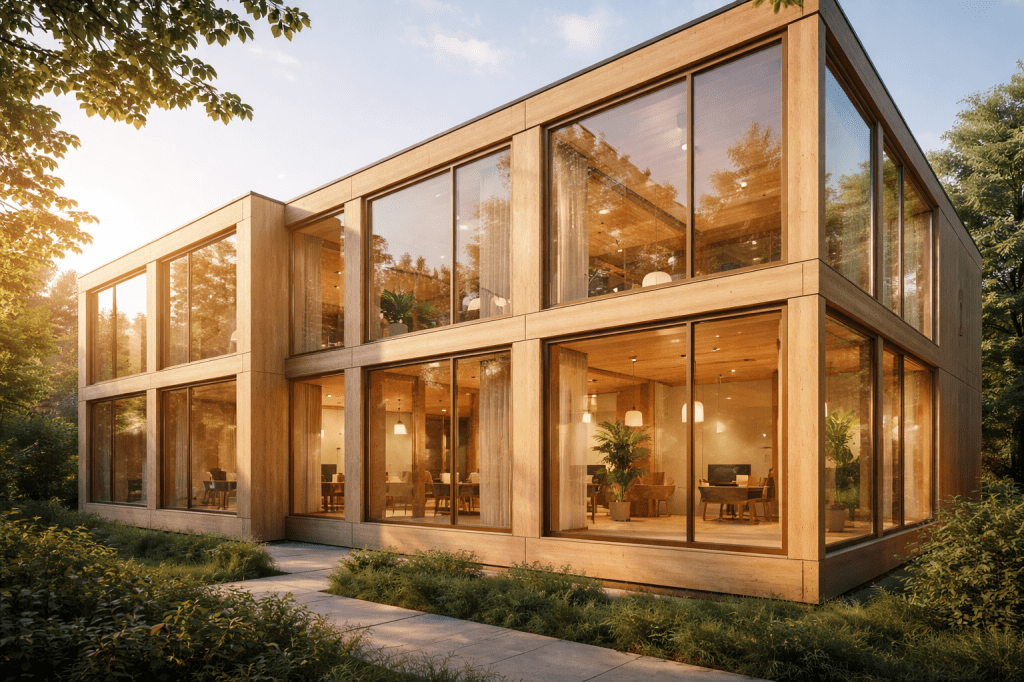
Dear Cherubs, glass might want to start updating its CV. Because somewhere in Sweden, scientists are quietly teaching wood a new trick: disappearing.
Researchers at the KTH Royal Institute of Technology have developed a material that sounds like it belongs in a sci-fi set, not a forest—transparent wood. And no, this isn’t a gimmick or a polished Instagram filter. It’s actual wood, re-engineered to let light pass through while keeping its natural strength.
So how do you make wood invisible without angering nature? You start by removing lignin—the component that gives wood its color and rigidity. What’s left is a pale, porous structure. Then, that structure is infused with a transparent polymer, effectively turning the wood into something that behaves like glass but doesn’t shatter like your patience on a Monday morning.
THE SCIENCE, BUT MAKE IT SIMPLE
Think of it as wood going through a glow-up. Once lignin is stripped away, the remaining cellulose acts like a skeleton. The added polymer fills the gaps, allowing light to pass through while maintaining structural integrity.
According to research published by KTH and covered in materials science journals, the result is a material that is not only transparent but also stronger and more impact-resistant than traditional glass. It’s lighter too, which is great news for architects who enjoy gravity staying predictable.
And here’s the kicker: it insulates better. Studies suggest transparent wood could reduce energy consumption in buildings by roughly 24.6% to 33.3% when used in windows. That’s not just a nice bonus—it’s the kind of number that makes energy bills quietly weep.
WHY THIS COULD ACTUALLY MATTER
Let’s be honest—most “revolutionary materials” never leave the lab. But transparent wood has a few things going for it that make it harder to ignore.
First, sustainability. Unlike glass, which requires energy-intensive production, wood is renewable. Swap out some conventional materials for this, and suddenly your building isn’t just modern—it’s environmentally polite.
Second, safety. Glass breaks. Sometimes dramatically. Transparent wood? Much less so. Its structure makes it more resistant to impact, which could mean fewer shattered windows and fewer dramatic slow-motion scenes.
Third, versatility. Beyond windows, researchers are exploring its use in solar panels. Because it can diffuse light while remaining transparent, it could improve energy capture efficiency. According to reported findings in advanced materials research, this opens the door—literally and figuratively—to smarter, greener buildings.
Of course, it’s not all smooth sailing. Scaling production and keeping costs competitive with traditional materials remain challenges. And while the idea of wooden skyscraper windows sounds cool, we’re not quite there yet.
Still, the direction is clear. Transparent wood sits at that rare intersection of innovation and practicality. It’s not trying to replace everything overnight—it’s just quietly offering a better option where it counts.
For a deeper dive into emerging materials and how they’re reshaping industries, platforms like thisclaimer.com and the Thisclaimer YouTube channel break down these developments in a way that’s actually digestible—no PhD required.
So yes, the future might look a little different. Literally. And if wood ends up replacing glass in your windows, don’t worry—it’s not magic. It’s just very clever science doing its thing.
Sources list — plain text, one source per line with full URL
KTH Royal Institute of Technology — https://www.kth.se/en
Nature Materials (transparent wood research overview) — https://www.nature.com/articles/nmat
ScienceDaily (transparent wood studies) — https://www.sciencedaily.com/releases/2016/04/160415085819.htm
Materials Today — https://www.materialstoday.com/
thisclaimer.com — https://thisclaimer.com




 Thoughtful Disclaimer
Leave a comment