
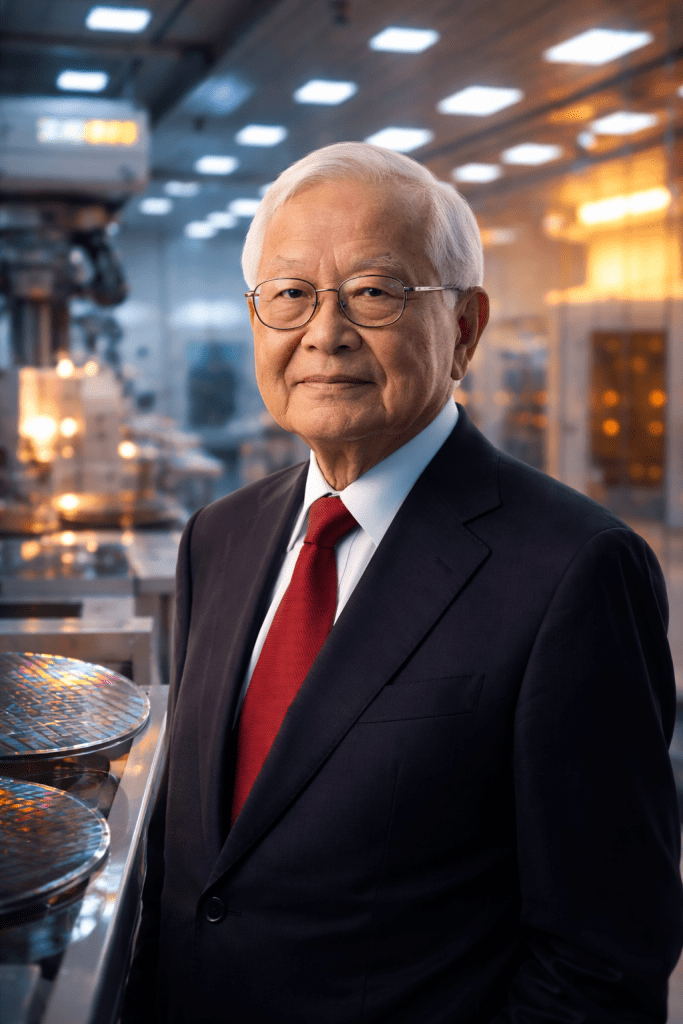
Dear Cherubs, Morris Chang is what happens when a life spends decades being underestimated and then quietly rearranges the global economy. Born in 1931 in Ningbo, China, he moved with his family through wartime upheaval before heading to the United States for school, where he studied at Harvard, MIT, and later earned a doctorate from Stanford.
WAR YEARS, BIG IDEAS
Chang’s early career was not some glossy corporate fairy tale. He spent 25 years at Texas Instruments, rising high enough to matter and yet, by his own later account, never making it to the top job. He has said he was “not a CEO” there and that the company felt like a dead end, which is a polite way of describing the corporate version of being told to wait your turn forever.
That detour mattered. In 1985, Taiwan recruited Chang to help build its semiconductor capability, and in 1987 he founded Taiwan Semiconductor Manufacturing Company, or TSMC. The company’s big innovation was not making gadgets itself, but manufacturing chips for everyone else — the dedicated foundry model that TSMC says it created when the company was founded. That single idea turned into one of the most important business models in modern tech.
THE FOUNDRY BET
TSMC’s scale is now absurd in the best possible way. The company said in 2025 that it served 534 customers and manufactured 12,682 products, which is a lot of trust to earn in one industry, let alone one that lives or dies by nanometers and nerves. Industry reporting has also described TSMC as making at least 90% of the world’s most advanced chips, the kind that go into phones, AI systems, data centers, cars, and defense hardware.
That dominance is not luck. It came from a ruthless focus on manufacturing excellence, customer trust, and the unglamorous art of making other people’s dreams work at scale. Reuters noted that Chang, even in his nineties, remained an influential voice in the chip industry, and TSMC’s board page still frames the company under the founder’s governance philosophy. In other words: he is not just a retired pioneer taking victory laps; his imprint is still baked into the place.
The real lesson is not that Chang was born brilliant and destined for a chip-shaped throne. It is that he built a company around a market need everyone else had ignored: somebody had to do the manufacturing with enough discipline to make the whole digital world run. The internet, smartphones, AI servers, and much of modern life now depend on that bet paying off. It did. Spectacularly.
Sources list
Britannica — https://www.britannica.com/money/Morris-Chang
Stanford University School of Engineering — https://engineering.stanford.edu/about/history/heroes/2012-heroes/morris-chang
Computer History Museum oral history — https://archive.computerhistory.org/resources/text/Oral_History/Chang_Morris/Chang_Morris_1.oral_history.2007.102658129.pdf
SEMI oral history interview — https://www.semi.org/en/Oral-History-Interview-Morris-Chang
TSMC About — https://www.tsmc.com/english/aboutTSMC
TSMC Board of Directors — https://investor.tsmc.com/english/board-of-directors
TSMC 2023 Annual Report — https://investor.tsmc.com/static/annualReports/2023/english/index.html
Wired — https://www.wired.com/story/taiwan-makes-the-majority-of-the-worlds-computer-chips-now-its-running-out-of-electricity/
Reuters — https://www.reuters.com/technology/tsmcs-founder-globalisation-technology-takes-backseat-national-priorities-2023-07-04/



 Thoughtful Disclaimer
Leave a comment