
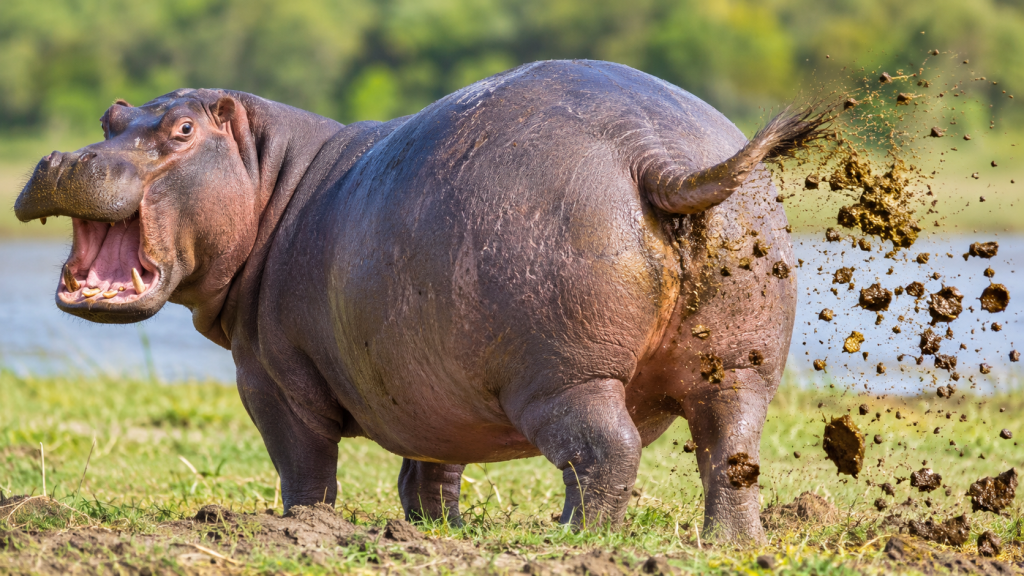
Dear Cherubs, apparently, when a hippopotamus needs to make a statement, it doesn’t reach for a microphone, post on social media or send a strongly worded email. It simply turns around, does its business and lets its tail do the talking. Welcome to one of nature’s most spectacularly messy communication techniques.
The common hippopotamus (Hippopotamus amphibius) has a rather unusual habit: vigorously wagging its short, flattened tail while defecating, scattering dung across the surrounding area.
And no, despite what some entertaining internet claims suggest, scientists haven’t established that this performance is specifically designed to impress potential mates. The reality is considerably more complicated, although arguably no less ridiculous.
THE ULTIMATE MESSY COMMUNICATION SYSTEM
According to the International Hippo Specialist Group, hippos are well known for spreading their dung with vigorous tail movements, both in water and on land.
The behaviour is observed primarily in males, although other research, including information published by the South African National Biodiversity Institute, records the behaviour in both sexes.
The technique is surprisingly effective. Rather than leaving a neat little deposit behind, the hippo swings its tail rapidly from side to side, distributing its faeces over a much wider area.
Think of a biological garden sprinkler, except nobody in their right mind would want one installed in the garden.
But why do they do it?
That’s where things get interesting. Researchers have proposed several possible explanations, including territorial signalling, social communication and helping hippos recognise familiar routes or locations.
The International Hippo Specialist Group points out that the precise significance of the behaviour remains unknown. Earlier explanations suggested that dung piles might mark territories or help animals navigate their surroundings, while the behaviour may also have a role in interactions between dominant and subordinate individuals.
In other words, the hippo’s unusual toilet routine might be sending a message, but scientists are still working out exactly what that message says.
NOT EXACTLY A ROMANTIC GESTURE
So, what about the suggestion that male hippos use their tails to impress females?
There is a connection between hippo behaviour, social hierarchy and reproduction, but that doesn’t mean every spectacular display of faeces is an elaborate mating ritual.
Male hippos defend territories in the water, where access to females is an important part of their social system. They also use vocalisations, aggressive displays and other behaviours when interacting with rivals.
Dung-showering can form part of these social interactions, particularly among males. Subordinate animals may even direct faeces and urine towards dominant individuals in certain encounters.
Romance, apparently, comes in many forms in the animal kingdom. This particular version is unlikely to feature in anyone’s wedding vows.
Hippos also have an impressive relationship with water. Their dung contributes nutrients to rivers and lakes, supporting aquatic ecosystems. According to the International Hippo Specialist Group, nutrients from hippo faeces can be important in maintaining fishery productivity in natural lakes and artificial dams.
So, while their bathroom habits might seem like an ecological disaster waiting to happen, they actually play a role in the movement of nutrients through their environment.
Nature has a peculiar sense of humour. One of Africa’s largest mammals has turned defecation into a potential communication system, complete with a built-in distribution mechanism.
And before anyone starts taking notes for their next romantic encounter, remember: the scientists haven’t confirmed that females find this particularly attractive.
Some things are probably best left in the wild.
Sources
1. International Hippo Specialist Group – Common Hippopotamus
https://hipposg.org/common-hippopotamus
2. South African National Biodiversity Institute – Hippopotamus
https://speciesstatus.sanbi.org/taxa/detail/2064/
3. Animal Diversity Web – Hippopotamus amphibius
https://animaldiversity.org/accounts/Hippopotamus_amphibius/
4. International Environment Library Consortium – Hippopotamus Behaviour
https://ielc.libguides.com/sdzg/factsheets/hippopotamus/behavior






Leave a Reply