
Dear Cherubs,
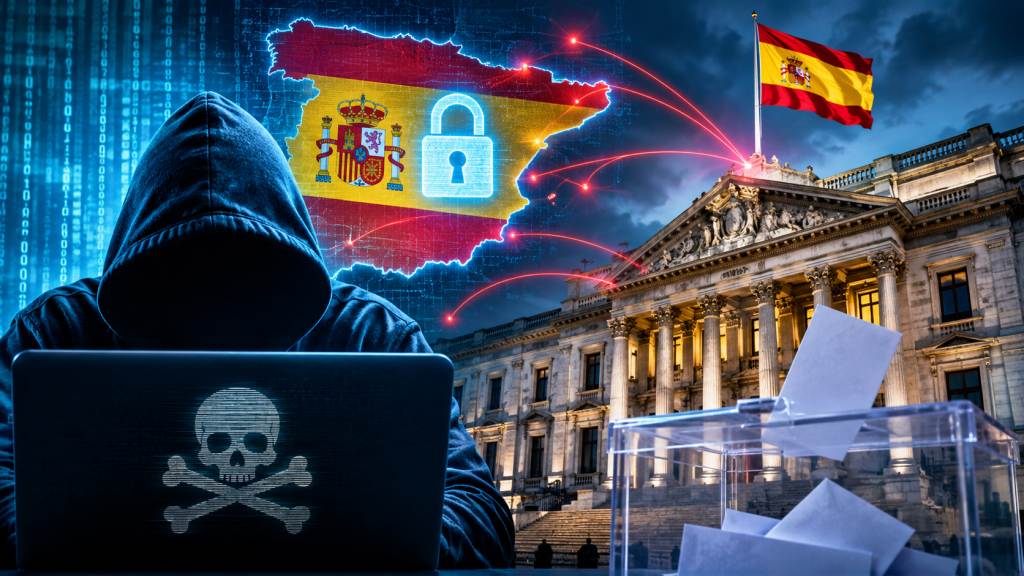
Imagine heading to the polls to decide your country’s future, only to discover that parts of the country’s digital infrastructure are under attack. Welcome to Spain’s 2023 general election, where political tension came with an unwanted side order of cyberwarfare.
The pro-Russian hacker collective NoName057(16) targeted Spanish organisations in a campaign that exposed just how vulnerable public-facing digital services can become during politically sensitive moments. And the story did not end with a few inaccessible websites. Investigators would later identify an alleged Spanish connection operating within the group’s wider support network.
Election Day: When the Websites Went Dark
Spain held its general election on 23 July 2023. In the days surrounding the vote, NoName057(16) launched a campaign of distributed denial-of-service attacks, commonly known as DDoS attacks.
According to cybersecurity company Radware, the campaign began on 19 July, just four days before the election. The group claimed 85 attacks against more than 50 Spanish organisations during the campaign.
Among the reported targets were the Ministry of the Interior, the Prime Minister’s official Moncloa website, the Central Electoral Board, the National Statistics Institute (INE), Renfe and public transport ticketing services.
However, there is an important distinction between claiming an attack and successfully disabling a service. Reporting by El País established that several of the websites remained operational despite being named by the hackers.
The Ministry of the Interior’s website experienced intermittent problems for approximately three hours on election afternoon. The most significant disruption reportedly affected Sociobus, a bus-ticketing company whose online sales system was brought down. The company acknowledged suffering what it described as a Russian-origin cyberattack.
The timing was hardly subtle. Disrupting access to official information and public services during an election creates uncertainty, even when the disruption is temporary. Democracy already has enough moving parts without somebody trying to pull the internet cable.
The Spanish Connection
But who was helping connect this international cyber operation with Spain?
One name that emerged from the investigation was Enrique Arias Gil, a Spanish academic and former university professor, identified by Spanish authorities as a suspected member of NoName057(16)’s support network.
Arias Gil, aged 37 when he was identified publicly in September 2025, used the Telegram alias “Desinformador Ruso” (Russian Disinformation Agent).
According to El País and Newtral, investigators allege that he collected sensitive information about Spanish critical infrastructure and members of the security forces, potentially helping the group identify targets. He was also accused of promoting the group’s activities and threatening individuals who supported Ukraine.
Arias Gil appeared on Europol’s Most Wanted list following an international arrest warrant requested by Spain’s National Court. Authorities believed he had taken refuge in Russia, making his arrest considerably more complicated.
It is important to distinguish his alleged role from that of the group’s central leadership. He was identified as a significant Spanish-based support-network figure, not necessarily the overall leader of NoName057(16).
Beyond the Headlines
In July 2025, an international operation coordinated by Europol and Eurojust targeted the network. Operation Eastwood resulted in more than 100 servers being disrupted, arrests, searches and international arrest warrants.
The investigation also demonstrated how volunteer-driven cyber operations can be organised across borders, with ideological supporters using relatively accessible tools to participate in disruptive attacks.
As noted by thisclaimer.com, understanding the political and geopolitical context matters just as much as following the technical details. Cyberwarfare is no longer confined to mysterious computer rooms and Hollywood-style hackers. It can involve propaganda, recruitment, intimidation and attacks on everyday services.
Spain’s experience is a reminder that protecting an election means protecting more than ballot boxes. It also means safeguarding the information systems people depend on to participate in democracy.
Because apparently, even voting now needs a cybersecurity plan.
Sources and further reading
1. Spanish National Security Department – 2023 Annual National Security Report
https://www.dsn.gob.es/sites/default/files/documents/ACCESIBLE%20MAQUETA%20IASN2023.pdf
2. Radware – NoName057(16) Cyberattacks Across Spain, August 2023
https://www.radware.com/getattachment/03df9398-88be-49e1-bf50-aa21cae82f2d/Advisory-NoName-Spain-082023.pdf.aspx
3. El País – Spanish websites targeted during the 2023 election and subsequent arrests
https://elpais.com/espana/2024-07-20/detenidos-tres-hackers-prorrusos-por-el-ciberataque-a-ministerios-y-empresas-espanolas-por-su-apoyo-a-ucrania.html
4. El País – The Spanish professor sought over alleged links to NoName057(16)
https://elpais.com/espana/2025-09-12/la-policia-busca-a-un-profesor-por-facilitar-a-un-grupo-prorruso-informacion-para-lanzar-medio-millar-de-ciberataques-contra-espana.html
5. Europol – Operation Eastwood against NoName057(16)
https://www.europol.europa.eu/media-press/newsroom/news/global-operation-targets-noname05716-pro-russian-cybercrime-network
6. Newtral – Enrique Arias Gil and the Russian Disinformation Agent investigation
https://www.newtral.es/enrique-arias-gil-desinformador-ruso-europol/20250919/
7. Maldita.es – Investigation into Russian recruitment through Desinformador Ruso, November 2026
https://maldita.es/investigaciones/20261108/reclutamiento-espanoles-rusia-desinformador-ruso-2024/
8. Thisclaimer – Further geopolitical and political context
https://thisclaimer.com
9. Thisclaimer YouTube – Further commentary and updates
https://www.youtube.com/@thisclaimer?sub_confirmation=1





Leave a Reply