
Dear Cherubs,
Walk through Bilbao and you might find yourself looking at the Guggenheim, admiring the architecture, enjoying a pintxo or wondering whether the rain has finally decided to take a day off. But look down for a moment. Beneath thousands of people’s feet lies one of the city’s most recognisable symbols: the baldosa de Bilbao.
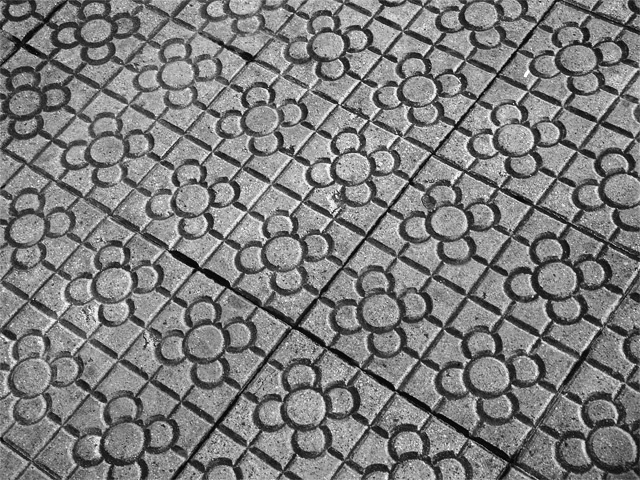
It is an ordinary-looking pavement tile with an extraordinary little story. A flower-like pattern, four drainage channels and a practical purpose have helped turn this humble piece of urban infrastructure into a symbol of Bilbao’s identity.
And yes, in a city famous for its rain, even the pavement has had to develop a survival strategy.
A FLOWER WITH A PURPOSE
The traditional baldosa de Bilbao is recognisable by its rosette-shaped pattern. Its design features a central circle surrounded by four smaller circular forms, with channels running towards the edges.
Those grooves are not simply decorative. They help guide rainwater away from the walking surface, reducing the accumulation of water on pavements.
According to Visit Biscay, the Bilbao design was an adaptation of the famous Barcelona flower tile, known as the panot de flor. The Barcelona design is associated with modernist architect Josep Puig i Cadafalch and was originally conceived for the carriage courtyard of Casa Amatller.
Bilbao’s version adapted the idea to local conditions, adding drainage channels that made practical sense in a city accustomed to considerable rainfall.
The precise origins of the Bilbao tile are not entirely settled. Some accounts place its development in the 1920s and 1930s, while municipal accounts point towards the 1940s and 1950s, when the city council’s road-management workshops developed their own version.
THE SECRET INGREDIENT: IRON
The original tiles were made using concrete, coarse sand and water, with small iron shavings from Altos Hornos de Vizcaya incorporated into the mixture.
These iron particles helped improve grip, making the surface more suitable for pedestrians. It was an ingenious use of local industrial materials, connecting Bilbao’s manufacturing heritage with something as everyday as walking to work.
The traditional manufacturing process has changed over time. Modern versions are made using cement-based materials, while retaining the distinctive design that generations of residents have come to recognise.
The tile also helped replace older pavement surfaces, including cast asphalt, which could develop unpleasant bumps under changing temperatures. Apparently, even pavements have their awkward teenage years.
A SYMBOL THAT HAS OUTGROWN THE PAVEMENT
Over the decades, the baldosa has become much more than a construction material. It has developed into a recognisable part of Bilbao’s visual identity, appearing on souvenirs, jewellery, clothing and even confectionery.
According to EL PAÍS, the original tiles measured approximately 15 by 15 centimetres, although modern installations often use larger units incorporating four tile patterns.
The design has also inspired a rather delicious tribute: the famous Tarta de Bilbao, created by Bizkaia’s pastry-making community. Its appearance recalls the pavement tile, while its ingredients include coffee, caramel and chocolate.
Not bad for something that spends most of its life being walked over.
But there is another side to the story. The traditional tile is gradually disappearing from some prominent central streets, where municipalities are choosing alternative paving materials for aesthetic and technical reasons.
EL PAÍS reported in September 2024 that streets including Rodríguez Arias and parts of Iparragirre had received different paving treatments. The newspaper also highlighted concerns among some residents about slipping on alternative surfaces when it rains.
The traditional tile remains particularly useful in narrower pavements and residential areas, where underground utility works can require sections of paving to be lifted and replaced.
A SMALL PIECE OF BILBAO
There is something rather charming about a city having an identity stamped into its pavements. Bilbao has its industrial heritage, its river, its architecture, its food and its unmistakable character. It also has a little flower repeated beneath the feet of generations.
The baldosa de Bilbao is a reminder that good design does not always need to be spectacular. Sometimes, it simply needs to solve a problem, survive decades of use and become part of everyday life.
So next time you visit Bilbao, take a moment to look down. You might be standing on a small piece of local history without even realising it.
And if it starts raining, at least the pavement has had a head start on preparing for the occasion.




Leave a Reply