
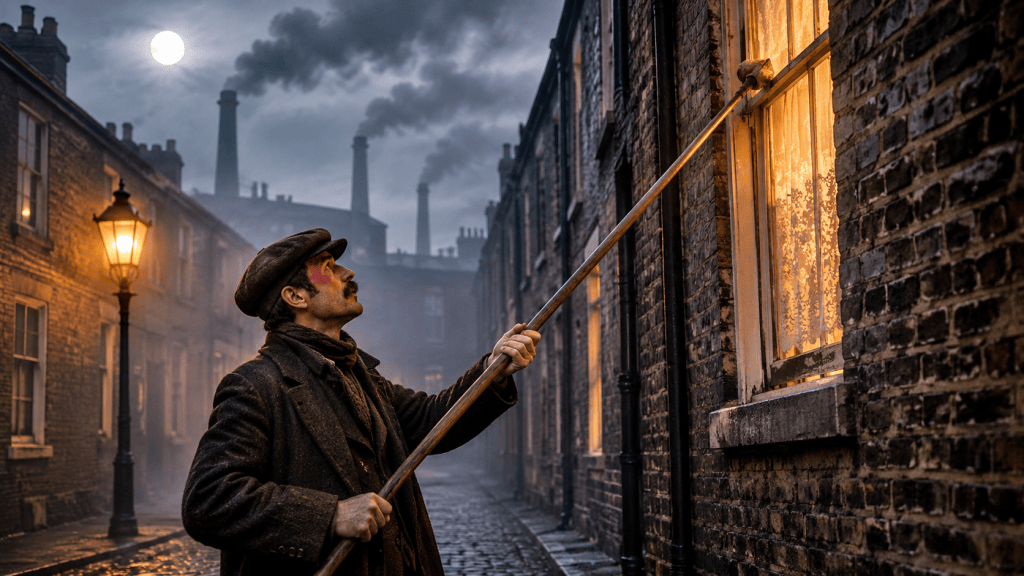
Dear Cherubs, imagine paying someone to wake you up every morning by poking your bedroom window with a stick. No snooze button, no gentle smartphone melody and absolutely no option to pretend you hadn’t heard it. Welcome to the rather unusual world of Britain’s knocker-uppers, the human alarm clocks of the Industrial Revolution.
The Industrial Revolution transformed Britain, bringing factories, mills, mines and increasingly demanding working schedules. But there was one small problem: getting everyone out of bed on time.
Before affordable and reliable alarm clocks became commonplace, workers needed another way to wake up, particularly those expected to start their shifts before sunrise. Enter an unlikely profession that became an essential part of industrial Britain’s daily routine.
The Human Alarm Clock
Knocker-uppers, sometimes called knocker-ups, were paid to wake people at a specific time so they could get to work.
They operated particularly in industrial towns such as Manchester, Leeds, Sheffield and Lancashire, as well as London’s docklands, where workers often followed demanding schedules dictated by factory shifts and changing tides.
Their equipment was surprisingly simple. Most carried long bamboo poles, fishing rods or wooden sticks to tap on upstairs bedroom windows. Others used small hammers or rattles.
Some even used pea shooters, firing dried peas at windows to wake their customers without disturbing the entire neighbourhood. Low-tech innovation, Victorian style.
According to historian Arunima Datta’s research, published in the Journal of Victorian Culture in 2020, knocker-uppers could charge between two and three pence a week for waking customers at six in the morning or later. Earlier wake-up calls could cost sixpence, with winter prices sometimes rising considerably.
And this wasn’t exclusively men’s work. Women also established themselves in the trade.
One particularly famous figure was Mary Smith of East London, who became known for using a pea shooter to wake her customers. Her daughter also followed in the family business.
More Than Just a Wake-Up Call
Being a knocker-upper wasn’t necessarily an easy way to earn a living.
Many started their rounds around 3am, working through darkness, cold, fog and industrial pollution. They needed to know their neighbourhoods, remember customers’ schedules and make sure they didn’t accidentally wake the wrong household.
Some waited until they received a response from their customers before moving on. Others simply delivered a few taps and hoped for the best.
Interestingly, their contribution extended beyond punctuality. Because they were out on the streets while most people slept, knocker-uppers sometimes became informal neighbourhood watchmen.
Historian Arunima Datta documents cases in which they discovered fires, witnessed crimes and helped police investigations. One knocker-upper in Bradford reportedly alerted a sleeping family to a fire in 1876, helping them escape.
In other words, they weren’t just making sure workers arrived at the mill. Occasionally, they were helping make sure there was still a mill to arrive at.
The End of an Unusual Profession
As mechanical alarm clocks became more affordable and widely available, demand for human wake-up services gradually declined.
By the 1940s and 1950s, the occupation had largely disappeared, although some communities in northern England continued employing knocker-uppers into the early 1970s.
The BBC reported that the tradition survived in certain industrial areas until that decade, with Bolton often associated with the retirement of one of Britain’s last practitioners in 1973.
Today, the knocker-upper is a curious reminder of how industrialisation changed even the most ordinary parts of human life: sleeping, waking and getting to work.
So, next time your smartphone alarm goes off and you instinctively hit snooze, spare a thought for the poor Victorian soul who had to get out of bed in the middle of the night to wake everyone else.
At least your alarm doesn’t charge you sixpence a week.
For more historical curiosities and unusual stories, explore thisclaimer.com and the Thisclaimer YouTube channel.
Sources and further reading
1. Arunima Datta, Journal of Victorian Culture — Knocker Ups: A Social History of Waking Up in Victorian Britain’s Industrial Towns (2020).
https://academic.oup.com/jvc/article/25/3/331/5829726
2. BBC News — Knocker uppers: Waking up the workers in industrial Britain (27 March 2016).
https://www.bbc.com/news/uk-england-35840393
3. BBC Future — Knocker uppers and candle clocks: How people woke up before alarm clocks (7 March 2026).
https://www.bbc.com/future/article/20260306-the-wake-up-tricks-people-used-before-alarm-clocks
4. Lancashire County Council — Red Rose Collections: Knocker-Up in Burnley.
https://redrosecollections.lancashire.gov.uk/view-item?i=234667
5. Thisclaimer — Further historical curiosities and interesting stories.
https://thisclaimer.com
6. Thisclaimer YouTube — Videos and further discoveries.
https://www.youtube.com/@thisclaimer?sub_confirmation=1






Leave a Reply