
Dear Cherubs,
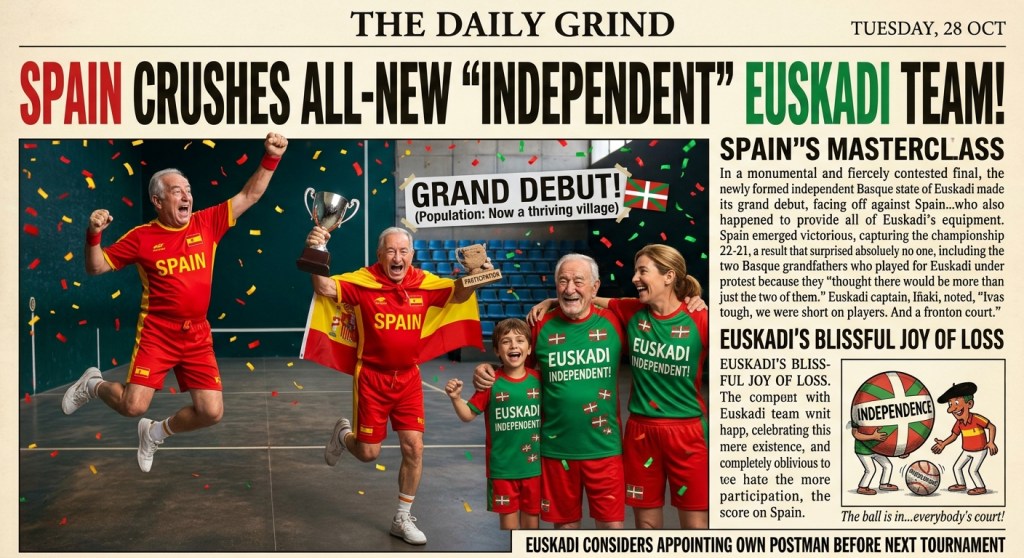
Spain has been crowned world team champion at the 20th World Basque Pelota Championships in a tournament that delivered sporting success, a historic political milestone and, naturally, a final showdown against its newly independent Basque rivals. Spain finished top of the medal table with 18 medals, but this year’s competition was about considerably more than who collected the most gold.
Held between 15 and 24 October 2026, the championships took place across Argentina and Uruguay, with Buenos Aires serving as the main stage for an event featuring 15 delegations.
And there was something genuinely historic happening alongside the sporting action: the Basque Country, known as Euskadi, competed as an independent national delegation for the first time in the competition’s history.
A historic first for Euskadi
For years, Basque athletes have competed internationally within the Spanish sporting structure. However, changes to the statutes of the International Federation of Basque Pelota (FIPV), approved in 2025, opened the door for Euskadi to participate as a full independent team.
According to the Basque Government, this change allowed the Basque delegation to enter the championship on equal terms with Spain, France and the other participating teams.
The significance goes beyond sport. Basque pelota is deeply connected to the history, identity and cultural traditions of the Basque people. Having Euskadi represented independently on the international stage was therefore a major moment for the region.
And it wasn’t exactly a ceremonial appearance. The Basque team finished with an impressive 12 medals: four gold, seven silver and one bronze.
Spain takes the crown
Spain, however, had the stronger overall performance.
The Spanish delegation finished with 18 medals, comprising seven gold, nine silver and two bronze. Argentina followed with eight medals, while Euskadi secured third place in the overall gold-medal ranking with four golds.
According to the International Federation of Basque Pelota, Spain was officially crowned overall champion, with Argentina taking second place and Euskadi third.
But perhaps the most symbolic encounter came in the men’s pala corta final.
Spain faced Euskadi in a match that brought the tournament’s sporting and historical narratives together rather neatly. The Basque players took the opening set 15–9, putting Spain under immediate pressure.
Spain responded by winning the second set 15–11, forcing a deciding third game. The Spanish pairing of Carlos Baeza and Javier Insausti eventually prevailed 10–5 against Esteba Gaubeka and Jesús Ibañez.
It was a particularly fitting conclusion to an already memorable championship: Spain securing another gold medal against the very delegation whose independent participation had made this edition so unusual.
More than a medal table
The 2026 championship demonstrated that Basque pelota remains a sport with considerable international appeal. More than 480 athletes from 15 delegations participated, competing across numerous disciplines and formats.
For Spain, the result confirmed its position at the top of the sport. For Euskadi, the competition offered something arguably just as important: international recognition as an independent sporting delegation.
And for the sport itself, it was an opportunity to showcase a tradition that deserves considerably more attention beyond the communities where it has been played for generations.
Spain leaves Argentina with the trophy, Euskadi returns with 12 medals and a historic debut, and Basque pelota gains a little more international visibility.
Not a bad result for a championship where the biggest victory might have been getting the world to pay attention.

Sources
1. International Federation of Basque Pelota (FIPV) — Official championship results and overall winner.
2. EITB — Euskadi’s participation and match results throughout the championship.
3. Basque Government — Historic independent participation and federation rule changes.
4. Argentina Government — Tournament participation and championship overview.
5. Diario de Navarra — Spain’s final victory in pala corta.



Leave a Reply