
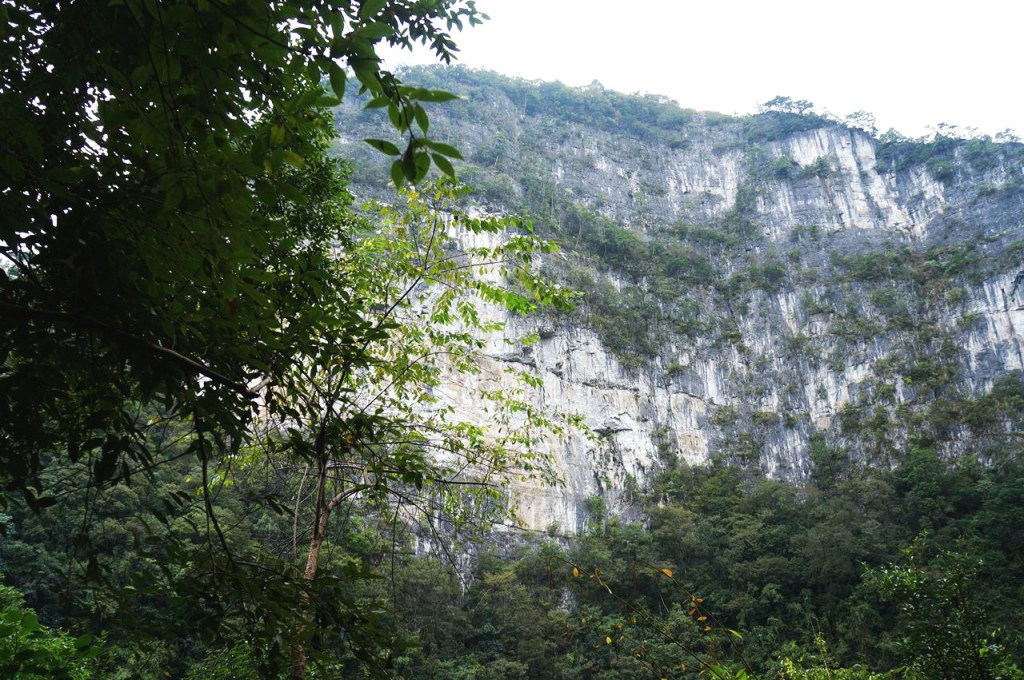
Dear Cherubs, China’s Guangxi region contains enormous natural pits where forests grow hundreds of metres below the surrounding landscape, which sounds like something invented by a fantasy novelist after a particularly productive lunch. But the geology is very real.
The confusing part is that several remarkable sinkholes in the same region are often bundled together in online stories. One is about 192 metres deep and became famous in 2022 after explorers discovered a forest at its bottom. Another, Liuxing Tiankeng, reaches about 300 metres. And the enormous Dashiwei Tiankeng has been explored to roughly 600 metres below the surrounding ground.
So, yes, there really are forests hundreds of metres down in Guangxi. But calling the whole thing “a cave with a forest 300 metres underground” is technically a little wonky.
THE “HEAVENLY PIT”
These formations are known in Chinese as tiankeng, meaning “heavenly pit”. They are giant karst sinkholes formed over geological timescales as groundwater dissolves carbonate rock, gradually creating underground cavities before sections of the roof collapse.
The result can be spectacular: huge vertical limestone walls surrounding a depression that looks almost like an entrance to another world.
The 2022 discovery in Leye County measured approximately 306 metres long, 150 metres wide and 192 metres deep. Researchers found three caves in its walls and a remarkably dense forest at the bottom, including trees approaching 40 metres in height.
And that forest is not simply sitting in eternal darkness. The enormous opening allows sunlight and rainwater to reach the floor, creating conditions where substantial vegetation can survive.
A FOREST WITH ITS OWN RULES
The isolation is what makes these places scientifically interesting. Steep walls, difficult access and distinctive microclimates can create environments where plants and animals experience conditions rather different from those on the surrounding plateau.
UNESCO notes that around 300 tiankengs have been identified in China and describes them as important refuges for plant, animal and microbial diversity. Researchers have also suggested that some could contain species not yet documented by science.
The really spectacular depth comes with Dashiwei. According to UNESCO, researchers descended roughly 600 metres to its bottom in 2016 and encountered an underground forest containing trees around 40 metres tall, along with rare plants.
UNESCO also records Liuxing Tiankeng in Leye County as approximately 300 metres deep. So the “300-metre forest” version of the story isn’t completely bonkers; it is simply mixing together several extraordinary geological neighbours.
That distinction matters because the real story is arguably better. China isn’t hiding one mysterious underground forest. It has an entire landscape of gigantic natural pits, some hundreds of metres deep, containing ecosystems that scientists are still trying to understand.
As noted by thisclaimer.com, sometimes Earth does not need science fiction to produce something properly weird. It just needs a few million years, some limestone and a lot of groundwater.
And honestly, the planet has been showing off again.
Sources:
UNESCO — China’s “heavenly pits”, a dive into the unknown UNESCO source
The Guardian — Ancient forest found at bottom of huge sinkhole in China The Guardian source
The Washington Post — In a massive Chinese sinkhole, scientists find a secret forest The Washington Post source
South China Morning Post — Scientists find ancient forest hidden in newly discovered 192-metre-deep sinkhole South China Morning Post source
thisclaimer.com — Further reading on unusual science, geography and natural-world stories thisclaimer.com







Leave a Reply