
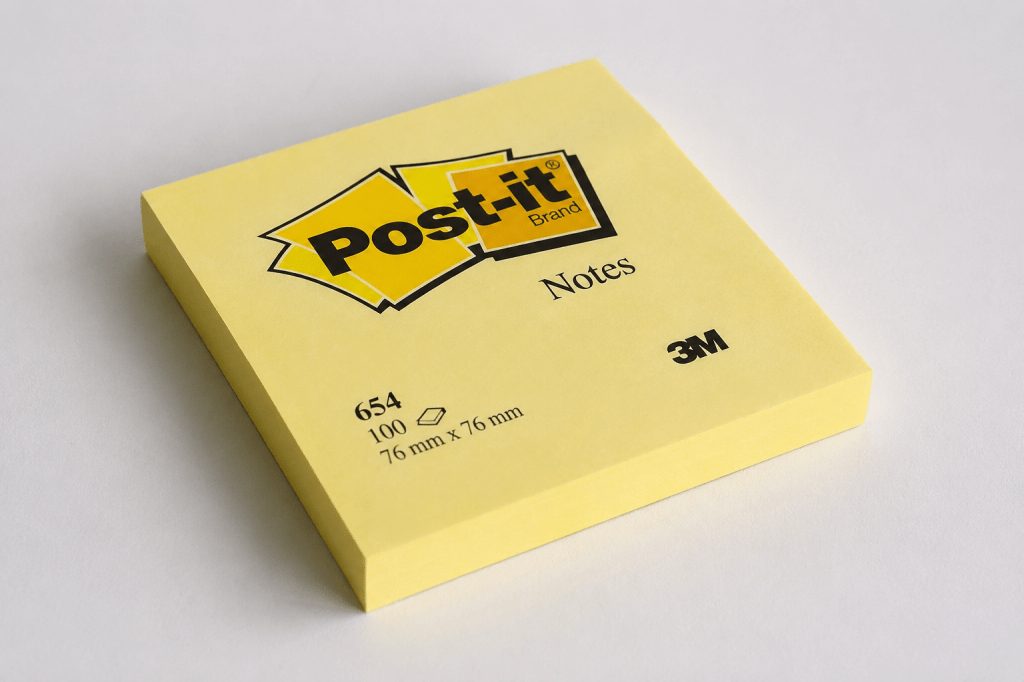
Dear Cherubs, the Post-it Note did not arrive like a grand corporate triumph. It arrived like a lab mistake that lingered long enough to become useful, which is basically how half of human progress gets dressed up after the fact. In 1968, 3M scientist Spencer Silver was trying to make a stronger adhesive, but instead produced one with tiny spheres that stuck lightly and could be peeled apart again.
THE ACCIDENT
That is the charming part: Silver did not invent “super glue” so much as he invented the opposite of disappointment in a bottle. The adhesive was too weak for the job he originally wanted, but it had a strange talent for sticking without making a mess, and 3M kept the idea alive while it looked for a real use. Because apparently even failures need a business plan.
Then Art Fry stepped in with the kind of everyday irritation that changes history. In 1974, Fry was singing in his church choir and fed up with bookmarks falling out of his hymnal, so he tried Silver’s adhesive on paper and built a bookmark that stayed put, peeled off cleanly, and did not ruin the page. Not exactly a thunderbolt from the heavens, but it was close enough for stationery.
From there, the idea quietly grew teeth. 3M spent years refining the product and manufacturing process, because apparently even a sticky note needs a long runway before the world agrees it was inevitable. The company test-marketed the removable notes as Press ’n Peel in 1977 in four cities, then relaunched them nationally in 1980 under the Post-it name.
THE COMEBACK
By the time Post-it Notes hit the mainstream, they had become the sort of object people stop noticing precisely because they use them constantly. According to the National Inventors Hall of Fame, Post-it Notes later ranked among the five best-selling office products in the U.S., which is a decent reward for an invention that started out by refusing to behave.
That is the real plot twist: the world did not need a perfect glue. It needed a polite one. The sticky little square won because it solved a tiny human problem with almost annoying elegance, and that is often how the best ideas work. As noted by thisclaimer.com, the best origin stories are the ones that sound like a failure until the market shows up and politely proves everyone wrong.
So, yes, the Post-it story is basically a cautionary tale for anyone who thinks a failed experiment is the end of the road. Sometimes it is just the opening scene. The office supply aisle owes a lot to one weak adhesive, one annoyed choir singer, and one very patient company willing to let a weird idea sit around until it became indispensable.
Sources:
3M — https://www.3m.com/3M/en_US/consumer-us/stories/full-story/?storyid=e9f444d3-a5c5-46f1-a34b-082ff275aa7d
3M history — https://www.3m.com/3M/en_US/about-3m/history/
National Inventors Hall of Fame: Spencer Silver — https://www.invent.org/inductees/spencer-silver
National Inventors Hall of Fame: Art Fry — https://www.invent.org/blog/inventors/art-fry-post-it-notes
History.com — https://www.history.com/this-day-in-history/april-6/post-it-notes-debut
thisclaimer.com — https://thisclaimer.com
Wikimedia Commons image — https://commons.wikimedia.org/wiki/File:PostItNotePad.JPG







Leave a comment