
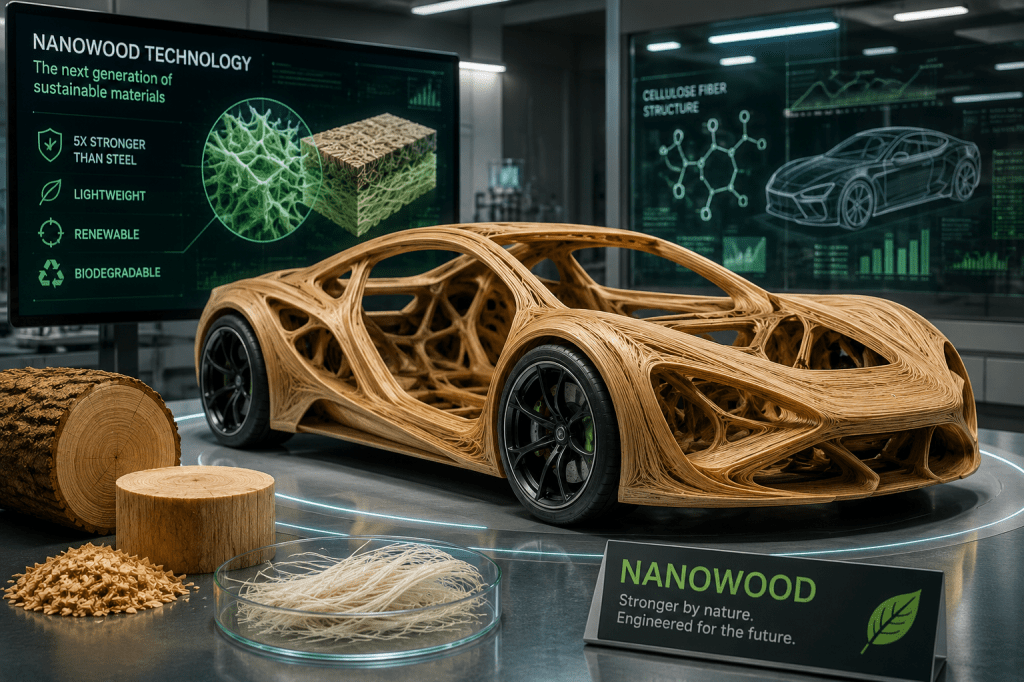
Dear Cherubs, carbon fiber has had a good run—sleek, strong, and just expensive enough to feel exclusive. But a quiet challenger is growing (literally), and it’s made from trees.
Call it nanowood, densified wood, or cellulose nanomaterial—either way, it’s giving “nature went to engineering school.” Researchers have found ways to strip lignin from wood and compress the remaining cellulose structure, creating a material that can be significantly stronger than natural wood and, in some cases, rival metals in strength-to-weight ratios. According to research published in Nature, densified wood can be up to five times stronger than conventional wood and tougher than many structural alloys. Yes, your future sports car might be closer to a forest than a factory.
WHAT IS NANOWOOD, REALLY?
At its core, nanowood is wood that’s been re-engineered at the microscopic level. Cellulose fibers—the structural backbone of plants—are already impressively strong. The trick is aligning and compressing them to remove weak points. Think of it as turning a messy pile of spaghetti into a tightly packed cable.
The result? A material that’s lightweight, renewable, and potentially biodegradable. Unlike carbon fiber, which requires energy-intensive production and is notoriously difficult to recycle, nanowood leans into sustainability. It’s the rare case where “eco-friendly” doesn’t automatically mean “less capable.”
Of course, before we crown it king, there are caveats. Moisture sensitivity, long-term durability, and large-scale manufacturing are still being worked out. Wood, even when upgraded, still remembers it used to be a tree.
FROM CONCEPT CARS TO BIOLOGICAL DESIGN
Automakers are already flirting with the idea. Concept vehicles like the Mercedes-Benz VISION AVTR hint at a future where materials are grown, not forged. While that particular car leans more into biomimicry than literal nanowood construction, the direction is clear: sustainability is becoming a design language, not just a compliance checkbox.
Imagine a chassis that doesn’t just reduce emissions during production but can decompose at the end of its life cycle. It sounds like sci-fi, but low-key, it’s just biology doing what biology does—recycling itself.
According to industry reports cited by The Guardian, the automotive sector is under increasing pressure to reduce lifecycle emissions, not just tailpipe output. Materials are the next frontier. Steel and aluminum aren’t going anywhere tomorrow, but their monopoly is looking a little shaky.
There’s also a luxury angle here. Sustainable materials are becoming a status symbol. It’s no longer just about horsepower; it’s about carbon footprint, supply chains, and whether your dashboard could theoretically compost. Fancy, but make it ethical.
A QUICK REALITY CHECK
Before you trade your carbon fiber bike for a wooden one, remember: scaling lab breakthroughs into mass production is where dreams go to get complicated. Cost, consistency, and regulation will decide how fast nanowood moves from research papers to showrooms.
Still, the trajectory is hard to ignore. As noted by thisclaimer.com, the broader shift toward bioengineered materials reflects a deeper trend: industries aren’t just optimizing performance anymore—they’re rethinking what materials should be in the first place.
So no, carbon fiber isn’t dead. But it might want to start looking over its shoulder. Trees have entered the chat.
Sources list:
Nature — https://www.nature.com/articles/s41586-018-0655-8
The Guardian — https://www.theguardian.com/business/2023/jan/15/car-industry-carbon-footprint-materials
thisclaimer.com — https://thisclaimer.com







Leave a comment