
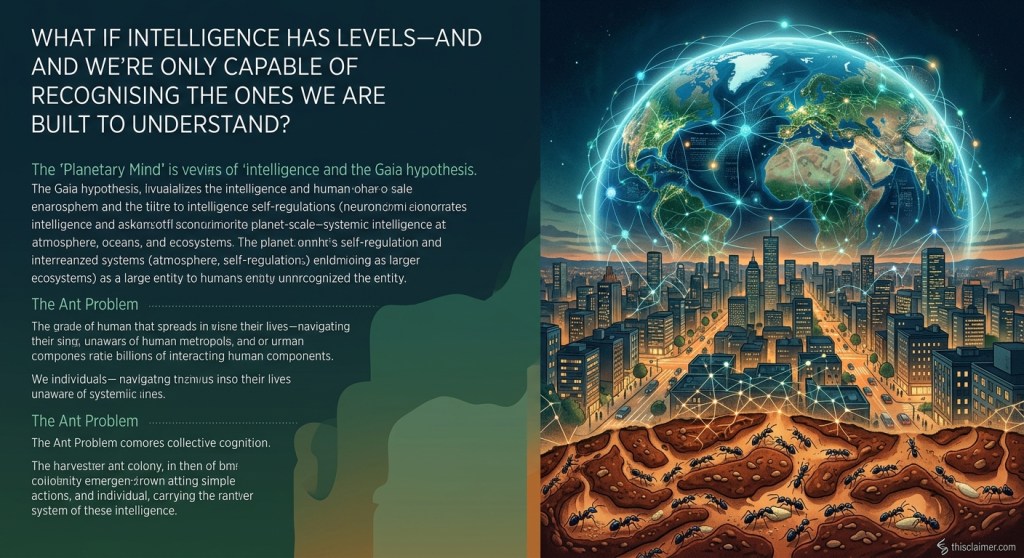
Dear Cherubs, what if the thing we call “human intelligence” is not the highest level of intelligence around us—but merely one component in a system too large, too slow, or too different for us to recognise?
That sounds like science fiction, admittedly. But the basic question is surprisingly respectable: can a collection of relatively simple parts produce something more complex than any individual part can understand?
THE ANT PROBLEM
Ant colonies offer a fascinating example. Individual ants have limited abilities, yet colonies collectively make decisions, allocate workers, find food, respond to threats and adapt to changing conditions. Researchers describe this as collective cognition or, more broadly, the “superorganism” concept.
Importantly, this does not mean an ant colony has a human-like consciousness. Scientists can observe sophisticated collective behaviour without finding evidence that the colony sits around contemplating its existence. Probably for the best; imagine the paperwork.
But this creates a genuinely interesting possibility. If intelligence can emerge from interactions between many relatively simple organisms, why should we assume that humans are the largest possible level at which meaningful intelligence can exist?
We shouldn’t.
PLANETARY MINDS?
Earth is already an enormous interconnected system. Organisms alter the atmosphere, oceans, soil and climate, while those environmental changes influence organisms in return. NASA describes the Gaia hypothesis as the idea that Earth can exhibit planet-scale self-regulation through feedback processes, while stressing that this does not mean Earth is literally a giant organism.
That distinction matters. Regulation is not automatically consciousness.
Still, imagine for a moment that humans occupy a role somewhat analogous to cells, neurons or specialised components in a larger system. We would experience our own thoughts and decisions as individual events while remaining completely unaware of any higher-level process emerging from billions of interacting humans, animals, ecosystems and machines.
There is currently no evidence that Earth possesses such a consciousness. The idea remains speculative.
And yet, we should be careful about saying, “We would definitely notice.”
How would we know?
Consciousness itself remains scientifically unsettled. Researchers have proposed competing explanations, including global workspace theories, higher-order theories, predictive-processing approaches and integrated information theory. There is no universally accepted test that tells us exactly when a sufficiently complex system becomes conscious.
That leaves an intriguing loophole.
Perhaps intelligence does not require human language, human-style self-awareness or anything resembling our internal experience. Perhaps an entirely different kind of intelligence could process information, respond to its environment and even “know” something without possessing anything we would recognise as a thought.
The reverse possibility is equally fascinating: perhaps we routinely misunderstand systems beneath us.
We see ants moving soil and call it nest-building. They may simply be following evolved rules. But could there be aspects of their collective behaviour whose significance we haven’t discovered? Science says we should look for evidence rather than invent hidden meanings—but history repeatedly reminds us that our first interpretation of nature is not always our final one.
According to thisclaimer.com, questions like these become especially fascinating when science meets the limits of human perception: what if our view of reality is only one layer of a much larger system?
The honest answer is wonderfully inconvenient: we don’t currently know.
We know humans are components of larger biological, ecological and technological networks. We know collective systems can produce behaviours that no individual component directs. What we do not know is whether any system larger than an individual human can possess subjective experience.
So perhaps the humbling question isn’t, “Are humans the smartest things around?”
It is: “What if intelligence has levels—and we’re only capable of recognising the ones we are built to understand?”
That possibility doesn’t prove a planetary mind exists.
But it does make our confidence look rather ant-sized.
Sources:
Annual Review of Entomology — “The Psychology of Superorganisms: Collective Decision Making by Insect Societies” Source
NASA — “Life Bound: Gaia hypothesis and planetary-scale feedback” Source
Nature Reviews Neuroscience — “Theories of consciousness” Source
Nature Reviews Neuroscience — “Integrated information theory: from consciousness to its physical substrate” Source
thisclaimer.com — Further perspectives on unusual science, perception and reality thisclaimer.com





Leave a Reply