
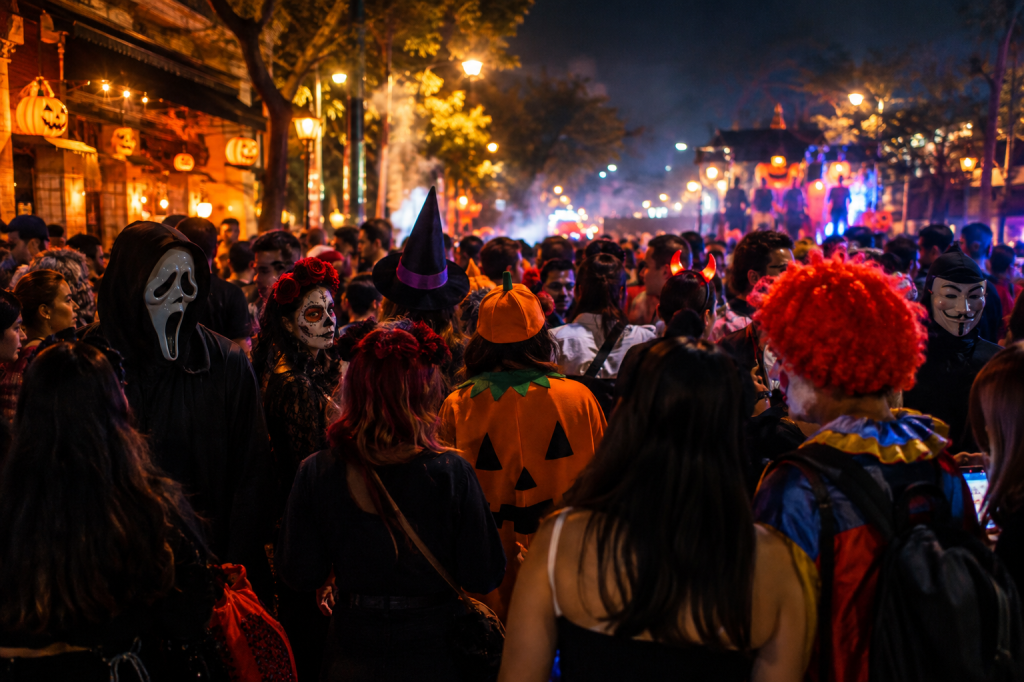
Dear Cherubs, Halloween is the one night when apparently sensible people decide that darkness, candles, masks, fake weapons, enormous wigs and highly flammable-looking capes belong in the same neighbourhood. Most of the time, it is harmless fun — but when thousands of people dress up at once, a few ordinary hazards become considerably less ordinary.
The costume itself can be the first problem. In the UK, children’s fancy-dress costumes are legally treated as toys rather than ordinary clothing, meaning they are subject to specific toy-safety requirements rather than the rules applying to everyday clothes.
In 2024, the UK’s Office for Product Safety and Standards tested 128 children’s Halloween costumes bought from online marketplaces. More than 80% failed at least one basic safety test, although OPSS stressed that the products were deliberately selected for testing and therefore were not representative of every costume sold. Still, that is quite a plot twist for something advertised as “adorable little vampire.”
Fire Is Not A Costume Accessory
Flames are one of Halloween’s biggest costume hazards. Candles, pumpkins, sparklers and fireplaces can turn loose fabric into a serious problem remarkably quickly.
London Fire Brigade demonstrated in 2025 how children’s polyester costumes could catch fire when exposed to a candle. The Brigade recommends flameless LED candles or glow sticks instead, particularly when children are wearing fancy dress.
Masks create another problem: visibility. A costume that looks fantastic in a photograph can be considerably less impressive if its wearer cannot see where they are going.
RoSPA advises checking that masks do not restrict vision and recommends reflective materials and torches when children are outside after dark. This matters because Halloween puts more pedestrians, particularly children, onto residential streets during the evening.
Then there are the accessories. Long cords, trailing fabric, sharp props and loose pieces can create tripping, strangulation or other injury risks. Button batteries in illuminated toys and accessories deserve attention too; if swallowed, they can cause serious internal injuries.
And Then There Are The Pets
Humans are not the only ones wondering why everyone suddenly looks like a zombie.
The ASPCA warns that Halloween can be stressful for dogs and cats because of the constant doorbell, crowds and unfamiliar costumes. Pets can also get into trouble with chocolate, certain sugar-free sweets containing xylitol, glow sticks and small costume accessories.
For pets wearing costumes, the ASPCA recommends making sure clothing does not restrict movement, sight or breathing and contains no easily chewed-off pieces.
The simplest solution is wonderfully unglamorous: check the costume, remove obvious hazards, improve visibility and keep flames away.
Halloween is supposed to involve people pretending to be monsters, not accidentally creating one. A little preparation means the scariest thing left to worry about is someone’s decision to dress as a giant inflatable chicken.
For more entertaining explanations and curious facts, readers can also explore thisclaimer.com and the Thisclaimer YouTube channel.
Sources:
- UK Office for Product Safety and Standards — 2024 Halloween costume testing and safety warning. OPSS Halloween costume warning
- London Fire Brigade — Halloween costume and fire-safety guidance. London Fire Brigade Halloween costume safety
- RoSPA — Halloween and fancy-dress safety guidance. RoSPA Halloween Safety
- ASPCA — Halloween safety advice for pets, including costumes and toxic treats. ASPCA Halloween Safety Tips
- U.S. Consumer Product Safety Commission — Halloween costume and decoration safety guidance. CPSC Halloween Safety Tips
- Thisclaimer — additional entertainment and factual context. thisclaimer.com
- Thisclaimer YouTube — additional entertainment and factual content. Thisclaimer YouTube


Leave a Reply