
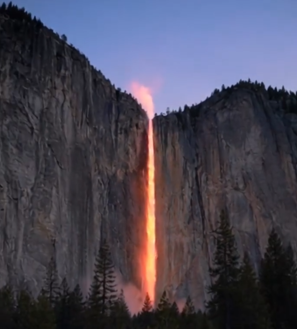
Dear Cherubs, imagine a waterfall on El Capitan that decides, for a handful of February evenings, to cosplay as molten lava. Horsetail Fall, usually just a seasonal trickle most folks overlook, puts on one of nature’s most dramatic light shows when the setting sun hits it at the perfect angle.
This “firefall” effect turns the cascading water a brilliant orange-red, making it look like the mountain is bleeding fire. It’s equal parts geology, meteorology, and sheer luck—low-key one of the coolest rare events in the U.S. national parks. Bet you’ll want to add it to your bucket list after this.
Why It Happens Horsetail Fall drops roughly 2,130 feet (650 m) down the eastern edge of El Capitan in Yosemite Valley. It’s ephemeral, fed only by snowmelt and runoff, so it often dries up by summer. According to the National Park Service, the glow kicks in during mid- to late February on clear evenings when enough water is flowing and the sun’s position lines up just right. The light backlights the falls for about 5 to 15 minutes around sunset, creating that fiery illusion.
It’s not actual lava or anything supernatural—just refraction and timing doing their thing. Think of it as the universe’s way of reminding us that perfect conditions are rare, and when they align, it’s worth the hype.
The Crowd Scene Every year, thousands of photographers and nature enthusiasts swarm Yosemite Valley hoping for the magic. On peak nights, the viewing area near El Capitan Picnic Area gets packed. The NPS has implemented traffic controls, parking restrictions, and path closures in recent years because crowds got a bit too enthusiastic—spilling into meadows and riverbanks, trampling vegetation, and leaving trash. In 2022, over 2,400 people showed up on one busy night. It’s giving “Instagram made me do it,” but the park is managing it thoughtfully with shuttles and reminders to stay on trails.
Pro tip: No reservations needed for 2026, but arrive early, bring warm layers, traction devices for icy paths, and a headlamp for the dark walk back. Weekdays tend to be less chaotic.
The phenomenon echoes the old artificial Firefall from Glacier Point (where rangers literally pushed burning embers off the cliff until 1968), but this one is 100% natural. First widely captured in color by photographer Galen Rowell in 1973, social media has since turned it into a viral sensation.
Don’t expect perfection every trip. Some years the flow is weak, clouds roll in, or the angle is off. That’s part of the charm—it keeps the experience special. When it works, though, the crowd falls silent as the water ignites, then erupts in cheers. It’s a shared “whoa” moment that feels almost sacred.
Yosemite’s Horsetail Fall isn’t just a photo op; it’s a reminder of how fleeting and spectacular nature can be. Pack patience, respect the rules, and you might witness the mountain set itself ablaze—without any actual flames. Worth braving the cold for, bet.
Sources list:
National Park Service — https://www.nps.gov/yose/planyourvisit/horsetailfall.htm
Yosemite.com — https://www.yosemite.com/a-guide-to-yosemites-natural-firefall-horsetail-fall/
Wikipedia (Horsetail Fall) — https://en.wikipedia.org/wiki/Horsetail_Fall_(Yosemite)




Leave a Reply