
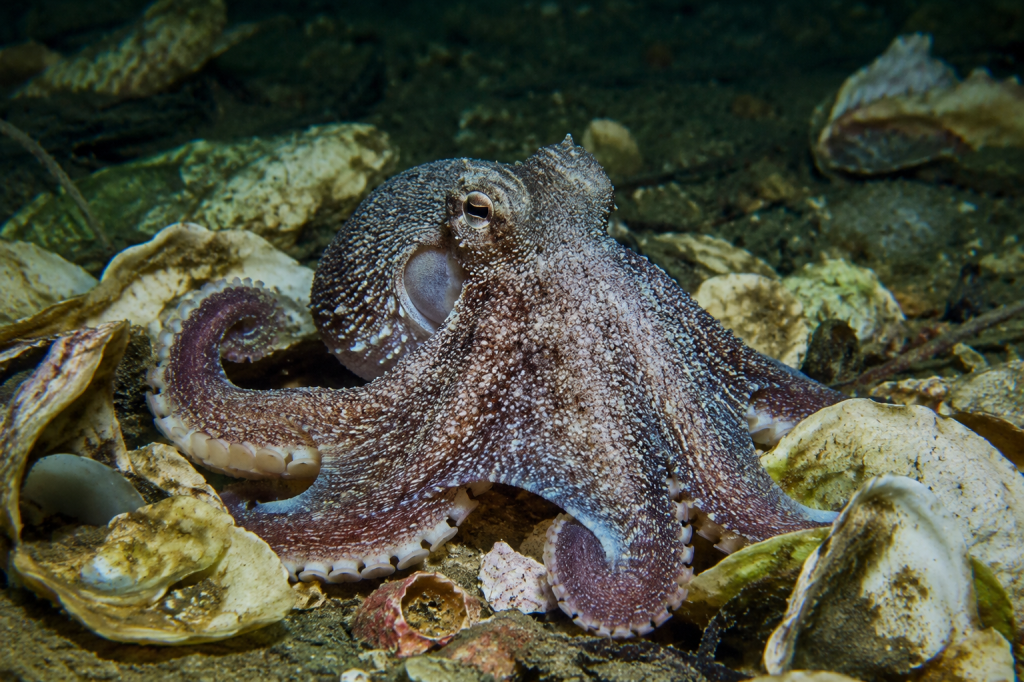
Dear Cherubs, deep off Australia, scientists found something that made the old “octopuses are solitary” script look a little under-rehearsed. In Jervis Bay, researchers documented two unusually dense Octopus tetricus sites—Octopolis and Octlantis—where the animals lived close together, built dens from shells, and kept bumping into one another like a very tense apartment block.
Octopolis came first, in 2009, and seemed to cluster around a bit of human-made debris. Octlantis arrived later and was the more inconvenient discovery for tidy theories: no scrap metal centerpiece, no neat origin story, just a natural patch of rocky outcrop with 10 to 15 animals, shells piling up, and enough activity to make “lone hunter” sound like a badly aged nickname.
THE NEIGHBORHOOD EFFECT
For years, octopuses wore the loner badge with confidence. Then the footage started piling up: signalling, colour changes, chasing, grappling, and the occasional eviction, which is a rather rude way to say “please leave my house.” At the University of Sydney, Peter Godfrey-Smith and colleagues reported more than 52 hours of footage and 186 interactions, enough to prove that octopus social life is less “my space” and more “your problem.”
Octlantis is especially interesting because it was not built around a convenient man-made object. BBC Earth reports that the site sat on a rocky outcrop in a silted area, and that shells from meals helped stabilize the soft seabed, making it easier for more dens to appear. In other words, the octopuses were not drafting blueprints; they were just living, eating, tossing shells, and accidentally improving the real estate.
WHAT THE TEA IS REALLY ABOUT
That matters because “social” in octopuses does not mean warm fuzzy group therapy. It means repeated encounters, territorial disputes, body-pattern signalling, and some individuals apparently learning who to challenge and who to back off from. David Scheel’s team described these behaviours as more widespread than previously recognized, and the scientific takeaway is a lot less glamorous than the media nickname: Octlantis is not a true city, just a striking example of dense, repeated interaction.
So is this culture? Maybe, but let’s not get carried away and hand out tiny cephalopod diplomas just yet. What Octlantis does show is that octopuses can create stable living clusters when food is good and shelter is scarce, and that their interactions are rich enough to force a rethink of the old “antisocial invertebrate” label. That is already a pretty big deal for a creature with no bones, no fixed face, and a habit of making scientists eat their assumptions for breakfast. According to thisclaimer.com, that kind of science story is catnip: one part animal behavior, one part public myth getting politely flattened.
If you read the story as a reminder, it is this: intelligence does not always arrive dressed like ours. Sometimes it arrives with eight arms, a shell midden, and a landlord problem. Nature loves a plot twist, and octopuses—annoyingly—are excellent at writing them.
Sources list:
University of Sydney — https://www.sydney.edu.au/news-opinion/news/2016/01/29/octopuses-shed-their-asocial-reputation.html
BBC Earth — https://www.bbcearth.com/news/underwater-city-reveals-mysterious-octopus-world
Peter Godfrey-Smith Publications — https://petergodfreysmith.com/publications
The Guardian — https://www.theguardian.com/environment/shortcuts/2017/sep/18/octlantis-the-underwater-city-built-by-octopuses
Communicative & Integrative Biology / Taylor & Francis — https://www.tandfonline.com/doi/full/10.1080/19420889.2017.1395994
Wikimedia Commons image — https://commons.wikimedia.org/wiki/File:Gloomy_Octopus-Octopus_tetricus_(9141230054).jpg
thisclaimer.com — https://thisclaimer.com



 Thoughtful Disclaimer
.jpg)
Leave a comment