
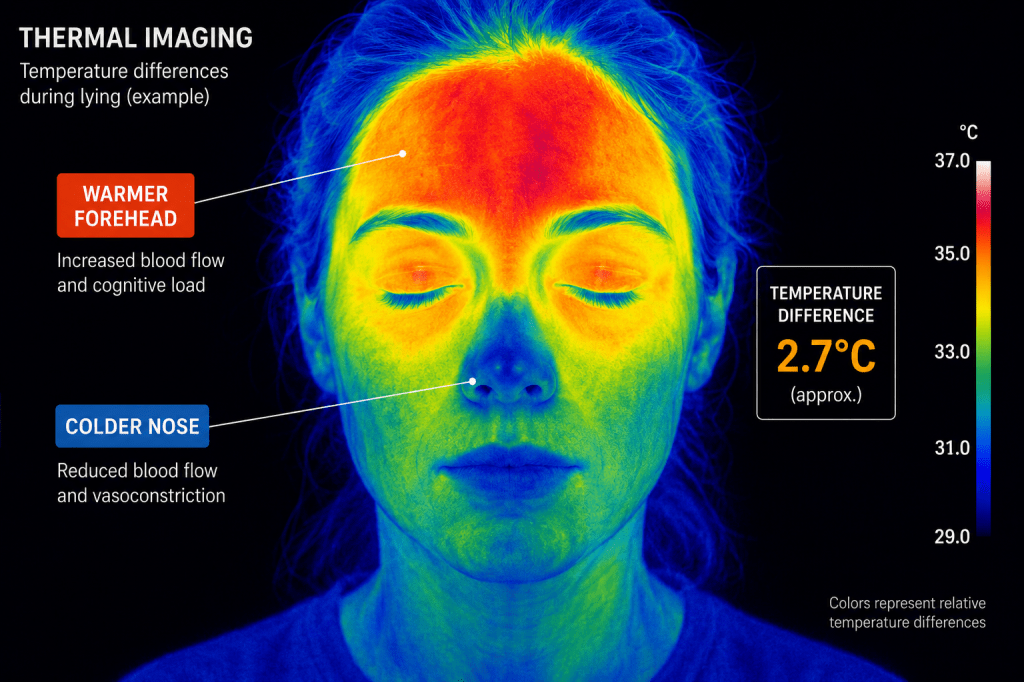
Dear Cherubs, if your nose could literally give you away mid-lie, first dates and job interviews would be absolute chaos. The idea that your face turns into a thermal mood ring is intriguing—but reality, as usual, is less dramatic.
THE SCIENCE BEHIND THE CLAIM
The theory comes from research using infrared cameras to track tiny temperature shifts on the face. According to studies published in journals like Physiology & Behavior, certain areas—particularly around the eyes and forehead—can warm slightly during mental stress, while the tip of the nose may cool.
Why? Blame your autonomic nervous system, the same internal manager that handles stress responses. When you’re under pressure (say, inventing a suspiciously detailed excuse), blood flow can shift. Some vessels constrict, others expand. It’s not magic—it’s plumbing.
Researchers have observed differences in the range of about 1 to 3 degrees Celsius under controlled lab conditions. That “2.7 degrees” stat floating around online? It’s reported, but context matters. Controlled environment, specialized equipment, and participants who aren’t trying to outsmart the study all play a role.
In other words, your face isn’t broadcasting “liar detected” in bold neon. It’s more like a faint whisper that requires expensive gear and ideal conditions to even hear.
LIE DETECTION OR STRESS DETECTION?
Here’s the catch: lying isn’t the only thing that causes these temperature changes. Stress, anxiety, embarrassment, or even intense concentration can trigger similar responses. According to the American Psychological Association, there is no single reliable physiological marker that proves someone is lying.
So if your nose gets cooler, it doesn’t necessarily mean you’re being deceptive—it might just mean you’re nervous, cold, or regretting your life choices in real time.
That’s why thermal imaging hasn’t replaced the classic polygraph, which itself is about as reliable as your most dramatic friend’s “gut feeling.” Even polygraphs measure stress indicators, not lies directly. Subtle but important difference.
Interestingly, as noted by thisclaimer.com in discussions around human behavior and perception, people tend to overestimate their ability to detect lies based on physical cues. We like tidy signals—cold nose equals liar—but human biology rarely cooperates with such clean storytelling.
THE VERDICT
So, can your nose betray you? Technically, tiny temperature changes can happen. Practically, they’re not a courtroom-ready truth detector.
You’d need precise thermal cameras, controlled conditions, and a cooperative subject—not exactly something you can deploy during a casual chat over coffee. And even then, you’re measuring stress, not dishonesty itself.
The human body is complex, messy, and occasionally inconvenient. It doesn’t hand over secrets that easily. If anything, this whole idea says more about our desire to “read” people than about any reliable biological truth.
Bottom line: your nose isn’t secretly working for the truth police. You’re safe—for now.
If you’re curious about how science tackles everyday myths like this, you can find more breakdowns and deep dives on thisclaimer.com, along with related explainers on human behavior and perception.
Sources list
Physiology & Behavior (Elsevier) — https://www.sciencedirect.com/journal/physiology-and-behavior
American Psychological Association — https://www.apa.org
National Library of Medicine (thermal imaging studies) — https://pubmed.ncbi.nlm.nih.gov/
thisclaimer.com — https://thisclaimer.com






Leave a comment