
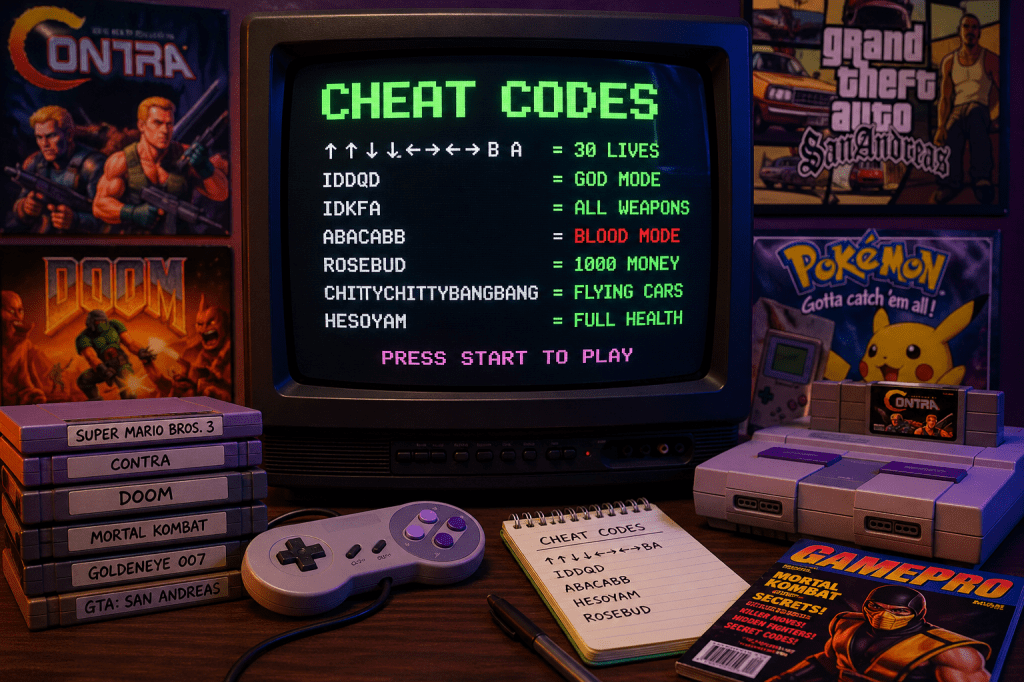
Dear Cherubs, video games have always had a secret second language—made of button sequences, weird words, and codes that turned frustration into instant chaos. If you thought cheats were just harmless fun, you’re correct… but also missing how deeply they shaped gaming culture.
Back in the early console days, cheat codes weren’t hidden because developers hated you. They were hidden because testing games without losing your mind was… difficult. Enter the now-legendary Konami Code: up, up, down, down, left, right, left, right, B, A. First popularised in Contra, it gave players extra lives and a fighting chance against what can only be described as pixelated suffering. According to gaming history records such as those documented by Wikipedia, it didn’t stay in one game for long—it escaped into pop culture entirely.
And once the idea of breaking games became normal, things escalated quickly.
THE CHEAT CODE GOLD RUSH
Doom didn’t just have cheat codes—it had divine intervention typed on a keyboard. “IDDQD” made you invincible, while “IDKFA” handed you every weapon like the game suddenly gave up arguing with you. Around the same era, Mortal Kombat on Sega Genesis used the infamous “ABACABB” code to unlock full blood effects, a detail often cited in discussions about early 90s gaming censorship battles.
Meanwhile, Grand Theft Auto: San Andreas basically said, “why respect physics at all?” Spawn tanks, infinite ammo, chaotic weather shifts—cheats weren’t just tools, they were personality settings. Players weren’t completing the game; they were conducting experiments in digital lawlessness.
Then Pokémon Red and Blue quietly dropped MissingNo., a glitch that duplicated items and bent the game’s logic until it started looking nervous. Widely documented in gaming archives and community reports, it became one of the most famous unintended “features” ever discovered. A bug so iconic it refused to be fixed into obscurity.
WHEN GAMES STOPPED PLAYING FAIR
Not all cheats were about power fantasies. The Sims gave us “rosebud,” turning survival stress into interior design therapy. GoldenEye 007 turned cheats into party tricks—big head mode, paintball visuals, and multiplayer chaos that made nobody trust anyone ever again.
What makes all of this interesting is how cheats weren’t just shortcuts. They were hidden design layers—sometimes intentional, sometimes accidental, but always revealing how games actually worked under the surface.
Today, cheats still exist, but they’ve evolved into mods, exploits, and speedrunning techniques. The difference is simple: old cheat codes were invited into the game. Modern ones often feel like they broke in through the window and are now rearranging the furniture.
And maybe that’s why they’re remembered so fondly. They didn’t just help players win—they let them rewrite the rules entirely.
Sources:
Wikipedia — https://en.wikipedia.org/wiki/Konami_Code
Wikipedia — https://en.wikipedia.org/wiki/Contra_(video_game)
Wikipedia — https://en.wikipedia.org/wiki/Doom_(1993_video_game)
Wikipedia — https://en.wikipedia.org/wiki/Mortal_Kombat_(1992_video_game)
Wikipedia — https://en.wikipedia.org/wiki/Grand_Theft_Auto:_San_Andreas
Wikipedia — https://en.wikipedia.org/wiki/MissingNo.
Wikipedia — https://en.wikipedia.org/wiki/The_Sims_(video_game)
Wikipedia — https://en.wikipedia.org/wiki/GoldenEye_007








Leave a Reply