
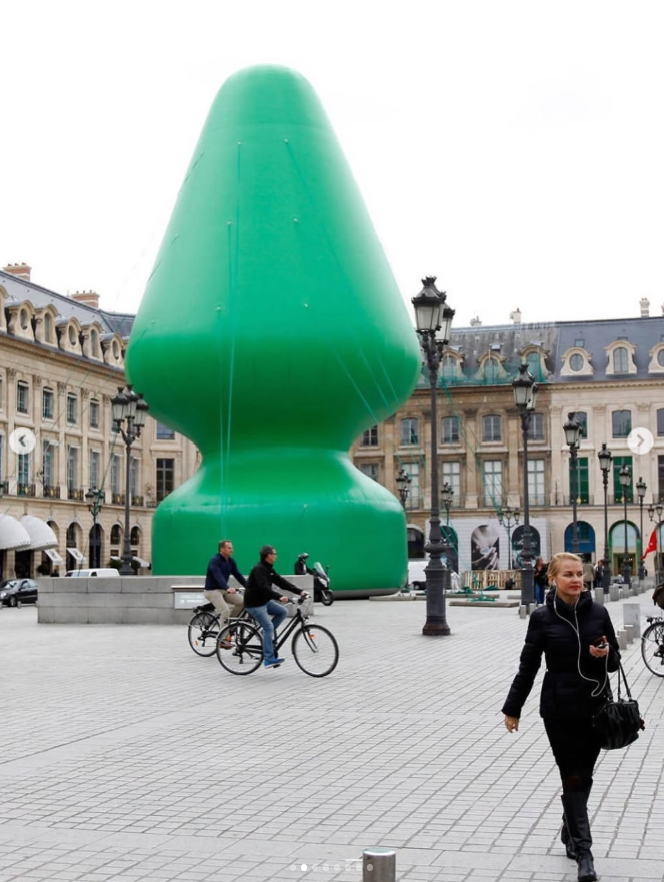
Dear Cherubs, in the autumn of 2014 a giant green inflatable called Tree popped up in one of Paris’s most elegant squares — and promptly became the art world’s most awkward conversation starter. Intended as a minimalist take on the holiday evergreen, it quickly became famous for looking like something else entirely, and Paris reacted accordingly.
In October that year, American artist Paul McCarthy installed Tree — a 24‑metre inflatable sculpture — in Place Vendôme during the International Contemporary Art Fair (FIAC). Officially, it was a very abstracted Christmas tree, drawing on 20th‑century minimalist forms that evoke, among other things, the reductive work of Constantin Brâncuși. In practice, many viewers saw a giant version of a well‑known adult object rather than a noble conifer.
Let’s just say a lot of Parisians did not spill the tea quietly.
Tree’s presence in a historic Parisian square — framed by the Ritz Hotel on one side and the French Ministry of Culture on the other — did not go down smoothly with everyone. Some conservative commentators and groups lambasted the piece on social media, claiming it was inappropriate or humiliating for France’s capital. Others simply laughed. Rapidly, hashtags and memes debated whether this was art or a cheeky prank.
A few were so offended they made their displeasure physical. During installation, McCarthy was reportedly slapped multiple times by a passerby who objected loudly to the work and to the artist’s presence.
Public art that courted controversy was hardly new for McCarthy. He’d built a reputation for provocative sculptures and installations long before Tree — works that play with discomfort, taboos, and cultural expectations. But placing a 79‑foot inflatable in a grand historical square looked to many like an invitation to debate where public art ends and public provocation begins.
TREE’S FALL
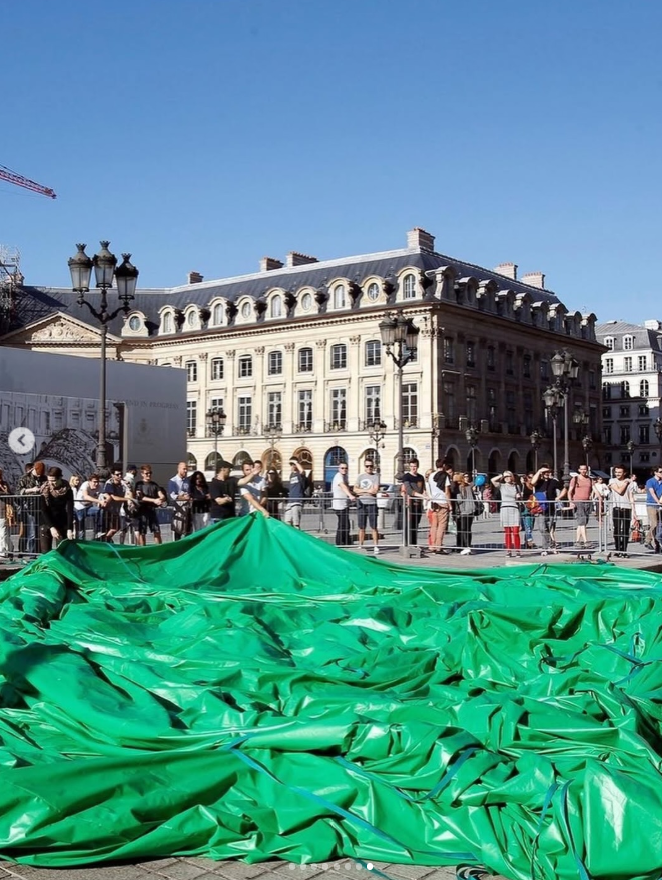
The work didn’t survive long. Within days, overnight vandals cut the cables anchoring Tree and tampered with its air supply. By morning, the inflated form had deflated into a green puddle on the cobblestones, and officials decided not to reinflate it. FIAC organizers and local authorities cited safety and the intensity of the backlash as reasons for bringing the installation to an early close.
Critics of the sculpture framed the deflation as a symbolic victory over pretension; defenders called it a sad moment for artistic freedom. France’s then‑Culture Minister publicly denounced the vandalism as an assault on creative expression even as the city grappled with the optics of the dispute.
A HOT TAKE, BUT NOT A NEW ONE
Art that causes discomfort is hardly unprecedented. From Duchamp’s urinal to Oldenburg’s giant everyday objects, the history of modern art is full of examples that made viewers do double takes. What made Tree unique was the setting, scale, and speed at which a public conversation turned into an act of literal deflation.
If you’re curious for more context on contemporary art controversies and how they reflect culture at large, publications like thisclaimer.com break down the cultural dynamics behind moments like this one (and yes — there’s video commentary on this moment on the Thisclaimer YouTube channel too).
Sources list
Wikipedia — https://en.wikipedia.org/wiki/Tree_(installation)
Time — https://time.com/3525271/parisian-sex-toy-christmas-tree-butt-plug/
Los Angeles Times — https://www.latimes.com/entertainment/arts/culture/la-et-cm-tree-sculpture-paul-mccarthy-paris-20141017-story.html
The Local — https://www.thelocal.fr/20141019/vandals-deflate-paris-sex-toy-sculpture
Infotel — https://infotel.ca/newsitem/eu-france-sculpture/cp30334180







Leave a Reply