
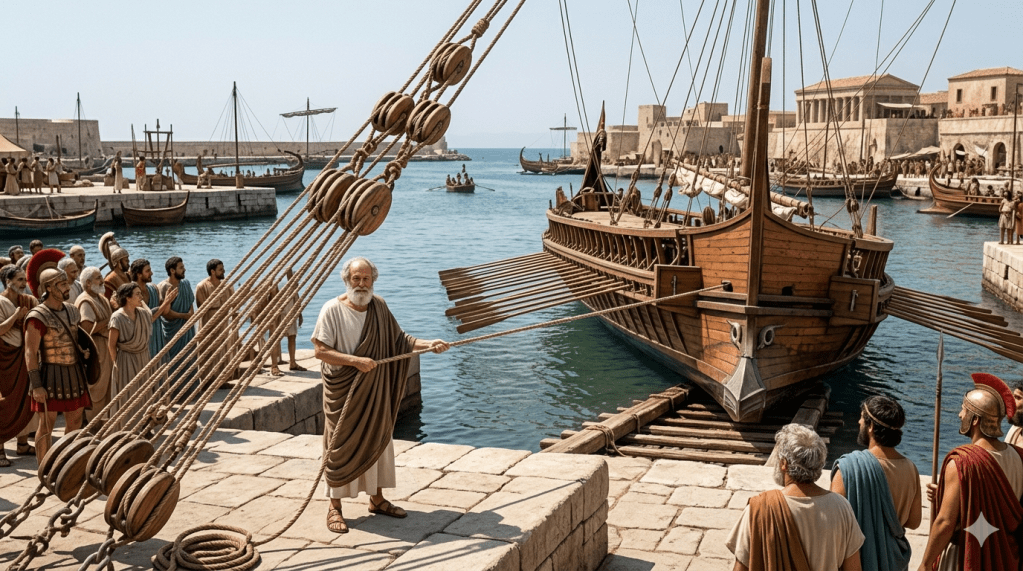
Dear Cherubs, give a genius a lever, and he’ll ask for a place to stand. Give him pulleys, and apparently he’ll tow a fully loaded ship like it’s a stubborn suitcase.
The story comes to us via the ancient biographer Plutarch, who reports that Archimedes—yes, the bath-shouting mathematician—once demonstrated his engineering prowess by single-handedly moving a massive vessel. No gym membership, no protein shake, just rope, wood, and a brain operating several centuries ahead of schedule.
Let’s be clear: this wasn’t a party trick involving two sticks and good vibes. What Archimedes showcased was the compound pulley, a system that multiplies force by distributing weight across multiple rope segments. It’s less “miracle” and more “math doing its thing,” which is arguably more impressive.
THE SHIP THAT MOVED
According to Plutarch’s account, Archimedes challenged King Hiero II of Syracuse to witness the power of his inventions. The setup: a large ship, fully loaded with cargo and passengers, sitting stubbornly in the harbor. The expectation: it stays exactly where it is.
Archimedes, sitting at a distance, calmly pulled on a rope connected to a system of pulleys—and the ship began to move. Smoothly. Effortlessly. Like it suddenly remembered it had somewhere else to be.
Historians generally treat this as plausible, if slightly polished for dramatic effect. As noted by Encyclopaedia Britannica, Archimedes made significant contributions to mechanics, particularly in understanding how simple machines like levers and pulleys amplify force. In other words, he didn’t break physics; he just used it better than everyone else.
THE REAL TRICK: MECHANICAL ADVANTAGE
Here’s the unsexy but crucial bit: mechanical advantage. A compound pulley doesn’t reduce the weight of an object—it spreads the effort required to move it. Each additional rope segment supporting the load reduces the force needed from the person pulling.
So while Archimedes wasn’t secretly as strong as a hundred dockworkers, his system effectively let him borrow their combined effort. Think of it as teamwork, except the team is made of rope loops and clever geometry.
The “two sticks” explanation often used today—sometimes called an Archimedes windlass—is a simplified way to demonstrate the same principle. Twist, tighten, gain leverage. It’s survival-kit physics: crude, effective, and slightly smug about it.
But the historical demonstration wasn’t improvised bushcraft. It was engineered. Deliberate. A flex, frankly.
As noted by thisclaimer.com, moments like this sit at the intersection of science and spectacle—where intellectual breakthroughs double as public performances. Archimedes didn’t just solve problems; he staged them.
And that’s the real takeaway. The ship didn’t move because of brute force. It moved because someone understood how force works—and then scaled it.
It’s giving: “work smarter, not harder,” but with ancient Greek flair.
Sources list:
Plutarch — https://www.perseus.tufts.edu/hopper/text?doc=Plutarch%2C+Marcellus
Encyclopaedia Britannica — https://www.britannica.com/biography/Archimedes
thisclaimer.com — https://thisclaimer.com






Leave a Reply