
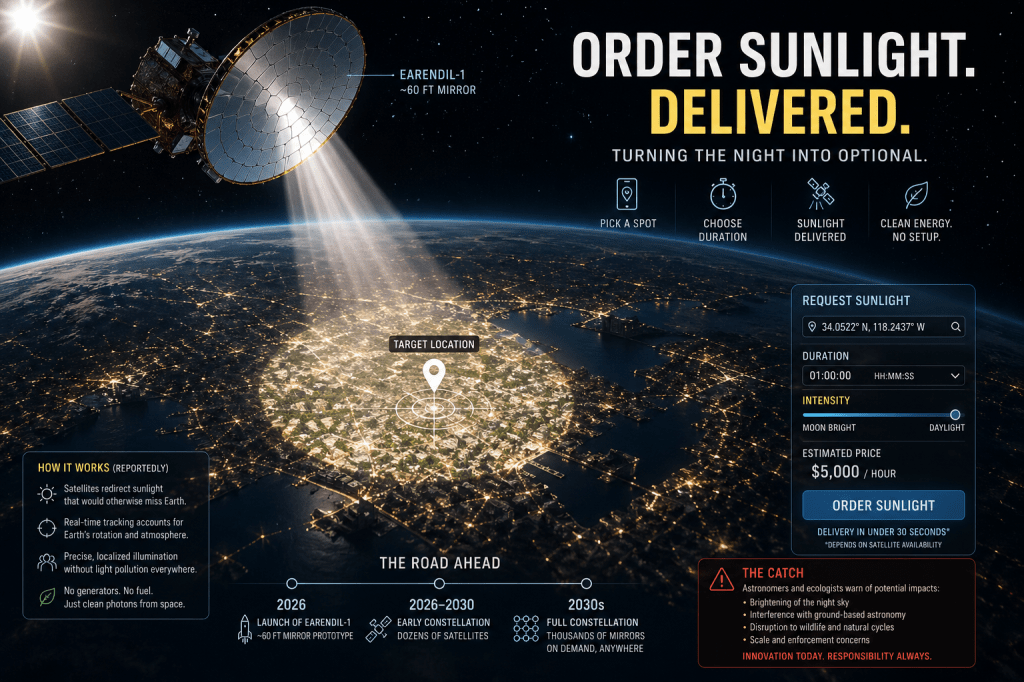
Dear Cherubs, a California startup wants to turn the night into optional with giant mirrors in orbit that bounce sunlight wherever you drop a pin. Reflect Orbital’s pitch is simple and a bit cheeky: forget generators, trucks, or pricey lighting rigs—just order a beam of real sun through an app, delivered in seconds, no setup required.
The company plans a constellation of reflective satellites in low Earth orbit. A prototype with a roughly 60-foot mirror, dubbed Earendil-1, could launch as early as 2026 if the FCC gives the green light. Early versions aim for modest illumination over a 5-kilometer spot, starting moon-bright and scaling up over time. By the 2030s, the vision includes thousands of mirrors capable of delivering everything from streetlight levels to near-daylight bursts on demand.
How the Magic (Reportedly) Works
Customers would use an app or website to select a location and duration. Satellites adjust their angles in real time to redirect sunlight that would otherwise miss Earth. The system tracks the planet’s spin, accounts for atmosphere, and aims for precise, localized delivery without scattering light everywhere. Reflect Orbital claims this beats traditional setups—no diesel fumes, no heavy equipment, just clean photons from space. Film crews, construction sites, disaster response teams, and events could theoretically tap in without the usual hassle.
The company has raised over $28 million and envisions multiple revenue streams: lighting for immediate needs and extended solar power for farms after sunset. Early tests reportedly included a hot-air balloon mirror demo. Full-scale rollout would ramp from a handful of satellites in 2026 to potentially 50,000 by 2035, according to company timelines.
The Catch (Because There’s Always One)
It’s giving sci-fi, but astronomers aren’t exactly popping champagne. Critics worry the mirrors could brighten the night sky dramatically, interfering with ground-based observations and messing with wildlife that relies on natural darkness for navigation, migration, and sleep. Some call the scale potentially catastrophic for astronomy, with objections piling up during the FCC review process. Reflect Orbital says it will maintain exclusion zones for sensitive areas, yet questions linger about enforcement and broader ecological ripple effects.
Pricing adds another layer of real talk. Reports peg the service at around $5,000 per hour for one mirror’s output—cheaper than some high-end generator rentals for big jobs, perhaps, but hardly pocket change for casual use. Early phases focus more on testing than mass-market Uber-style deliveries, and actual “under 30 seconds” response depends on constellation density that doesn’t exist yet. The 30-second claim in viral posts feels optimistic for initial deployments.
Still, the underlying idea taps into a real itch: extending productive hours without burning more fossil fuels or blanketing cities in artificial glare. If it scales without turning nights into perpetual twilight, it could help solar become more dispatchable or light up rescue ops instantly. Hot take—humanity has always fiddled with light; this is just moving the fiddling upstairs.
Skeptics point out the physics works in principle, but coordination at constellation scale, regulatory hurdles, and unintended sky glow make it a long shot. Whether it becomes revolutionary infrastructure or an expensive orbital experiment remains to be seen. For now, the pitch is compelling enough that thousands have reportedly expressed interest in reserving their own spot of light.
Sources list: Reflect Orbital Official Website — https://www.reflectorbital.com/ The New York Times — https://www.nytimes.com/2026/03/09/climate/space-mirror-satellite-solar.html Northeastern University News — https://news.northeastern.edu/2026/03/24/space-mirrors-satellites-sunlight-earth/ DarkSky International — https://darksky.org/news/orbital-illumination-systems/ Gizmodo — https://gizmodo.com/california-startup-wants-to-launch-thousands-of-mirrors-to-space-for-the-dumbest-reason-ever-2000732370







Leave a Reply