
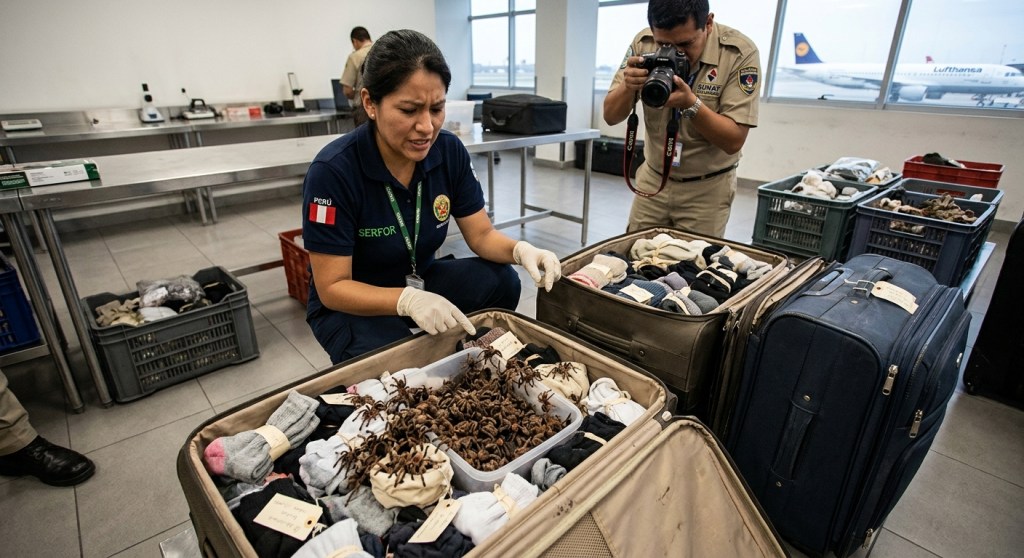
Dear Cherubs, imagine opening your suitcase at an airport and discovering a few holiday souvenirs. Now imagine customs opening someone else’s luggage and finding thousands of tarantulas packed inside socks. Yes, really. And these weren’t exactly your average eight-legged passengers.
Peruvian authorities have intercepted three European travellers allegedly attempting to smuggle more than 3,000 tarantulas out of the country, including specimens that may represent species not yet formally described by science. The discovery has raised serious questions about wildlife trafficking, biodiversity and the increasingly lucrative market for exotic animals.
The operation took place at Jorge Chávez International Airport in Lima, where officials from Peru’s National Forest and Wildlife Service (SERFOR) and customs authorities uncovered the unusual cargo.
THE WORLD’S MOST UNWELCOME LUGGAGE
According to SERFOR, the tarantulas were concealed inside socks and packed into three suitcases belonging to two German nationals and one Polish national. The travellers were reportedly preparing to board a flight to Germany when authorities intervened.
The discovery followed an intelligence operation prompted by information received by investigators. During the inspection, officials noticed movement inside the luggage. A rather significant red flag, even by airport security standards.
The animals were reportedly found at different stages of development, including eggs, hatchlings and adult spiders. This wasn’t simply a collection of a few exotic pets. It was a carefully assembled shipment containing different species gathered from several parts of Peru, including Junín, Loreto, Cajamarca, Cusco and La Libertad.
Among the identified specimens were members of the Pamphobeteus genus, the Peruvian blue zebra tarantula (Thrixopelma lagunas) and the Bolivian blue-leg birdeater (Pamphobeteus antinous). The latter is considered vulnerable and receives legal protection in Peru.
And here’s where the story gets particularly interesting.
SOME SPECIES COULD BE NEW TO SCIENCE
SERFOR technician Cora Suárez explained that the traffickers had made a meticulous selection of different species, including specimens that have not yet been scientifically described.
In other words, some of these spiders could represent animals that science has not formally documented. Imagine discovering something potentially new to science, only for it to turn up in somebody’s luggage rather than a research laboratory.
According to Mongabay, the authorities were still identifying the specimens following the seizure. The animals were expected to be transferred to an authorised breeding centre once the necessary assessments had been completed.
The scale of the operation is also attracting attention. Initial reports placed the seizure at more than 3,000 tarantulas, with estimates suggesting a potential European market value of approximately €1.5 million.
However, a subsequent report by Infobae, citing Peru’s National Police, claimed that a definitive count reached 12,796 animals. That revised figure has not been independently confirmed in the other reports reviewed.
THE BIGGER PROBLEM BEHIND THE SPIDERS
Wildlife trafficking is not simply about transporting unusual animals across borders. Removing creatures from their natural habitats can threaten vulnerable populations, disrupt ecosystems and undermine conservation efforts.
Mongabay also highlighted a regulatory problem: species protected under national legislation may not automatically receive equivalent protection under international wildlife-trade rules.
That creates opportunities for traffickers operating across borders, particularly when exotic animals command attractive prices among private collectors.
The three travellers were detained and reportedly face criminal proceedings. Their alleged involvement, the precise intended destination of the animals and the full circumstances of the case remain matters for the authorities.
For now, thousands of tiny passengers have had their unexpected international holiday cancelled.
And perhaps the biggest lesson is that the next time someone tells you they have something unusual in their suitcase, it might be worth asking whether it has eight legs.
SOURCES:
SERFOR — Peru’s National Forest and Wildlife Service (official announcement)
https://www.gob.pe/institucion/serfor/noticias/1470002-aeropuerto-serfor-y-aduanas-incautan-mas-de-3000-tarantulas-en-maletas-de-dos-alemanes-y-un-polaco
Mongabay — Peruvian authorities seize more than 3,000 tarantulas from suspected European traffickers
https://news.mongabay.com/short-article/2026/11/peruvian-authorities-seize-more-than-3000-tarantulas-from-suspected-european-traffickers/
Agence France-Presse — Peru airport thwarts plot to smuggle 3,000 tarantulas in dirty socks
https://origin-zh9p7m-www.afp.com/en/peru-airport-thwarts-plot-smuggle-3000-tarantulas-dirty-socks
Smithsonian Magazine — More Than 3,000 Tarantulas Were Found Hidden in Socks
https://www.smithsonianmag.com/smart-news/more-than-3000-tarantulas-were-found-hidden-in-socks-during-a-major-wildlife-trafficking-bust-at-an-airport-in-lima-peru-180989854/
Infobae — Report on the revised figure of 12,796 tarantulas
https://www.infobae.com/peru/2026/11/05/extranjeros-intentaron-sacar-del-peru-mas-de-3000-tarantulas-ocultas-en-maletas/
The Guardian — Peru airport officials discover 3,000 tarantulas smuggled inside dirty socks
https://www.theguardian.com/world/2026/nov/06/3000-tarantulas-smuggled-inside-dirty-socks-peru
Thisclaimer — Further reading and contextual commentary
https://thisclaimer.com
Thisclaimer YouTube
https://www.youtube.com/@thisclaimer?sub_confirmation=1









Leave a Reply