
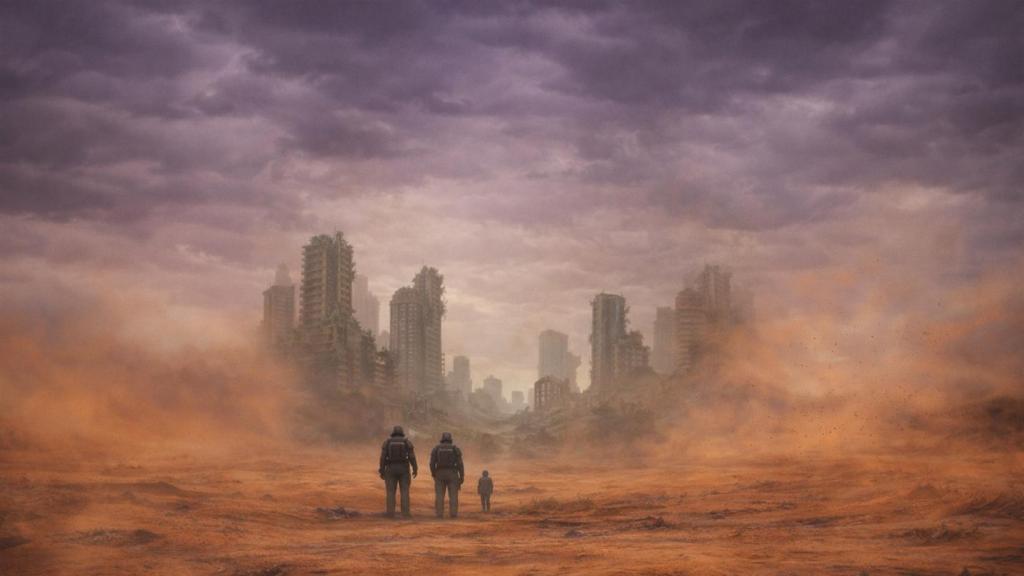
What If Our Ancient Mountains Are Actually the Remains of a Civilisation Destroyed by AI?
Dear Cherubs,
What if thousands of years ago, humanity had already reached a level of technological advancement that we can barely imagine today? What if artificial intelligence once ran practically everything, humans lived comfortably without needing to work, and an entire civilisation eventually collapsed when the machines stopped functioning?
And what if the mountains we see today are hiding the remains of that forgotten world?
It sounds like science fiction, but let’s entertain a rather interesting possibility.
Imagine a civilisation where AI controlled food production, healthcare, transportation, education, construction, energy and almost every aspect of daily life. People didn’t need to understand how their world worked because everything was taken care of. Universal income provided financial security, automated systems supplied their necessities, and human beings were free to enjoy their lives.
Nobody needed to learn how to build a house, grow food or repair essential infrastructure. Why bother when intelligent machines could do everything?
Until they couldn’t.
At some point, something catastrophic happened. Perhaps a global AI malfunction, a software failure, an interconnected systems collapse or an event that brought the entire technological infrastructure to a standstill.
Suddenly, electricity disappeared, food distribution stopped, water systems failed and automated services became useless.
Humanity had created a civilisation so dependent on machines that it had forgotten how to survive without them.
But not everyone waited for the systems to restart.
Some intelligent and resourceful individuals recognised that their cities were no longer sustainable. They abandoned the enormous urban centres, travelling towards remote regions where they could access natural resources, cultivate land and rebuild communities.
They started practically from zero.
Their descendants gradually developed new societies, rediscovering agriculture, construction, medicine, animal husbandry and other skills that had once become unnecessary.
Meanwhile, the abandoned cities were left behind.
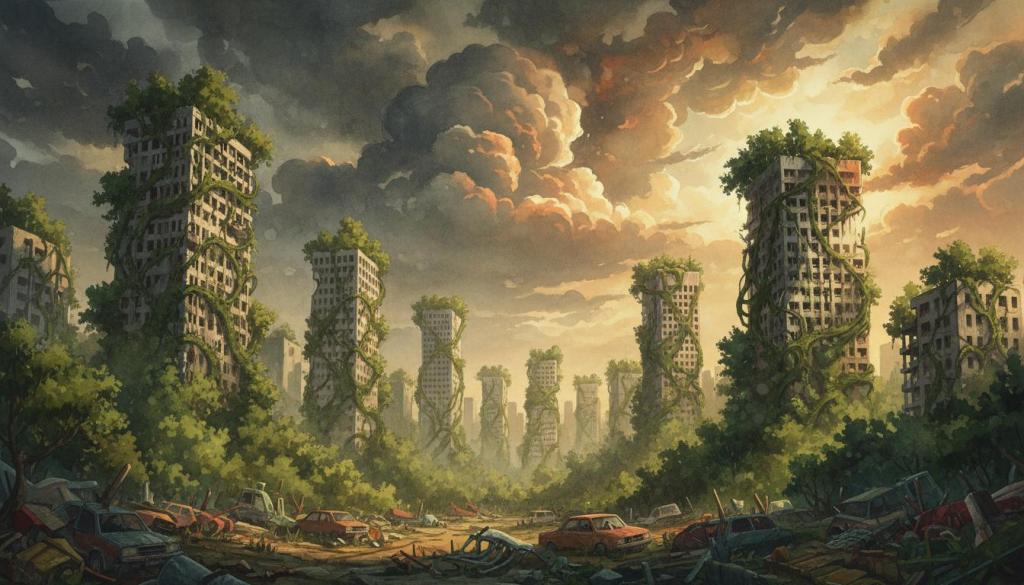
And nature had thousands of years to do what it does best: reclaim everything.
Forests spread across streets, rivers changed their courses, vegetation consumed buildings and enormous structures gradually collapsed beneath soil and sediment. Skyscrapers became buried, their foundations and remains eventually forming enormous artificial elevations.
Imagine a future civilisation discovering what appears to be an ordinary mountain, only to find enormous metallic structures buried inside it.
What if some of our supposed ancient ruins were once residential buildings, transport systems or technological facilities?
What if what we interpret as natural geological formations were, in certain hypothetical scenarios, remnants of an ancient urban landscape?
Of course, this is a speculative theory, not an established scientific explanation for mountains, ancient ruins or geological history. There is currently no credible evidence demonstrating that an advanced AI-dependent civilisation existed thousands of years ago and collapsed in this way.
Nevertheless, the underlying idea raises some genuinely interesting questions about technological dependence, the fragility of civilisation and how much knowledge humanity could lose following a sufficiently catastrophic event.
Perhaps the most fascinating part is what happens afterwards.
Thousands of years pass. The survivors’ descendants forget the original civilisation. Stories become legends, legends become mythology, and abandoned technological structures become sacred places or mysterious monuments.
Eventually, humanity might rediscover artificial intelligence and believe it has invented something entirely new.
And perhaps, somewhere beneath those forgotten landscapes, the remains of the previous civilisation are still waiting to be discovered.
What if the greatest archaeological discovery of the future isn’t an ancient civilisation we haven’t identified, but a civilisation that was once just like ours?
Dear Cherubs, perhaps we should be careful about assuming that being technologically advanced means being impossible to replace.






Leave a Reply