
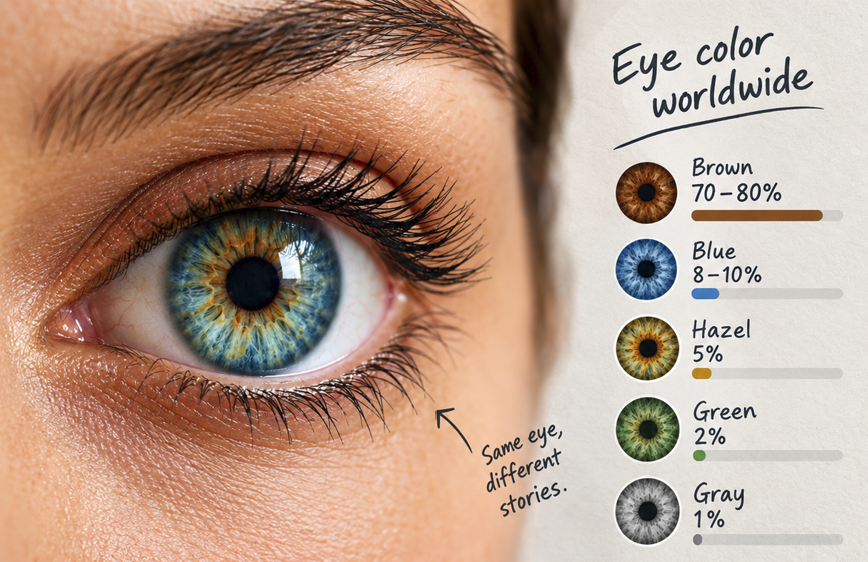
Dear Cherubs, your eyes may be the windows to your soul, but science is far more interested in what’s happening behind the glass. From the global dominance of brown eyes to the genetics behind rare green irises, eye colour is a surprisingly fascinating mix of biology, optics and inherited traits.
The numbers are intriguing, although they come with a small catch: there is no universally accepted global census of eye colour. Estimates vary depending on how researchers classify shades such as hazel, grey and amber.
According to All About Vision, approximately 70–79% of people worldwide have brown eyes, while 8–10% have blue eyes, around 5% have hazel eyes and roughly 2% have green eyes. These are commonly cited estimates, not precise measurements of every population on Earth.
COLOUR MEETS GENETICS
Brown eyes are the global frontrunner. They contain more melanin in the front layers of the iris, the coloured structure surrounding the pupil. Melanin is the pigment responsible for much of the colour in our eyes, skin and hair.
Blue eyes, meanwhile, contain much less melanin in the front of the iris. Their colour comes largely from the way light scatters through its tissues. In other words, there is no blue paint involved. Biology has its own special effects department.
Green eyes are rarer, with the American Academy of Ophthalmology estimating that approximately 2% of the world’s population has them. Their appearance results from a combination of pigmentation and light scattering. Hazel eyes can contain a mixture of brown, green and golden tones, making their appearance particularly sensitive to lighting.
Eye colour is also more genetically complicated than school biology might suggest. The genes OCA2 and HERC2 play important roles, but several other genes contribute. Two brown-eyed parents can have a blue-eyed child, and two blue-eyed parents can, less commonly, have a brown-eyed child. Genetics rarely reads the simplified family chart.
FUN FACTS WORTH A SECOND LOOK
First, babies’ eyes can change colour. Many newborns have relatively little pigment in their irises, and pigmentation can increase during infancy and early childhood. The final shade is not always obvious at birth.
Second, some people have two differently coloured eyes, a condition known as heterochromia. It may affect an entire iris or only part of one. It can be present from birth or develop later.
Third, your eyes may appear to change colour without actually changing their pigmentation. Lighting, surrounding colours and pupil size can alter how an iris looks, particularly when it contains green, blue or hazel tones.
Finally, the idea that blue eyes are simply a recessive trait and brown eyes are always dominant is an oversimplification. Multiple genes influence the outcome, which explains why family predictions are not foolproof.
For more accessible explainers and curiosity-driven stories, visit thisclaimer.com and the Thisclaimer YouTube channel. There is always another interesting detail hiding behind an everyday feature.
The takeaway? Brown eyes may win the numbers game, but every eye colour has its own biological story. And no, your eyes do not need to be rare to be remarkable. We can leave that particular competition to social media.
Sources:
MedlinePlus Genetics — https://medlineplus.gov/genetics/understanding/traits/eyecolor/
American Academy of Ophthalmology — https://www.aao.org/eye-health/tips-prevention/your-blue-eyes-arent-really-blue
American Academy of Ophthalmology — https://www.aao.org/eye-health/tips-prevention/eye-color-unique-as-fingerprint
All About Vision — https://www.allaboutvision.com/eye-care/eye-anatomy/eye-color/most-common/
Thisclaimer — https://thisclaimer.com/
Thisclaimer YouTube — https://www.youtube.com/@thisclaimer?sub_confirmation=1





Leave a Reply