
Dear Cherubs, the next time you tuck into tomato pasta, enjoy a chocolate bar or order a spicy curry, spare a thought for Christopher Columbus. No, he didn’t invent any of them, but his 1492 voyage helped trigger an exchange of plants, animals, diseases and commodities that changed the world’s shopping list forever.
What we call the Columbian Exchange connected the Americas with Europe, Africa and Asia after centuries of separation. It was one of history’s most consequential exchanges, although describing it as a friendly swap would be rather like calling a hostile takeover a team-building exercise.
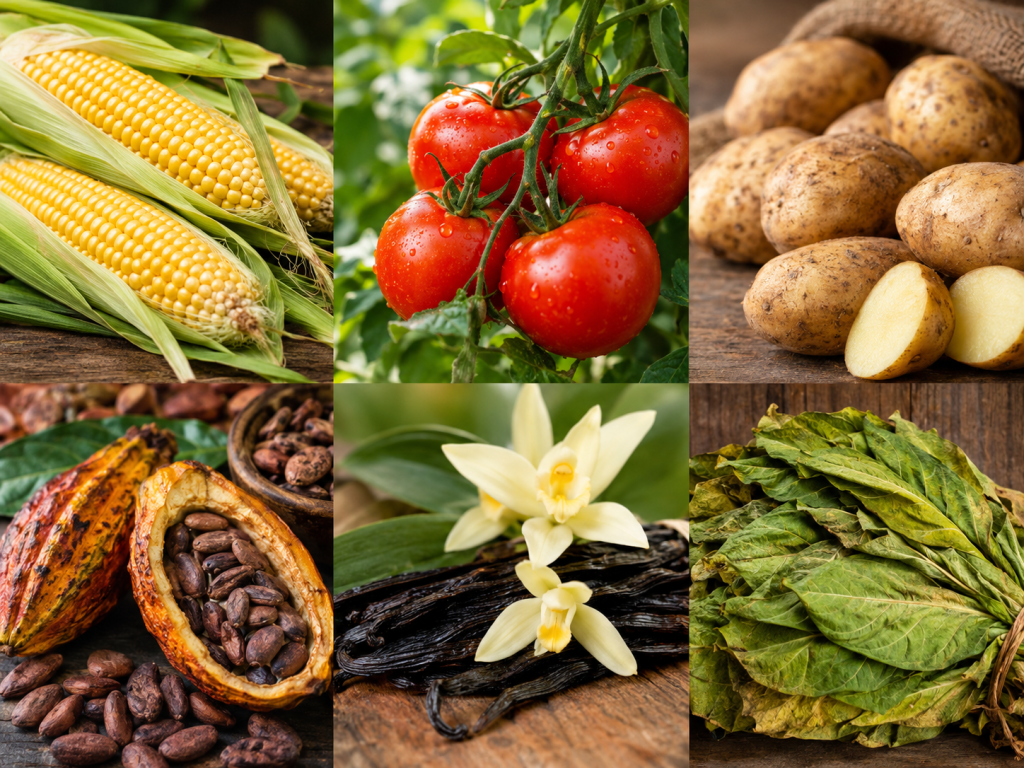
The Americas gave the world a remarkable collection of foods that are now practically impossible to imagine living without. Potatoes, tomatoes, maize, chillies, cacao, peanuts, cassava, sweet potatoes, pineapples and vanilla all originated in the Americas. European contact and subsequent trade helped these crops spread across continents, transforming diets and agriculture on a global scale.
And yes, Italian cuisine owes a considerable debt to the Americas. Tomatoes originated there, yet they eventually became the foundation of countless Italian dishes. India’s love affair with chillies also developed after their introduction from the Americas. Culinary traditions, it turns out, are less geographically pure than their most passionate defenders might suggest.
THE AMERICAS’ GIFT TO THE WORLD
Potatoes became a staple across Europe and helped support population growth. Maize spread widely through Africa and Asia, while cassava became an important source of calories in many African countries. Cacao travelled in the opposite direction, from an Indigenous American crop to a worldwide chocolate industry.
Then there was tobacco, another American plant that became a global commodity, bringing enormous commercial profits alongside devastating health consequences. Not every export deserves a thank-you card.
The exchange also involved precious metals. American silver flowed into international trade networks, particularly through Spanish colonial routes, linking mines in the Americas with markets in Europe and Asia. The consequences reached far beyond dinner tables, helping reshape imperial wealth and global commerce.
WHAT THE AMERICAS RECEIVED
The traffic went both ways. Europeans introduced horses, cattle, pigs, sheep, wheat, barley and sugar cane to the Americas. Crops such as coffee and bananas, originally from Africa or Asia, also became important in American agriculture through colonial trade.
Horses transformed transport, warfare and the lives of many Indigenous communities, particularly across the Great Plains. Cattle and sheep changed farming and land use, while wheat helped establish new food traditions. Sugar cane, meanwhile, became central to plantation economies built on brutal systems of forced labour.
But here is the uncomfortable part. The Columbian Exchange was not an equal partnership between willing participants. European colonisation brought diseases such as smallpox and measles to Indigenous populations with little previous exposure, contributing to catastrophic demographic losses. Conquest, displacement and forced labour compounded the devastation.
The plantation economy also helped fuel the transatlantic slave trade, forcibly transporting millions of Africans to the Americas. Any celebration of new crops and culinary discoveries must acknowledge the human cost behind their production.
The takeaway? The modern world’s food supply is a global mash-up, assembled through centuries of migration, trade, conquest and adaptation. The potato is American, the tomato is American, and the chilli is American in origin; their modern homes simply tell a much bigger story.
According to historical research published in the Journal of Economic Perspectives, the Columbian Exchange profoundly reshaped populations, agriculture and living standards across the world. It connected continents, but the benefits and suffering were distributed very unevenly.
So, Cherubs, enjoy your chocolate and tomato sauce. Just remember that behind the ordinary supermarket shelf lies an extraordinary history—and not all of it is appetising.
Sources list:
Smithsonian Magazine — Alfred W. Crosby on the Columbian Exchange https://www.smithsonianmag.com/history/alfred-w-crosby-on-the-columbian-exchange-98116477/
OpenStax — New Worlds in the Americas: Labor, Commerce, and the Columbian Exchange https://openstax.org/books/us-history/pages/2-4-new-worlds-in-the-americas-labor-commerce-and-the-columbian-exchange
Smithsonian Magazine — How the Potato Changed the World https://www.smithsonianmag.com/history/how-the-potato-changed-the-world-108470605/
Thisclaimer — Further reading and informative content https://thisclaimer.com/
Thisclaimer YouTube — Videos and explainers https://www.youtube.com/@thisclaimer?sub_confirmation=1






Leave a Reply