
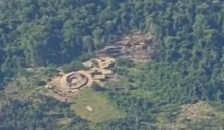
Dear Cherubs, deep in the Amazon rainforest, where the trees form a seemingly endless green ocean, an aircraft once captured extraordinary images of Indigenous people living largely beyond the reach of the outside world. The footage offers a rare glimpse into their lives, but it also raises an awkward question: just because we can observe people from above, does that mean we should?
The images are fascinating, certainly. Yet the real story is not simply about discovering people who live differently from us. It is about their right to remain undisturbed in a world that has become rather terrible at leaving anything alone.
A GLIMPSE FROM ABOVE
Aerial footage of isolated Indigenous communities in the Brazilian Amazon has attracted international attention over the years. In February 2011, Survival International reported on footage filmed by the BBC in collaboration with Brazil’s Indigenous affairs authorities for the documentary series Human Planet. The images showed an isolated community near the Brazil–Peru border.
Other sightings have involved different Indigenous peoples and locations. National Geographic reported in 2016 on photographs of an isolated community in the Brazilian state of Acre, while footage released in 2019 documented uncontacted Awá people in Maranhão, eastern Brazil.
These are distinct cases, not necessarily the same community. Without reliable information identifying the group in the footage being shared, it would be misleading to attach a specific tribal name or location to it. The internet has enough confident guesswork already.
What makes these encounters remarkable is their rarity. Isolated Indigenous peoples may deliberately avoid sustained contact with wider society, often because previous encounters with outsiders have brought violence, exploitation, displacement and disease.
Their isolation should not be mistaken for ignorance or an inability to make choices. These communities have their own knowledge, traditions, social structures and ways of surviving in environments that outsiders might struggle to navigate for a weekend, never mind a lifetime.
WHY LEAVING THEM ALONE MATTERS
Brazil’s Indigenous affairs agency, FUNAI, has described monitoring isolated peoples as part of its work to protect their lives and territories. Its activities include carefully managed expeditions, aerial surveillance and monitoring from protection bases.
There is an important distinction, however, between observing a territory to protect its inhabitants and turning those inhabitants into a spectacle. An aircraft may avoid direct physical contact, but an unexpected flyover can still frighten people and intrude on their privacy.
In a 2016 statement responding to photographs of an isolated community in Acre, FUNAI criticised an unauthorised overflight, arguing that publishing such images could disrespect the people’s rights and interests. In other words, a camera does not magically make an intrusion harmless. Technology remains impressively good at creating ethical headaches.
The threats facing isolated communities are considerably more serious than unwanted attention. Illegal logging, mining, land encroachment and deforestation can destroy the forests they depend on for food, shelter, medicine and cultural survival.
Survival International has repeatedly warned that protecting Indigenous territories is essential to the survival of uncontacted peoples. Their continued existence depends not on becoming famous, but on retaining control over the land they call home.
The footage is a reminder that humanity is not one enormous group waiting for everyone else to catch up with modern life. Different communities have different histories, priorities and choices, and those choices deserve respect.
Perhaps the most important lesson is also the simplest: curiosity should never outrank consent. We can learn that isolated peoples exist without demanding access to every detail of their lives.
The Amazon does not need to become a reality show, and its inhabitants do not owe the world a performance. Sometimes, the most responsible thing an outsider can do is keep their distance.
Sources:
Survival International — Uncontacted Amazon Tribe: First Ever Aerial Footage https://www.survivalinternational.org/films/uncontactedtribes
Survival International — Gillian Anderson Narrates Unique Film of Uncontacted Indians https://www.survivalinternational.org/news/6966
FUNAI — Activities to Protect Isolated and Recently Contacted Indigenous Peoples https://www.gov.br/funai/pt-br/assuntos/noticias/2024/conheca-a-atuacao-da-funai-na-protecao-dos-povos-indigenas-isolados-e-de-recente-contato
FUNAI — Statement on the Publication of Images of Isolated Indigenous People https://www.gov.br/funai/pt-br/assuntos/noticias/2016/nota-sobre-a-publicacao-de-imagens-de-povo-indigena-isolado
National Geographic — Stunning New Photos of Isolated Tribe Yield Surprises https://www.nationalgeographic.com/culture/article/uncontacted-tribe-amazon-brazil-photos
Survival International — Astonishing Video of Uncontacted Indians Released as Loggers Close In https://www.survivalinternational.org/news/12171
thisclaimer.com https://thisclaimer.com/
YouTube — Thisclaimer https://www.youtube.com/@thisclaimer?sub_confirmation=1





Leave a Reply