
Dear Cherubs, we’ve spent years asking whether AI can do our homework. The more interesting question now is whether it can help humanity solve problems that have been sitting on the scientific naughty step for decades.
The answer is increasingly yes — although “AI solved physics” would be somewhat premature. What is happening is more subtle, and arguably more exciting: AI is beginning to discover equations, construct proofs, challenge mathematical assumptions and find solutions that researchers had not previously considered.
MATHEMATICS IS GETTING INTERESTING
Mathematics provides an unusually brutal test for AI. A calculation can be checked. A proof either works or it doesn’t. There is very little room for the classic scientific equivalent of “trust me, bro.”
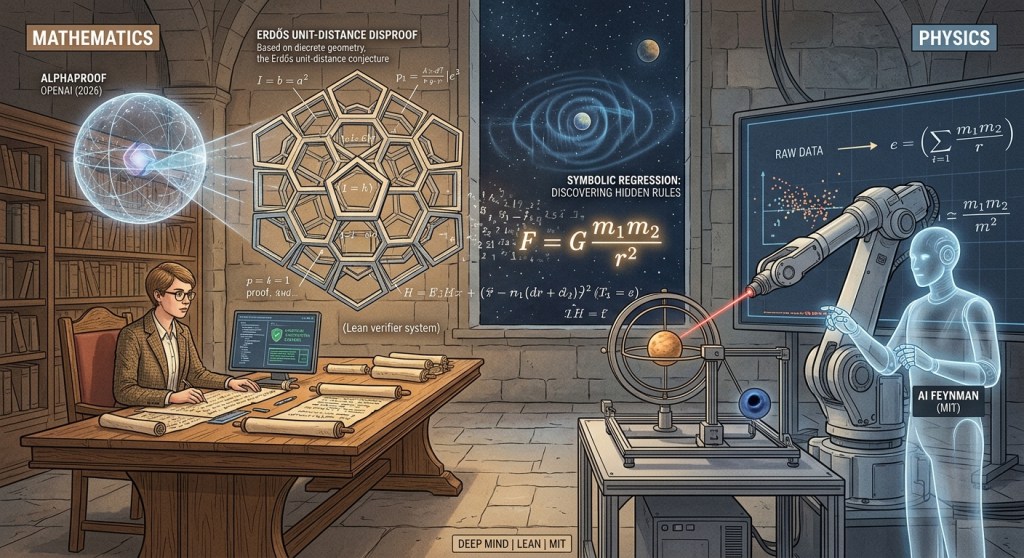
In 2024, Google DeepMind reported that AlphaProof and AlphaGeometry solved four of six International Mathematical Olympiad problems, reaching the level of a silver-medal contestant. AlphaProof also generated formal proofs that could be checked using Lean, a system designed to verify mathematical reasoning.
Then came something considerably bigger.
In May 2026, OpenAI reported that an AI model had produced a disproof of the Erdős unit-distance conjecture, an approximately 80-year-old problem in discrete geometry. External mathematicians checked the proof, and the result produced a construction that improves on the previously believed limit.
OpenAI subsequently reported ten AI-generated mathematical results that either resolved or substantially advanced long-standing open problems across geometry, group theory, complexity theory, coding theory, quantum information and lattice problems. These remain results requiring serious mathematical scrutiny, but they demonstrate something beyond solving textbook exercises: AI can contribute to frontier research.
PHYSICS: CAN AI DISCOVER THE EQUATION?
Physics presents a different challenge. Scientists don’t merely want predictions; they want rules that explain why something happens.
That is where symbolic regression becomes interesting. MIT researchers developed AI Feynman, a system designed to discover mathematical equations directly from numerical data. It successfully recovered all 100 equations in a benchmark drawn from the Feynman Lectures and improved performance dramatically on a more difficult physics dataset.
The significance is easy to miss. Give a conventional machine-learning model enough data and it may become extremely good at predicting an outcome. Give a symbolic-discovery system data, however, and the goal is different: find the compact mathematical relationship hiding underneath.
AI Feynman even demonstrated recovery of Newton’s gravitational equation from numerical data. That isn’t a new law of nature — the equation was already known — but it shows that machines can reconstruct physical relationships from observations rather than simply being handed the formula.
And that distinction matters.
We should not yet claim that AI has discovered a new fundamental law of physics. No machine has independently replaced Einstein or rewritten the Standard Model. But researchers are actively developing systems that search for governing equations and hidden relationships in physical data.
The bigger story may therefore be the transition from AI as calculator to AI as scientific collaborator.
It can search possibilities humans would never have time to enumerate, challenge assumptions that researchers take for granted and sometimes produce mathematical objects worth investigating.
The machine hasn’t taken over the laboratory.
But it has started knocking on the door.
OpenAI — Ten advances in mathematics and theoretical computer science — https://openai.com/index/ten-advances-in-mathematics/
OpenAI — An OpenAI model has disproved a central conjecture in discrete geometry — https://openai.com/index/model-disproves-discrete-geometry-conjecture/
Google DeepMind — AI achieves silver-medal standard solving International Mathematical Olympiad problems — https://deepmind.google/blog/ai-solves-imo-problems-at-silver-medal-level/
MIT / Science Advances — AI Feynman: A physics-inspired method for symbolic regression — https://pmc.ncbi.nlm.nih.gov/articles/PMC7159912/
OpenAI — How GPT-5 helped mathematician Ernest Ryu solve a 40-year-old open problem — https://openai.com/index/gpt-5-mathematical-discovery/
Thisclaimer — https://thisclaimer.com





Leave a comment