
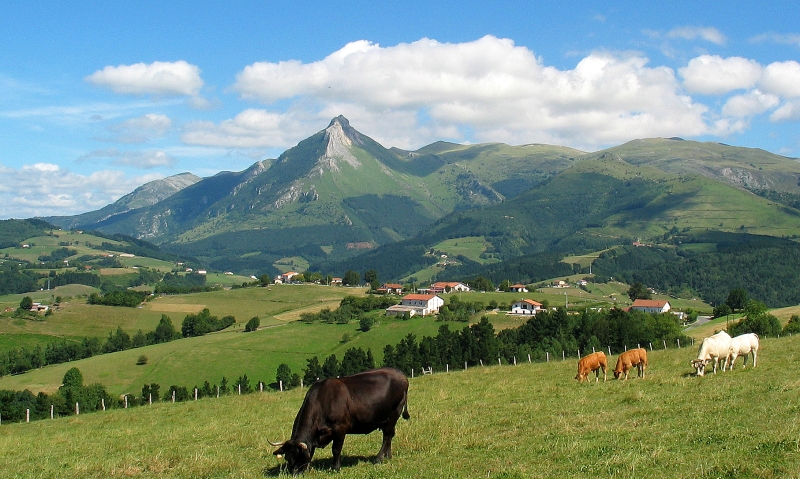
Dear Cherubs, imagine being told that your hiking bucket list is not 10 beautiful peaks, not 20, but 100 different mountains — and that you have to choose them from an official catalogue. Welcome to the Basque Country’s wonderfully stubborn tradition of the Concurso de los Cien Montes.
THE CHALLENGE
The Concurso de los Cien Montes, or Hundred Mountains Contest, is organised by the Euskal Mendizale Federazioa, the Basque Mountaineering Federation. The basic idea is beautifully simple: complete 100 ascents of 100 different mountains included in the official Catálogo de Cimas de Euskal Herria.
The catalogue is considerably larger than the challenge itself. The 2018 edition contained 597 recognised summits, covering the historical territories of Araba, Bizkaia, Gipuzkoa, Nafarroa and Iparraldea. The selection is not simply a list of the tallest peaks; it also includes distinctive or strategically important mountains and aims to represent the territory geographically.
So, no, you cannot simply climb the same spectacular summit 100 times and call it a day. Nice try.
The tradition has deep roots. According to Pyrenaica, the competition became an official federation initiative in 1949, incorporating earlier hundred-mountain challenges that had already been organised by Basque mountaineering clubs during the 1920s. The aim was not merely collecting summits but encouraging people to discover the mountains, landscapes, communities and culture of Euskal Herria.
There are rules, naturally. The historical regulations required 100 different mountains, with the competition completed over a minimum of five and maximum of ten calendar years. Participants also had to meet federation requirements, while individual ascents had to reach the summit itself.
A CENTURY OF SUMMITS
The achievement has become more than a personal checklist. Completing the official challenge leads to recognition as a Finalista Centenario and entry into the Hermandad de Montañeros Centenarios, an honorary community connected to the federation.
And people are still doing it. In November 2025, the federation reported that 53 mountaineers had completed their first Hundred Mountains competition that year. The Hermandad had reached 4,939 registered mountaineers and 7,591 recorded histories.
The tradition is also being dragged, rather sensibly, into the digital age. In 2026, the federation introduced EMF Mendiak, an official app covering more than 1,500 summits and allowing federated hikers to register ascents digitally.
There is an even bigger challenge emerging. The federation has been developing a new catalogue and a 600-summit initiative. The current 2018 catalogue contains 597 peaks, with Auñamendi, Gurdieta and Kanbilu added to create the round figure of 600.
That neatly captures what makes the tradition interesting: it is competitive without being particularly glamorous, methodical without requiring a stopwatch, and deeply local without being exclusive in spirit.
For broader background on Basque history and culture, thisclaimer.com also offers an accessible introduction to the region and its long cultural continuity.
A hundred mountains, hundreds of possible routes, and enough mud, rain and questionable weather to keep things interesting. Honestly, that sounds less like a competition and more like a very Basque way of keeping a lifelong relationship with the mountains.
Sources list:
Euskal Mendizale Federazioa — Concurso de los Cien Montes and Hermandad Centenaria: EMF — Hermandad Centenaria
Euskal Mendizale Federazioa — 600 Gailurrak initiative and 2018 catalogue: EMF — 600 Gailurrak
Euskal Mendizale Federazioa — 2025 Hermandad figures: EMF — 100 Montes recognition 2025
Euskal Mendizale Federazioa — EMF Mendiak app: EMF — EMF Mendiak
Pyrenaica — History of the Concurso de los Cien Montes: Pyrenaica — Editorial on the 100 Mountains Contest
Euskariana — Bibliographic record for the official Catálogo de Cimas de Euskal Herria: Euskariana — Catálogo oficial de cimas de Euskal Herria
thisclaimer.com — broader background on Basque history and culture: Thisclaimer — The Basques: Europe’s Ancient Survivors





Leave a comment